Mushroom Folklore
Mycophobia and Mycophilia: the Portuguese Paradox
Portugal occupies a unique intermediate position on the mycophobia–mycophilia scale. Despite a general background of mycophobia (fear of mushrooms), certain regions harbour a deeply rooted foraging tradition, accompanied by empirical knowledge passed down through generations.
Regional Differences
| Region | Attitude | Characteristics |
|---|---|---|
| Trás-os-Montes | Strong mycophilia | Ancient tradition, mushrooms as dietary staple |
| Beira Interior | Mycophilia | Festival Míscaros, active foraging |
| Alentejo | Moderate mycophilia | Silarcas, túberas — seasonal tradition |
| Coast / cities | Mycophobia | Mushrooms bought in shops |
Historical Evolution
- Antiquity: Romans on the Iberian Peninsula knew the gastronomic, medicinal, and toxic properties of mushrooms
- Middle Ages–19th c.: Mushrooms deeply integrated into rural diet of inland areas. In poor families, they “most often replaced meat at meals”
- 20th c.: Urbanisation led to knowledge loss. Trend towards mycophobia in cities
- 21st c.: Renaissance — associations, festivals, mycotourism, growing scientific interest
Fairy Rings (Anéis de fadas)
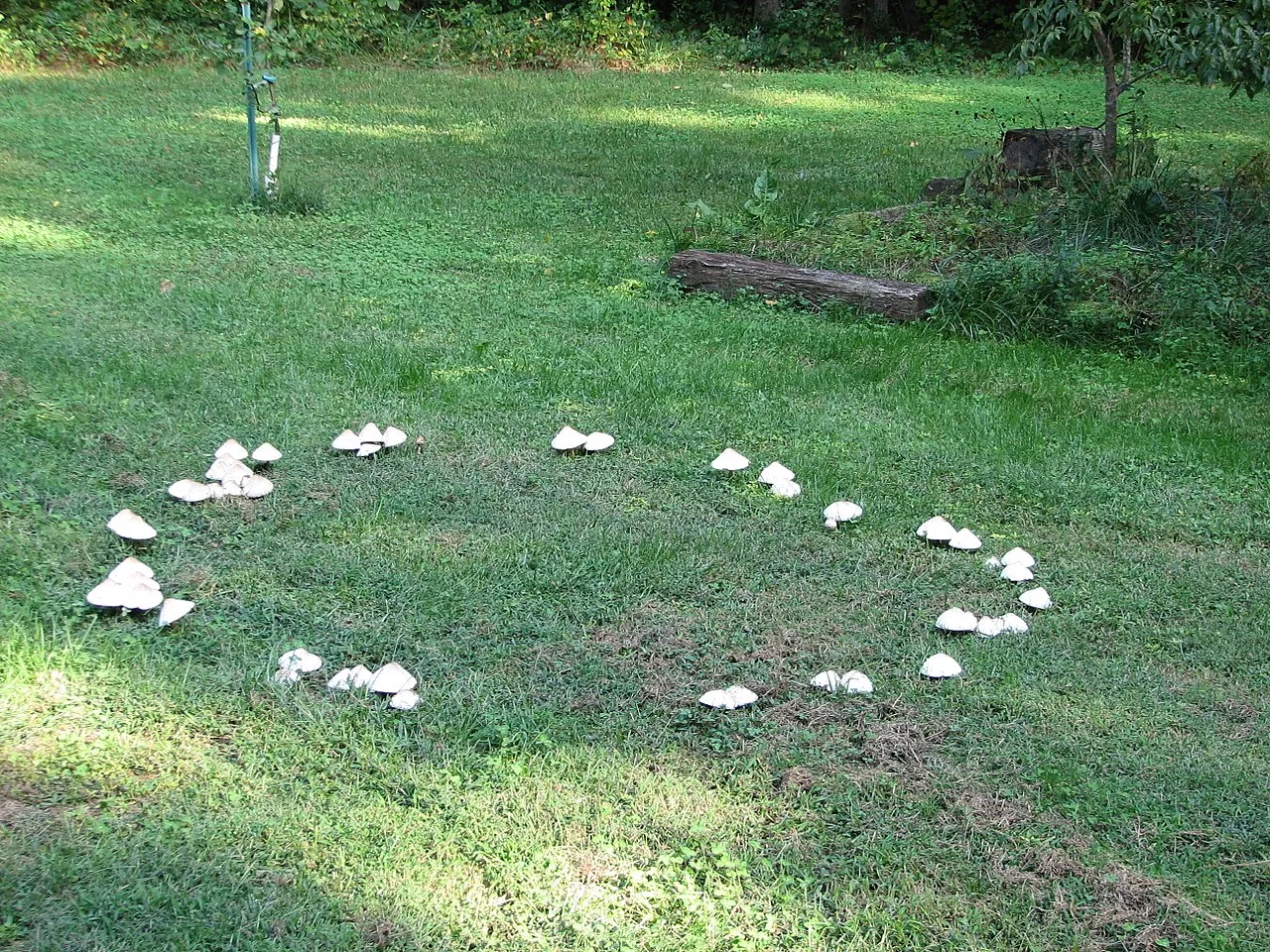
Circular formations of mushrooms in fields and forests are known in Portugal as anéis de fadas (fairy rings) or rodas de bruxas (witches’ circles).
Folk Beliefs
Portuguese folklore attributes these circles to nocturnal dances of fairy creatures, who danced so intensely they left marks on the ground. According to folk belief: if you step into the centre of a fairy ring, you may be carried away to the fairy world or find yourself in an uncontrollable dance.
Comparison with European analogues:
- Italy: Cerchi delle Streghe — witches held nocturnal gatherings
- Germany: Hexenringe — traces of witches’ dancing
- France: Ronds de sorcières — created by witches, guarded by toads
Scientific Explanation
Fungal mycelium grows radially from a central point. Each year, hyphae spread outward from the centre, producing mushrooms in a ring. Ring diameter increases by 10–30 cm annually; some rings are hundreds of years old.
Dangerous Identification Myths
The Silver Spoon
Myth: drop a silver spoon or coin into the pot with mushrooms — if it darkens, the mushrooms are poisonous.
Reality: any mushroom undergoing decomposition oxidises silver. Darkening is unrelated to toxicity.
Garlic and Onion
Myth: garlic or onion added during cooking will darken from poisonous mushrooms.
Reality: darkening is caused by enzymatic reactions and has nothing to do with poisons.
“If Animals Eat It, It’s Safe”
Myth: if slugs, larvae, or forest animals eat a mushroom, it is safe for humans.
Reality: different organisms have different sensitivity to toxins. Death cap is eaten by slugs without harm but is lethal to humans.
The Famous Portuguese Saying
“Todos os cogumelos são comestíveis — alguns apenas uma vez.” All mushrooms are edible — some only once.
This dark humour is the best reminder that there are no “grandmother’s tricks” for determining edibility.
More: Basic safety rules
Folk Names of Mushrooms
Portugal is rich in regional mushroom names reflecting centuries-old traditions.
Main Names
| Portuguese | Scientific | Translation / Etymology |
|---|---|---|
| Míscaro | Tricholoma equestre, Lactarius deliciosus | Collective term, varies by region |
| Tortulho / Turtulho | Boletus spp. | Large mushrooms; dialectal variant in the north |
| Sancha / Cardela | Lactarius deliciosus | Trás-os-Montes |
| Frade | Macrolepiota procera | “Monk” — from the cap shape |
| Silarca / Cilarca | Amanita ponderosa | Alentejo, spring mushroom from montado |
| Túbera / Criadilha | Terfezia arenaria | “Little tuber” — underground mushroom |
| Pinheira | Amanita caesarea and others | “Pine mushroom” — found under pines |
| Laranjinha | Amanita caesarea | “Little orange” — from cap colour |
| Rapazinho | Cantharellus cibarius | “Little boy” (diminutive) |
| Pé-de-carneiro | Hydnum repandum | “Sheep’s foot” |
| Trompeta-dos-mortos | Craterellus cornucopioides | “Trumpet of the dead” |
Etymology of “cogumelo”
The word cogumelo derives from Latin cucumellu-, a diminutive of cucŭma (cooking pot). The resemblance of a mushroom cap to an upturned pot gave rise to the name: cucuma → cucumella → cogumelo (little pot → mushroom).
Diminutive Forms
Portuguese is characterised by abundant use of diminutive suffixes (-inho/-inha), reflecting emotional closeness to the subject. Cogumelinho is not just “little mushroom” but an affectionate, homely form. Similarly: laranjinha (little orange → Caesar’s mushroom), rapazinho (little boy → chanterelle).
Proverbs and Sayings
| Portuguese | English equivalent |
|---|---|
| Crescer como cogumelos | To spring up like mushrooms |
| Todos os cogumelos são comestíveis, alguns apenas uma vez | All mushrooms are edible, some only once |
| Depois da chuva vêm os cogumelos | After the rain come the mushrooms |
Mushrooms in the Rural Economy
Historical Role
In Trás-os-Montes, mushrooms historically served as a meat substitute for poor families: “nas casas pobres fazem a maior parte das vezes o papel de carne numa refeição” (in poor homes, they most often replaced meat at meals). Foraging was a family tradition: knowledge of locations and species was guarded as valuable “capital”.
Modern Problem
Thousands of tonnes of wild mushrooms are exported annually from Trás-os-Montes to Spain through illegal channels: “Cogumelos da região geram milhares de euros mas vai tudo para Espanha” (the region’s mushrooms generate thousands of euros, but it all goes to Spain).
More: Mushroom markets
The “False Monk” (Falso frade)
One of Portugal’s best-known dangers is confusing the frade (parasol mushroom, edible) with its poisonous look-alikes. The newspaper PÚBLICO warned in 2018: “Há um falso frade venenoso que anda a enganar os amantes de cogumelos” (a poisonous false “monk” is fooling mushroom lovers).
More: Common look-alikes
Connection with Galicia
Northern Portugal and Spanish Galicia share a common mushroom tradition. The book “Cogumelos do Norte de Portugal e Galiza” (Afonso González, Maria Castro, Vitor Lópes Román) is a guide to mushrooms from both regions, illustrating the cultural unity of Minho and Galicia.
Image sources
- folklore.webp — Fairy ring — mushrooms growing in a circle. Author: L. J. Korsten. License: Public Domain. Source
Sources
- Peintner et al. — Mycophilic or Mycophobic? (PLOS ONE, 2013)
- Leite de Vasconcellos — Tradições Populares de Portugal (1882)
- Maria de Lourdes Modesto — Cozinha Tradicional Portuguesa (1982)
- Priberam — Dicionário: cogumelo
- CCRES — Cogumelos silvestres (ccres.pt)
- PÚBLICO — Há um falso frade venenoso (2018)
- PÚBLICO — Para colher cogumelos é preciso conhecer (2009)
- Jardim Gulbenkian — Anéis de fadas
- Afonso González et al. — Cogumelos do Norte de Portugal e Galiza
- Jornal Nordeste — Cogumelos da região geram milhares de euros
If this article was useful — help us write the next one.
☕ Support on Ko-fi