History of Mycology in Portugal
Overview
The history of mycology in Portugal spans over 170 years — from Friedrich Welwitsch’s first collections in the 1850s to the description of species new to science in the 2020s. For a long time, Portuguese mycology was closely linked to colonial botany (Angola, Mozambique, Brazil). Today the country is experiencing a “mushroom renaissance” — growing scientific research, citizen science, and public interest.
Early Mycology (19th – early 20th century)
Friedrich Welwitsch (1806–1872)
Austrian botanist who lived in Portugal for 14 years:
- Collected approximately 56,000 specimens, including fungi
- Published “Some notes upon the cryptogamic portion of the plants collected in Portugal” (1853)
- Commissioned by the Portuguese government, led an expedition to Angola (1853–1860), collecting 5,000 plant species
- Published “Fungi Angolenses” (1868) — description of Angolan fungi
- His collection became the foundation of the LISU herbarium (Jardim Botânico, Universidade de Lisboa)
Júlio Augusto Henriques (1838–1928)
- From 1873 — professor of botany and director of the Botanical Garden at the University of Coimbra
- Made Coimbra Portugal’s centre of botany
- Published works on fungi in Boletim da Sociedade Broteriana
- Developed the COI herbarium, now Portugal’s largest (~800,000 specimens)
- Conducted the first floristic survey of São Tomé and Príncipe
Gonçalo Sampaio (1865–1937)
- Professor of botany at the University of Porto (1912–1935)
- Described approximately 70 new lichen taxa (including the fungal component)
- The genus Sampaioa (Caliciaceae) was named in his honour
- Worked at the PO herbarium (Porto)
Camille Torrend (1875–1961)
French Jesuit, one of Portugal’s leading mycologists of the early 20th century:
- Studied at Colégio de São Fiel (1897–1898) and Colégio de São Francisco (Setúbal, 1900–1902)
- One of the main authors of the journal Brotéria (founded 1902)
- Published the first work on fungi from Mozambique (1905, 36 species, 2 new to science)
- Myxomycete monograph: “Les Myxomycètes” (Brotéria, 1908)
- From 1914 — professor in Brazil (Bahia)
- The genera Torrendia (Amanitaceae) and Torrendiella (Sclerotiniaceae) were named in his honour
- His herbarium (URM, Brazil) — South America’s largest mycological herbarium (~85,000 specimens)
Mathilde Bensaude (1890–1969)
Portugal’s first female mycological researcher:
- Doctorate — Sorbonne (Paris), Ph.D. 1918
- Her dissertation first proved heterothallism in Basidiomycetes — a fundamental discovery in mycology
- In 1931, founded the Serviços de Inspecção Fitopatológica (Plant Quarantine Service of Portugal)
- Key figure in the creation of CIFC (Centro de Investigação das Ferrugens do Cafeeiro) in Oeiras (1955)
- Result of CIFC’s work: over 90% of resistant coffee cultivars worldwide originate from its programmes
The Brotéria Journal (1902–2002)
- Founded by three Jesuits at Colégio de São Fiel
- Named after botanist Félix Avelar Brotero (1744–1828)
- Published ~1,300 scientific articles on botany, zoology, mycology
- Key platform for describing new species from Portugal, Spain, Angola, Mozambique
Herbaria with Mycological Collections
| Acronym | Institution | Founded | Size |
|---|---|---|---|
| LISU | Jardim Botânico, Universidade de Lisboa | 1839 | >200,000 specimens |
| COI | Universidade de Coimbra | 2nd half 19th c. | ~800,000 specimens |
| PO / PO-F | Universidade do Porto | ~1881–1892 | 2,300 fungal specimens + ~1,000 from Vasco Fachada |
Modern Mycology
Key Researchers
| Name | Institution | Achievements |
|---|---|---|
| Celeste Santos-Silva | Universidade de Évora | Described 2 new Terfezia species (T. lusitanica, T. solaris-libera); mycorrhization technology |
| Isabel C.F.R. Ferreira | IPB / CIMO | Bioactive compounds from mushrooms; listed among the world’s most-cited researchers |
| Nelson Lima | Universidade do Minho | Founded Micoteca (MUM) — international depository of fungal cultures (WIPO) |
| Ireneia Melo | Universidade de Lisboa | Curator of fungi at LISU herbarium, systematics of poroid basidiomycetes |
| Susana C. Gonçalves | Universidade de Coimbra | Chair of ECCF, assessed 80+ species for IUCN Red List |
| Vasco Fachada | Independent naturalist | 1st Navigator mycological survey (184 species); co-author of Entoloma sicoense description |
More: Mycological associations
Major Projects
- Flora Micologica Iberica (FMI) (1991–2009) — 54,138 records, 2,445 species (Portugal + Spain)
- MyCoLAB (Universidade de Coimbra) — fungal diversity, ecology, conservation
- “Cogumelos na Cidade” — mapping Coimbra’s mushrooms through citizen science (200+ species)
- BioDiversity4All — Portuguese iNaturalist node (276,000+ records)
Timeline of Key Discoveries
| Year | Event |
|---|---|
| 1853 | Welwitsch — first notes on Portugal’s cryptogams |
| 1868 | “Fungi Angolenses” — fungi of Angola |
| 1902 | Foundation of the Brotéria journal |
| 1905 | Torrend — first descriptions of Mozambican fungi |
| 1918 | Mathilde Bensaude — discovery of heterothallism in Basidiomycetes |
| 1931 | Creation of the Plant Quarantine Service |
| 1955 | Foundation of CIFC (coffee rust research) |
| 1991–2009 | Flora Micologica Iberica project |
| 2018 | Description of Terfezia lusitanica sp. nov. (Santos-Silva et al.) |
| 2019 | Description of Aeminiaceae fam. nov. — a new fungal family (Coimbra) |
| 2020 | Description of Terfezia solaris-libera sp. nov. (Alentejo) |
| 2022 | 1st Navigator mycological survey (184 species in SW Alentejo) |
| 2023 | Description of Entoloma sicoense sp. nov. (Serra de Sicó) |
| 2024 | First wild find of Tuber aestivum (summer truffle) in Portugal |
| 2024–2025 | 7 new fungal species from Portuguese limestones |
The Summer Truffle Discovery (2024)
In April 2024, chef Tanka Sapkota and his team for the first time in Portugal’s history discovered and certified Tuber aestivum (summer truffle) in the wild:
- Location: Alenquer and Sobral de Monte Agraço (Lisbon district)
- Under holm oaks (Quercus ilex)
- Found with the help of truffle dog Pina and Italian truffle hunter Giovanni Longo
- Confirmation: molecular (DNA) analysis
- Approximately 15 kg found
More: Portuguese truffles
How Many Fungal Species Are Known in Portugal?
The exact number is not established — no complete national checklist exists.
| Group | Number of species |
|---|---|
| Macrofungi (cogumelos) | >3,000 (estimate) |
| Rust fungi (Pucciniales) | 246–253 |
| Basidiomycota of the Azores | 544 |
| Marine fungi | 190 |
In the words of mycologists: “We know less than 10% of the fungal species estimated to exist” in Portugal.
Checklists and Publications
- Checklist of rust fungi — 246–253 species based on 2,313 records from 115 publications
- Basidiomycota of the Azores — 544 species
- Marine fungi — 190 species (156 confirmed marine)
- Fungi Iberici — journal of the Sociedade Ibérica de Micologia (SIM), free access
Fungal Conservation
Portugal has no national red list of fungi. According to the IUCN global assessment:
- At least 129 assessed species occur in Portugal
- Of these, 19 are threatened
- Susana Gonçalves (MyCoLAB) chairs the ECCF and has been assessing species for the Red List since 2019
Image sources
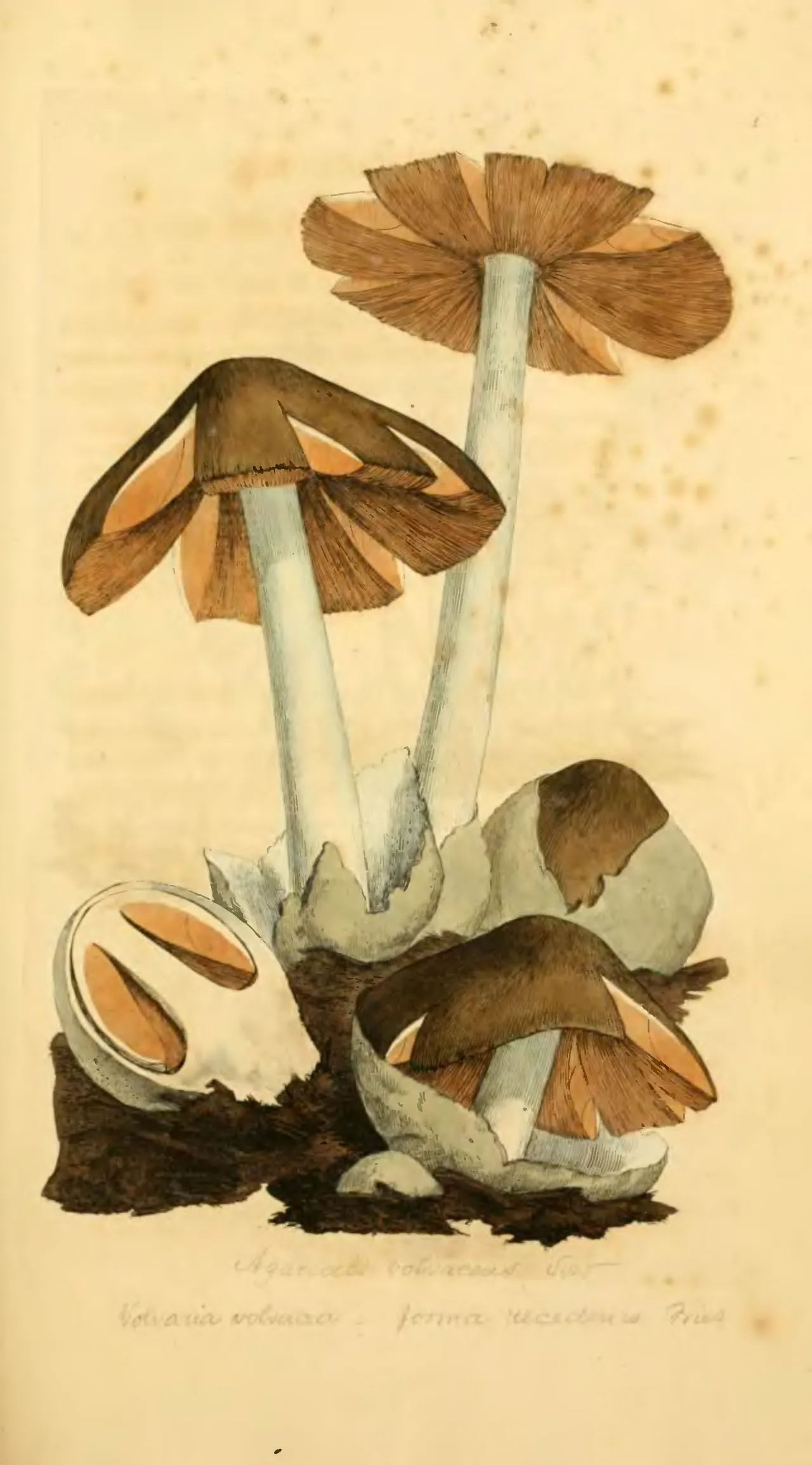
- history-mycology.webp — Illustration by James Sowerby — Coloured Figures of English Fungi (1797). Author: James Sowerby. License: Public Domain. Source
Sources
- Welwitsch F. — Fungi Angolenses (1868)
- Brotéria journal (1902–2002) — history of Jesuit science
- Mathilde Bensaude — Wikipedia; She Thought It (ILCML)
- Camille Torrend — Wikipedia; CIUHCT
- Universidade de Coimbra — Julio Henriques (herbário COI)
- Santos-Silva C. et al. — Terfezia lusitanica sp. nov. (Phytotaxa, 2018)
- First Record of Tuber aestivum in Portugal (MDPI, 2024)
- Entoloma sicoense sp. nov. (Phytotaxa 606(2), 2023)
- Flora Micologica Iberica (GBIF)
- BioDiversity4All — biodiversity4all.org
- CIFC — Hemileia vastatrix research (PMC)
- Re-Starting Mycology Working Group, University of Porto (ResearchGate, 2022)
All our knowledge is free. Creating it is not.
☕ Support on Ko-fi