Identification Basics
A Systematic Approach to Identification
Mushroom identification relies on a combination of features, not a single test. Use the four-step system:
- Habitat — what trees are nearby? Soil type? Substrate?
- Season — when was the mushroom found?
- Morphology — detailed examination (see below)
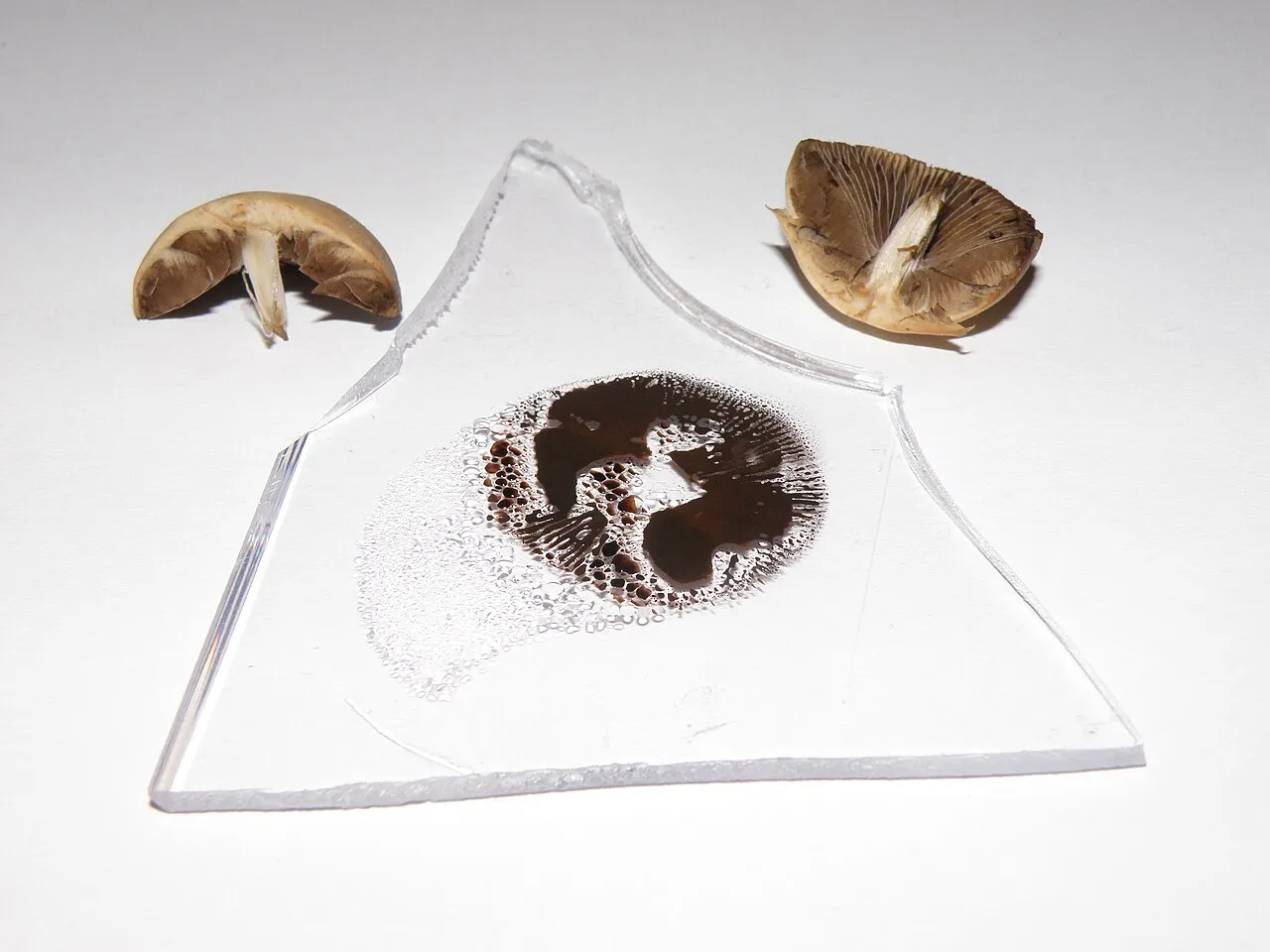
- Spore print — made at home
Morphological Features
Cap (pileo / chapéu)
Shape (changes as the mushroom matures):
| Shape | Portuguese | Description |
|---|---|---|
| Convex | Convexo | Dome-shaped — the most common |
| Flat | Plano | Mature stage of many species |
| Depressed | Depresso | Centre sunken (chanterelles, milk caps) |
| Funnel-shaped | Infundibuliforme | Deep funnel |
| Bell-shaped | Campanulado | Narrows towards the top |
| Umbonate | Umbonado | Raised bump at centre |
Also look for:
- Surface — smooth, scaly, slimy, warty
- Margin — even, wavy, striate, inrolled
- Colour — document when fresh (changes on drying)
Hymenophore (himénio)
The underside of the cap where spores are produced. Hymenophore type is one of the first identification features:
- Gills (lamelas) — the majority of mushrooms
- Tubes/pores (tubos/poros) — boletes, polypores
- Teeth/spines (acúleos) — hedgehog mushroom
- Folds (pregas) — chanterelles (thick, blunt, forked)
Gill attachment to the stem — a key diagnostic feature:
| Type | Portuguese | Characteristic genera |
|---|---|---|
| Free | Livres | Agaricus, Amanita, Lepiota |
| Adnate | Adnatas | Many species |
| Decurrent | Decorrentes | Cantharellus, Clitocybe |
| Sinuate | Sinuadas | Tricholoma, Entoloma |
Stem (estipe / pé)
- Ring (anel) — remnant of the partial veil. Present in Amanita, Agaricus, Lepiota
- Volva (volva) — remnant of the universal veil at the base. A sac-like “sheath” is characteristic of the genus Amanita
Flesh (carne / polpa)
Colour change on cutting — nick the cap and observe for up to 30 minutes:
- Porcini — flesh does not change colour
- Boletus luridus — flesh turns blue instantly
- Agaricus xanthodermus — stem base turns bright yellow (poisonous!)
- Saffron milk cap — orange latex, flesh turns green
Smell (cheiro):
- Floury (farináceo) — Calocybe gambosa, Clitopilus prunulus
- Anise — Clitocybe odora, Agaricus silvicola
- Phenolic/inky — Agaricus xanthodermus (poisonous!)
- Radish-like — Hebeloma crustuliniforme (poisonous!)
Latex (látex / leite) — a key feature for Lactarius:
- Orange latex = saffron milk cap (edible)
- White, acrid latex = often inedible or poisonous species
Spore Print
One of the most important diagnostic tools. Made at home:
- Remove the stem, place the cap gill-side down on paper (half white, half black)
- Cover with a glass to maintain humidity
- Leave for 6–24 hours
- Carefully lift the cap and record the colour
Print colour → genus:
| Colour | Characteristic genera |
|---|---|
| White/cream | Amanita, Lepiota, Russula, Clitocybe |
| Pink | Entoloma, Pluteus |
| Brown | Cortinarius, Hebeloma |
| Dark brown | Agaricus, Stropharia |
| Black | Coprinus, Psathyrella |
| Ochraceous | Boletus, Suillus |
More on technique: Forager’s equipment
Common Mistakes in Portugal
1. Caesar’s mushroom vs death cap
The most dangerous confusion in Portugal. Caesar’s mushroom is a prized delicacy, but at the “egg” stage it is practically indistinguishable from the death cap.
| Feature | A. caesarea (edible) | A. phalloides (deadly) |
|---|---|---|
| Cap | Orange-red, no warts | Greenish-olive |
| Gills | Yellow | White |
| Stem | Yellow | White with greenish tinge |
| Volva | White, sac-like | White, sac-like |
2. Field mushroom vs yellow stainer
| Feature | A. campestris (edible) | A. xanthodermus (poisonous) |
|---|---|---|
| Stem base flesh | No colour change | Bright chrome-yellow |
| Smell | Mushroomy | Phenolic (ink, carbolic soap) |
Test: cut the stem base — instant yellow staining = do not pick.
3. Chanterelle vs jack o’lantern
| Feature | Chanterelle | Jack o’lantern |
|---|---|---|
| Substrate | On soil | On wood (stumps, roots) |
| Hymenophore | Folds (thick, blunt) | True gills (thin) |
| Growth | Solitary or small groups | Large clusters |
4. Parasol mushroom vs small Lepiota species
More on look-alikes: Common look-alikes
False “Folk Methods”
- “If a silver spoon doesn’t tarnish — the mushroom is safe” — FALSE
- “If a slug eats it — it’s edible” — FALSE
- “Boiling neutralises the poison” — FALSE (amatoxins are heat-stable)
- “Poisonous mushrooms taste bitter” — FALSE (A. phalloides is pleasant-tasting)
- “If you can peel the cap — it’s safe” — FALSE
Identification Apps
| App | Features |
|---|---|
| iNaturalist | AI + community verification; citizen science |
| Picture Mushroom | Best accuracy among AI apps (~49%) |
| Shroomify | Step-by-step identification key, 400+ species |
| Fungipedia (pt.fungipedia.org) | Portuguese online guide |
Field Guides for Portugal
- “Cogumelos Silvestres de Portugal de Interesse em Conhecer” — José Luis Gravito Henriques (most Portugal-specific)
- “Guia de Campo — Cogumelos Silvestres” — DRAPC (free PDF)
- “Manual de Boas Práticas” — DGADR/ICNF (safe foraging guide)
- “Guía de los Hongos de la Península Ibérica” — Gabriel Moreno (584 species with keys)
Where to Learn
| Organisation | Programme |
|---|---|
| ICNF | UFCD 6359 (collectors) and UFCD 6358 (commercialisation) courses |
| A Pantorra (Mogadouro) | Mycological excursions and events |
| Fungipedia | Information project, practical mycology |
| MicNatur | Courses and workshops on identification and cultivation |
| LIFE MycoRestore | European project: mycology + sustainable forestry |
Image sources
- identification-basics.webp — Mushroom spore print — a key identification method. Author: Wikimedia Commons. License: CC BY-SA 3.0. Source
Sources
- DGADR — Manual de Boas Práticas de Colheita e Consumo de Cogumelos Silvestres
- DRAPC — Guia de Campo: Cogumelos Silvestres
- Gravito Henriques — Cogumelos Silvestres de Portugal de Interesse em Conhecer
- MushroomExpert.com — Studying Mushrooms
- Purzycki et al. — Accuracy of mushroom identification apps (2023)
- ICNF — Formação em Micologia
- A Pantorra — pantorra.pt
- LIFE MycoRestore — mycorestore.eu
All our knowledge is free. Creating it is not.
☕ Support on Ko-fi