Your First Mushroom Walk
Why Forage Mushrooms in Portugal?
Portugal is one of Europe’s richest countries for wild mushrooms. Over 3,000 macrofungal species have been recorded here, and the mild climate allows foraging nearly year-round. At the same time, mushroom culture in Portugal is less developed than in Eastern Europe: forests are less trampled, competition is lower, and species diversity is higher.
This article is a step-by-step guide for those who want to take their first mushroom walk in Portugal.
Step 1: Choose Your Timing
Peak Season: October–December
The best time for a first walk is October–November, after the first autumn rains. Mushrooms appear 5–15 days after heavy rainfall. If autumn is dry, the season may shift to November or even December.
| Period | What to Find | Difficulty for Beginners |
|---|---|---|
| October | Boletes, saffron milk caps, chanterelles | Medium — many species, easier to find |
| November | Peak season — maximum diversity | Best time for beginners |
| December | Oyster mushrooms, black trumpets, hedgehogs | Medium — cool but mushrooms are present |
| March–April | Morels, Amanita ponderosa | For advanced foragers |
More details: Seasonal Calendar
Ideal Weather
- Temperature: 10–18 °C (typical autumn in central and northern Portugal)
- Humidity: after 2–3 days of rain, but a dry foraging day itself
- Time: head out early (8:00–9:00 AM) — mushrooms are fresher, forests quieter, fewer people
Step 2: Choose Your Location
Recommended for First-Timers
| Location | Region | Ecosystem | Why It’s Good for Beginners |
|---|---|---|---|
| Mata Nacional de Leiria | Centre | Pine forests (P. pinaster) | Flat terrain, abundant saffron milk caps and slippery jacks |
| Serra da Arrábida | Setúbal | Oak forests on limestone | Species diversity, close to Lisbon |
| Serra da Estrela | Centre | Oak and chestnut forests | Classic boletes, rich mycoflora |
| Montesinho | Trás-os-Montes | Oak forests (montado) | Best in the country — but far from Lisbon |
Where to Look for Mushrooms
- Under oaks (Quercus) — boletes, Amanita species, chanterelles
- Under pines (Pinus) — saffron milk caps, slippery jacks
- Under chestnuts (Castanea) — porcini, chanterelles
- On fallen trunks — oyster mushrooms, honey fungus
More about ecosystems: Habitats
Where NOT to Forage
- Along roadsides (heavy metal contamination)
- In areas treated with pesticides or herbicides
- Near landfills and sewage outlets
- In Proteção Total zones of nature parks (foraging prohibited)
Step 3: Gather Your Gear
Essential Kit
| Item | Purpose | Notes |
|---|---|---|
| Wicker basket (cesto de vime) | Ventilation + spore dispersal | Mandatory in protected areas |
| Knife with brush | Cutting + cleaning | Opinel No. 08 Mushroom — a classic |
| Field guide | Identifying finds | Or an app: iNaturalist, Seek |
| Phone with GPS | Navigation + photographing finds | Mark coordinates of good spots |
| Water and snacks | No shops in the forest | At least 1 litre of water |
Clothing for Portuguese Forests
- Hiking boots — essential. Sand and limestone are slippery after rain
- Long trousers — protection from ticks, thorns, and brambles
- Layered clothing — morning forest can be 8–10 °C, midday 18 °C
- Waterproof jacket — autumn showers are unpredictable
- Hat/cap — for sun protection (even November can be warm)
More details: Forager’s Equipment
Step 4: Learn the “Safe Five”
For your first walk, focus on 5 species that are relatively easy to identify and have few dangerous look-alikes:
1. Saffron Milk Cap (Lactarius deliciosus)
- Where: under pines
- Key features: orange with concentric rings, turns green when damaged, exudes orange milky latex
- Portuguese: míscaro, sanchas
- More: Saffron Milk Cap
2. Porcini (Boletus edulis)
- Where: under oaks, chestnuts, pines
- Key features: brown cap, white stem with net-like pattern, pores (not gills!), white flesh that doesn’t change colour
- Portuguese: tortulho, cepe
- More: Porcini
3. Chanterelle (Cantharellus cibarius)
- Where: under oaks and chestnuts, in moss
- Key features: yellow-orange, funnel-shaped, with blunt ridges (not true gills!), apricot aroma
- Portuguese: rapazinho, cantarelo
- More: Chanterelle
4. Parasol Mushroom (Macrolepiota procera)
- Where: meadows, forest edges, clearings
- Key features: very large (cap up to 30 cm), scaly, movable ring on stem
- Portuguese: frade, roca, fuso
- More: Parasol Mushroom
5. Oyster Mushroom (Pleurotus ostreatus)
- Where: on trunks of deciduous trees (oak, poplar, willow)
- Key features: grows in shelf-like clusters, no central stem, grey-brown cap
- Portuguese: pleuroto, ostra
- More: Oyster Mushroom
Step 5: Know the Enemies
Before heading to the forest, study the deadly species found in Portugal:
| Species | Danger Level | Habitat | How to Distinguish |
|---|---|---|---|
| Death Cap | Deadly | Under oaks | Greenish cap, white gills, volva at base |
| Panther Cap | Highly toxic | Under trees | Brown cap with white patches, striate ring |
| Fool’s Webcap | Deadly | Under oaks | Rusty orange, gilled — symptoms appear 3–14 days later! |
More: Deadly Species | Dangerous Look-alikes
Step 6: Rules in the Forest
Collection Technique
- Cut, don’t pull — leave the mycelium in the soil
- Cover the hole — if you twist out a mushroom, cover the spot with leaves
- Don’t disturb the litter — never use rakes, hoes, or similar tools
- Only take what you know — the golden rule: “Não tem a certeza? Não apanhe!” (Not sure? Don’t pick!)
- Don’t mix — keep unknown species separate from edible ones
Legal Considerations
- Foraging for personal use up to 5 kg/day — permitted without a licence (based on the now-repealed Decreto-Lei 254/2009, which still serves as a reference)
- In nature parks — special rules apply (wicker basket mandatory, zone restrictions)
- On private land — you need the landowner’s permission
More: Foraging Laws
Step 7: After the Walk
Processing Your Harvest
- Sort mushrooms the same day — don’t delay
- Re-check at home — under good lighting, compare with your field guide again
- When in doubt, throw it out — better to lose a mushroom than your health
- Clean and prepare — brush clean, trim damaged parts
If You Feel Unwell
If you experience any symptoms after eating mushrooms (nausea, vomiting, diarrhoea, abdominal pain, dizziness), call immediately:
- CIAV (Anti-Poison Information Centre): 800 250 250 (free, 24/7)
- Emergency services: 112
Save any remaining mushrooms and vomit — this will help doctors identify the species and choose the right treatment.
More: First Aid for Poisoning
Forest Hazards (Not Mushrooms)
Ticks (carraças)
Ticks are active in Portugal from spring to autumn (less so in winter). Precautions:
- Wear long trousers tucked into socks
- Use repellent with DEET (20–30%) or picaridin
- After the walk, thoroughly check your body — especially armpits, groin, and scalp
Snakes
Portugal has two venomous vipers (Vipera seoanei in the north and V. latastei throughout the country), but encounters are extremely rare. Snakes avoid humans — stamp your feet and make noise when walking through tall grass.
Hunting Season
From October to February, hunting season is open in Portugal. On hunting days (usually Thursdays, Sundays, and holidays), hunters may be present in the forest. It’s recommended to:
- Wear bright clothing (orange vest)
- Avoid active hunting zones
- Check the ICNF calendar
Checklist for Your First Walk
- Studied the “Safe Five” species
- Know what a Death Cap looks like
- Packed basket, knife, and field guide
- Layered clothing, closed shoes, long trousers
- Water, snacks, charged phone
- Saved CIAV number: 800 250 250
- Told someone where I’m going and when I’ll be back
- Checked the weather forecast
Image sources
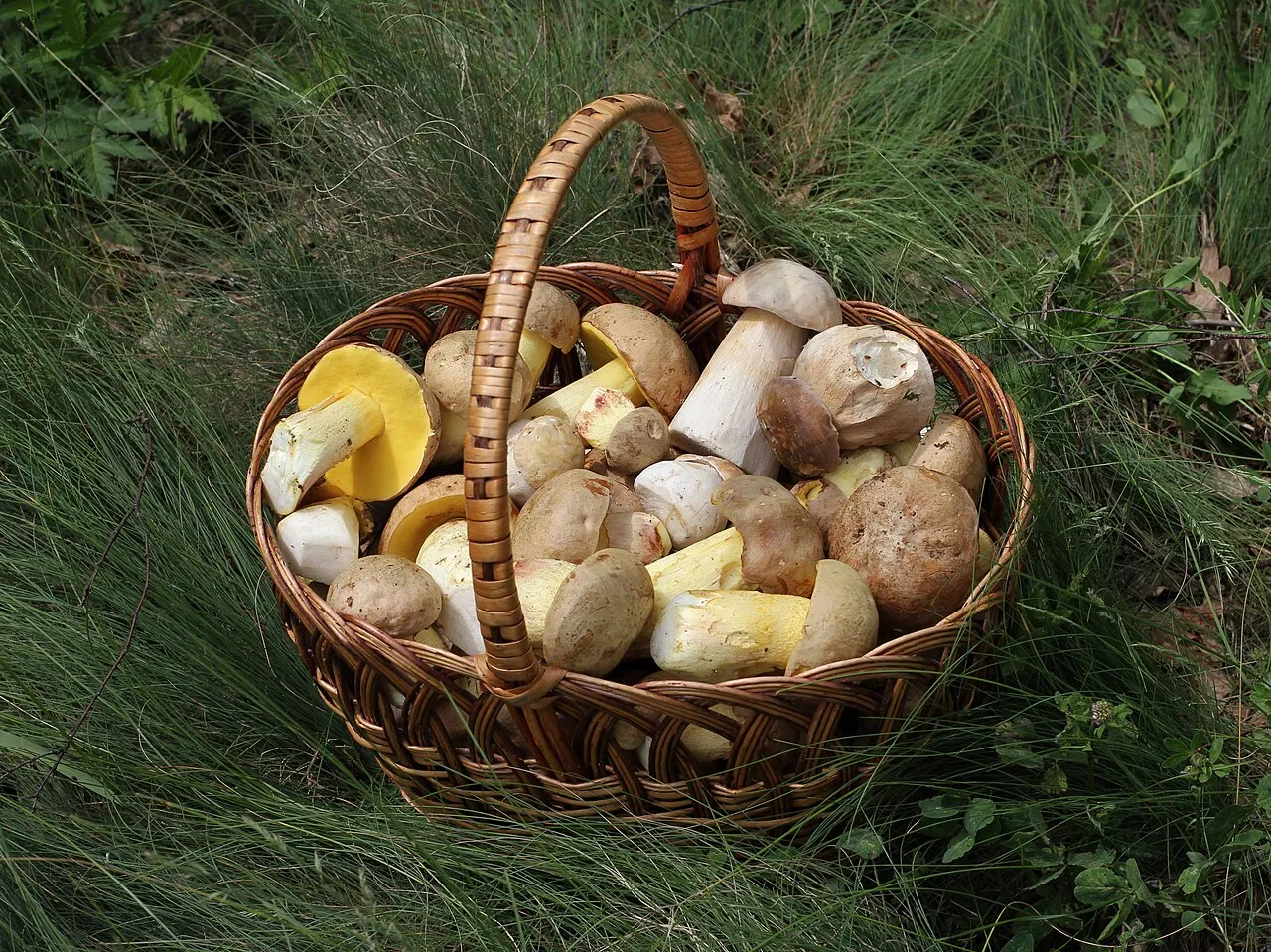
- first-walk.webp — Basket of mushrooms — your first foraging walk. Author: George Chernilevsky. License: CC BY-SA 3.0. Source
Sources
- CM Aguiar da Beira — Conselhos para Colheita de Cogumelos Silvestres
- ASAE — Consumo de Cogumelos Silvestres
- ICNF — Protected Areas Regulations
- CIAV — Centro de Informação Anti-Venenos (800 250 250)
- Hospital da Luz — Watch out for ticks
- Julie Dawn Fox — Hiking in Portugal: What You Need to Know
The light is on for free. But someone has to clean the lantern.
☕ Support on Ko-fi