Eucalyptus Plantations
Description
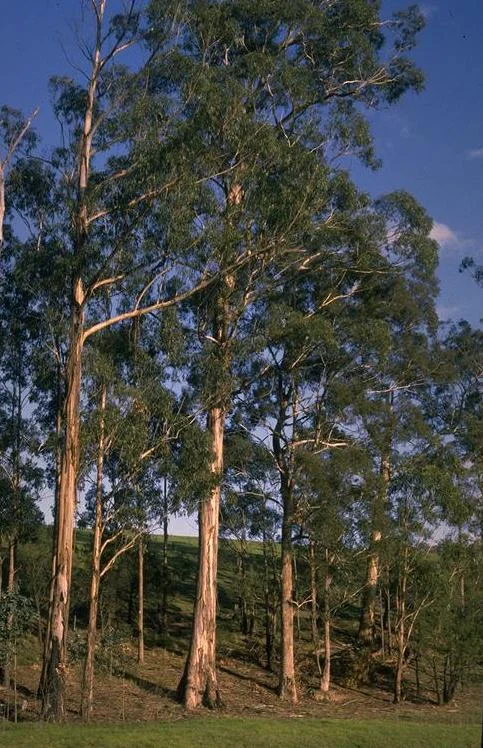
Eucalyptus plantations (Eucalyptus globulus) are the most widespread forest type in Portugal: ~845,000 ha (26.2% of forest area, ~10% of the country’s total area). These are industrial monocultures for the pulp industry with a rotation cycle of 10–12 years.
From a mycological perspective, eucalyptus plantations are a poor habitat. They are often called desertos verdes (“green deserts”) due to the significant reduction in biodiversity compared to native forests.
Geographic distribution
- Main regions: northern and central Portugal
- Area: ~845,000 ha — more than cork oak (736,000 ha) or pine (714,000 ha)
- Trend: despite government reduction policies (National Forest Strategy 2006), the area continues to grow
- Since the mid-20th century, native forests (Pinus pinaster, Quercus suber) have been systematically converted to eucalyptus plantations
Why eucalyptus is a poor mushroom habitat
Allelopathic compounds
Eucalyptus releases powerful allelochemicals: benzoic acid, hydroxybenzoic acid, vanillic acid, and terpenoids. The key compound — 1,8-cineole (eucalyptol) — suppresses germination and growth of competing plants and soil microorganisms.
Acidic and hydrophobic litter
- Soils under eucalyptus are highly hydrophobic (water-repellent)
- Microorganisms struggle to decompose leaves and bark
- Low organic matter, poor soil structure
- Soil absorbs rainwater significantly worse than under native forests
Limited mycorrhizal partners
- Low colonisation of roots — both ecto- and arbuscular mycorrhizas
- Fungal diversity significantly lower than in native oak forests
- Eucalyptus was brought from Australia — European fungi “don’t recognise” this tree
Impact on biodiversity
- 66% of cases where native forests are replaced by eucalyptus lead to biodiversity loss
- Replacing large areas of native forest with monospecific plantations → homogenisation of fungal communities
- Some fungal species are found only on plots with native trees — potential bioindicators of habitat quality
What mushrooms do grow
Co-introduced Australian species
Mycorrhizal partners from Australia were unintentionally introduced alongside eucalyptus:
| Species | Notes |
|---|---|
| Descolea maculata | Dominant co-introduction; has spread to native plants |
| Hydnangium carneum | Underground fungus, one of the most frequent |
| Laccaria fraterna | Australian Laccaria species |
| Pisolithus albus / P. microcarpus | Increase eucalyptus tolerance to salinity |
| Setchelliogaster rheophyllus | Easily co-introduced |
| Tricholoma eucalypticum | Specific to eucalyptus |
Native fungi on eucalyptus
A study on the Iberian Peninsula identified 26 ectomycorrhizal taxa associated with E. globulus. Only 3 were Australian; the rest were native European fungi that had formed novel associations with eucalyptus.
Some native genera colonising eucalyptus: Cortinarius, Laccaria laccata (European), Russula spp.
Saprotrophic species
- Oyster mushroom (Pleurotus ostreatus) — grows on dead eucalyptus wood
- Honey fungus (Armillaria mellea) — parasitises eucalyptus too
- Saprotrophs have limited presence due to the difficulty of decomposing eucalyptus litter
Scientific discovery: 184 species
The first mycological survey on Navigator Company land (Quinta de São Francisco) identified 184 macrofungal species, including species from eucalyptus plantations and surrounding ecosystems. Possibly over a dozen species new to science were discovered.
Ecological controversy
Replacement of native forests
- From 1958 to 1995, agricultural land and scrubland shrank dramatically, while eucalyptus plantations expanded dramatically
- Eucalyptus replaces cork oak, holm oak, and maritime pine
- 66% of replacements lead to biodiversity loss at all levels
Fire risk
Eucalyptus and pine covered ~70% of the burned area in the catastrophic Pedrógão Grande fire (2017). Eucalyptus bark rapidly conducts fire to the crown; leaves are highly flammable. By comparison, cork oak is a fire-resistant species.
Consequences for mushrooms
- Eucalyptus does not form mycorrhizas with native fungi of pine and oak forests
- Fungal species diversity is significantly lower than in native forests
- Eucalyptus litter decomposes more slowly due to essential oils
- However, arbuscular mycorrhiza (AM) can mitigate the allelopathic suppression of native trees by eucalyptus
Practical tips
- Don’t expect a rich harvest — eucalyptus plantations are mushroom-poor
- Look for “islands” of native trees within plantations — they harbour significantly more fungi
- Edges and transition zones — where eucalyptus borders oak or pine forest — are the most promising areas
- Oyster mushroom — one of the few culinarily valuable species growing on eucalyptus
- Be cautious with unfamiliar species — Australian co-introductions may look unusual
Image sources
- eucalyptus.webp — Blue gum eucalyptus (Eucalyptus globulus). Author: Ian Brooker, David Kleinig. License: CC BY 3.0. Source
Sources
- Fernández-Toirán L.M. et al. — Context dependency, co-introductions, novel mutualisms, and host shifts shaped the ectomycorrhizal fungal communities of Eucalyptus globulus // Scientific Reports, 2019
- Díez J. — Invasion biology of Australian ectomycorrhizal fungi introduced with eucalypt plantations into the Iberian Peninsula // Biological Invasions, 2005
- Biodiversidade.com.pt — Primeiro estudo micológico identifica 184 espécies de cogumelos
- Público — Estudo revela que eucalipto provoca «dramática redução» da biodiversidade, 2017
- Pereira H. — Cork Oak Woodlands on the Edge // Island Press
If this article was useful — help us write the next one.
☕ Support on Ko-fi