Montado (Cork Oak Woodlands)
Description
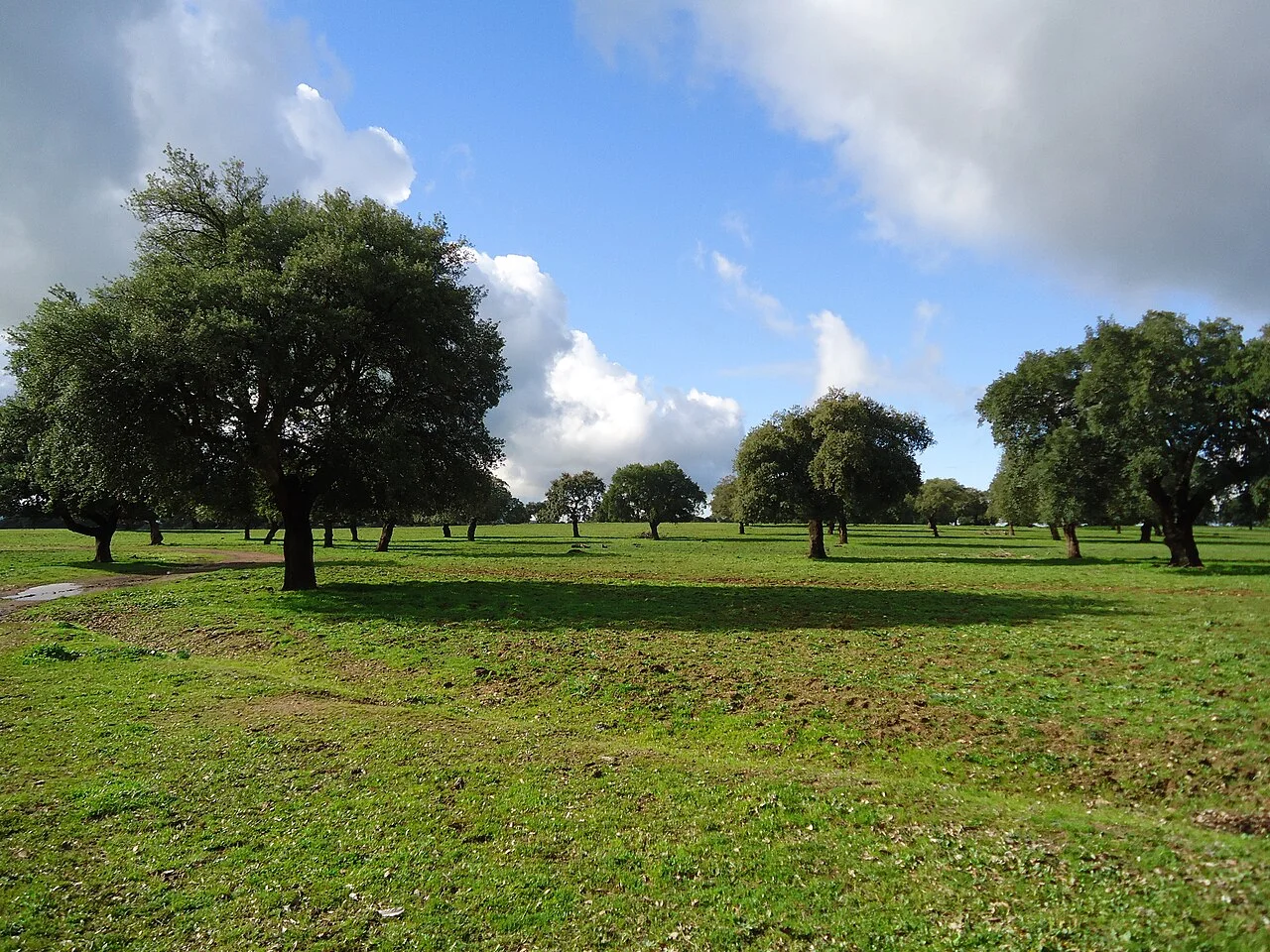
Montado is a unique agro-silvo-pastoral system of southern Portugal, shaped by human management over centuries. These are open oak woodlands integrated with pastures, cereal crops, beekeeping and livestock.
Montado covers over 1,063,000 ha — roughly one-third of Portugal’s total forest area:
- Cork oak (Quercus suber) — sobreiro: ~720,000 ha (22.3% of forests)
- Holm oak (Quercus rotundifolia) — azinheira: ~413,000 ha
In July 2025, the Montado da Serra de Serpa was recognised as a GIAHS (FAO) — Globally Important Agricultural Heritage System. It is also on the UNESCO Tentative List as a cultural landscape.
From a mycological perspective, montado is one of the richest mushroom habitats in Portugal: studies have identified 55 taxa of ectomycorrhizal fungi on cork oak roots.
Geographic distribution
Main regions
- Alentejo — the core region (largest montado area)
- Ribatejo — significant presence
- Algarve — southern edge of the range
- Lisbon and Tagus Valley — lower reaches of the Tagus and Sado rivers
Montado is found predominantly south of the Tagus River. 63% of all cork oaks on the Iberian Peninsula are in Portugal.
Soils and climate
| Parameter | Value |
|---|---|
| Climate | Mediterranean (Csa, Köppen) |
| Mean annual temperature | 13–17°C |
| Annual rainfall | 500–800 mm (wet winter, dry summer up to 3–4 months without rain) |
| Soil pH | 4.5–7.0 (acidic to neutral; cork oak does not tolerate calcareous soils) |
| Parent rock | Granite, gneiss, schist, sandstone |
| Altitude | 150–600 m (typically); up to 1,200 m (rarely) |
Characteristic mushrooms
Prized edible species
| Species | Portuguese name | Season |
|---|---|---|
| Bronze bolete (Boletus aereus) | Boleto-negro | Summer–autumn, also spring |
| Porcini (Boletus edulis) | Boleto, tortulho | Late summer–autumn |
| Caesar’s mushroom (Amanita caesarea) | Laranjinha | Summer–autumn |
| Chanterelle (Cantharellus cibarius) | Cantarelo, rapazinho | Autumn |
| Horn of plenty (Craterellus cornucopioides) | Trompeta-dos-mortos | Autumn |
| Hedgehog mushroom (Hydnum repandum) | Pé-de-carneiro | Autumn |
| Parasol mushroom (Macrolepiota procera) | Frade, guarda-sol | Autumn–winter |
| Amanita ponderosa | Silarca | Spring (February–April) |
| Terfezia arenaria | Túbera, criadilha | Spring (February–May) |
“White gold of the montado” — Silarca
Core mycorrhizal community
Studies have shown that the core fungal community consists of:
- Cenococcum geophilum — the only species found at all 15 montado study sites
- Families Russulaceae and Thelephoraceae — account for 56% of the total ectomycorrhizal community
- Other important groups: Cortinarius, Laccaria, Hebeloma, Pisolithus, Scleroderma
Dominant species: Lactarius chrysorrheus (most widespread in cork oak montado), Russula spp. (10+ species), Helvella lacunosa.
Dangerous species
- Deadly webcap (Cortinarius orellanus) — also found in oak forests
- Livid pinkgill (Entoloma sinuatum) — in montado broadleaf forests
- Jack-o’-lantern (Omphalotus olearius) — at the base of oak trunks
Seasonality
| Season | Months | Main species |
|---|---|---|
| Spring | February–April | Amanita ponderosa (silarca), Terfezia arenaria, occasionally Boletus aereus |
| Summer | June–August | Boletus aereus (after rains), Tuber aestivum |
| Autumn (main) | October–December | Boletus edulis, B. aereus, Amanita caesarea, Cantharellus, Lactarius, Russula, Hydnum, Macrolepiota |
| Winter | December–February | Tuber melanosporum, Macrolepiota procera, Helvella lacunosa |
Key factor: the start of the autumn season depends on the first autumn rains (usually October). In dry years, the season may be delayed or poor.
Mycorrhizal networks
The acidic, well-drained soils of the montado are an optimal environment for ectomycorrhizal fungi:
- Mycorrhizal networks increase root absorption area by 10–1,000× — critical during Mediterranean drought
- Inoculation with Pisolithus tinctorius increases cork oak seedling survival by 29% and enhances root growth under drought
- Ectomycorrhizal fungal diversity is positively correlated with traditional 9-year rotational management of montado
- Mechanical soil tillage (ploughing) and continuous grazing reduce sporocarp production
Read more: Mycorrhiza
Threats
Eucalyptus replacement
In 2017, 18,497 ha of eucalyptus were planted versus just 402 ha of cork oak. In Serra da Ossa (Alto Alentejo), thousands of hectares of montado have been destroyed by pulp companies.
Climate change
Rising temperatures, declining rainfall, soil degradation. Threat of desertification in the Alentejo.
Lack of regeneration
The main threat to sustainability — livestock and heavy machinery prevent the growth of young oaks. ICNF warns that many montados are ecologically unsustainable without proper management.
Cork oak decline
Widespread premature tree death — a complex problem involving pathogens, drought and poor management.
Practical tips
- Best regions: Alto Alentejo (Marvão, Castelo de Vide), Baixo Alentejo (Beja, Serpa), Alentejo Central (Évora)
- Spring (March) — silarca season (Amanita ponderosa); Festival da Silarca in Cabeça Gorda
- Autumn (October–November) — main season: boletes, chanterelles, Caesar’s mushroom
- Look under old oaks — centuries-old trees support the richest mycorrhizal networks
- Be extremely cautious — the death cap grows in the same places
Image sources
- montado.webp — Montado — cork oak forest with open canopy. Author: Parnacor15. License: CC BY-SA 3.0. Source
Sources
- Azul A.M. et al. — Land use practices and ectomycorrhizal fungal communities from oak woodlands // Mycorrhiza, 2009
- Barrico L. et al. — Diversity of soil basidiomycete communities associated with Quercus suber L. in Portuguese montados // European Journal of Soil Biology, 2010
- Sebastiana M. et al. — Ectomycorrhizal inoculation with Pisolithus tinctorius reduces stress induced by drought in cork oak // Mycorrhiza, 2018
- FAO — GIAHS: Montado da Serra de Serpa, 2025
- ICNF — 6.° Inventário Florestal Nacional (IFN6), 2019
- CCRES — Cogumelos silvestres em Portugal
If this article was useful — help us write the next one.
☕ Support on Ko-fi