Mountain Forests
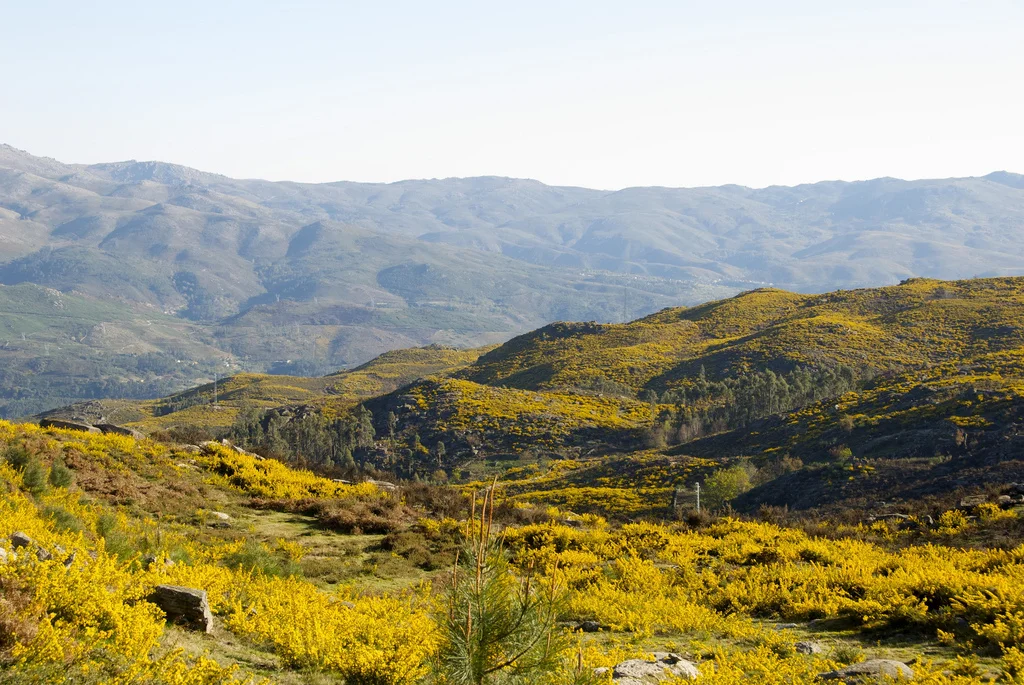
Description
Portugal’s mountain forests are special ecosystems where higher rainfall (up to 2,000–3,000 mm/year), cool climate and rich soils create conditions for a long and productive mushroom season. Unlike the arid southern lowlands, conditions here are closer to Atlantic and Central European types.
Main mountain tree species:
- Pyrenean oak (Quercus pyrenaica) — carvalho-negral: the main mountain tree (400–1,600 m)
- Iberian birch (Betula celtiberica) — bidoeiro: an Iberian Peninsula endemic, north-eastern mountain ranges
- European beech (Fagus sylvatica) — faia: relict/reintroduced species
Geographic distribution
Main mountain regions
| Region | Highest point | Features |
|---|---|---|
| Serra da Estrela | 1,993 m (Torre) | Highest point in continental Portugal; Q. pyrenaica, Betula, Taxus baccata forests (800–1,600 m) |
| Peneda-Gerês | ~1,545 m | Portugal’s only national park; Mata de Albergaria — one of the best-preserved oak forests on the Iberian Peninsula; UNESCO Biosphere Reserve |
| Serra do Marão | ~1,415 m | Q. pyrenaica forests; between Douro and Minho |
| Serra da Lousã | ~1,205 m | LIFE MycoRestore project — using mycology for forest resilience |
| Serra de Nogueira / Montesinho | ~1,320 m | Extensive Q. pyrenaica woodlands and chestnut groves |
Altitudinal belts
- 400–800 m: mixed forests (Pyrenean oak, chestnut, pine)
- 800–1,600 m: mountain forests of Q. pyrenaica, Betula celtiberica, occasional Taxus baccata
- 1,600–1,800 m+: subalpine belt — scrub formations (Juniperus), mountain grasslands; trees virtually absent
Climate and soils
- Rainfall: 2,000–3,000 mm/year (northern mountains) — significantly more than lowlands
- Temperature: winter frosts and snow above 800–1,000 m
- High humidity and mountain fogs provide additional moisture
- Soils: predominantly acidic, on granite and schist
Characteristic mushrooms
Edible species
| Species | Portuguese name | Season |
|---|---|---|
| Porcini (Boletus edulis) | Boleto, cepe | Autumn |
| Boletus pinophilus | Boleto-dos-pinheiros | Summer–autumn |
| Chanterelle (Cantharellus cibarius) | Cantarelo, rapazinhos | Autumn |
| Hedgehog mushroom (Hydnum repandum) | Pé-de-carneiro | Autumn–winter |
| Saffron milk cap (Lactarius deliciosus) | Míscaros, sanchas | Autumn |
| Charcoal burner (Russula cyanoxantha) | — | Autumn |
| Horn of plenty (Craterellus cornucopioides) | Trompeta-dos-mortos | Autumn |
Species richness of mountain oak forests
Pyrenean oak (Quercus pyrenaica) forms ectomycorrhiza with numerous fungi:
- Russula cyanoxantha — very common edible species; distinctive feature — flexible, greasy-to-the-touch gills
- Cortinarius trivialis — very common and abundant; easily recognised by slimy rings and violet-blue gills
- Laccaria laccata, Hebeloma spp. — common mycorrhizal partners of mountain oaks
- Genus Russula — dominates mountain forests (dozens of species)
- Genus Cortinarius — one of the most species-rich mycorrhizal genera
Dangerous species
- Fly agaric (Amanita muscaria) — widespread from lowlands to high mountains
- Panther cap (Amanita pantherina) — under oaks and birches
- Death cap (Amanita phalloides) — in mountain oak forests
Effect of altitude on fungal diversity
A study of Mediterranean altitudinal gradients (Scientific Reports, 2017) showed:
- Sporocarp biomass depends more on inter-annual rainfall variation than on altitude
- Species richness is determined by spatial scale and habitat type
- Key factor: late summer–early autumn rainfall is the limiting resource in Mediterranean climates
- Ectomycorrhizal and saprotrophic fungi respond differently to altitude
- Many species fruit at higher elevations in 2010 compared to 1960 (climate change effect)
LIFE MycoRestore
LIFE MycoRestore is a European project in Serra da Lousã (since 2019), aimed at innovative use of mycological resources for sustainable and productive Mediterranean forests. It includes species diversity monitoring, education and mycotourism development. Between October and January, dozens of events are held: mycological walks, training, gastronomic events.
Seasonality
| Season | Months | Main species |
|---|---|---|
| Autumn (main) | October–December | Boletus edulis, Cantharellus cibarius, Hydnum repandum, Russula spp., Cortinarius spp. |
| Spring | March–May | Morels, some chanterelles |
| Winter | December–February | Late Craterellus, Hydnum |
Above 1,000 m, the season may start earlier (earlier autumn rains) and last longer thanks to higher humidity.
Protection and regulations
Peneda-Gerês National Park
Portugal’s only national park has strict rules for mushroom picking:
- In total protection zones and partial protection type I zones, picking is prohibited (except for scientific purposes)
- In other zones, picking is allowed only for residents, using traditional methods
- Prohibited:
- Picking Amanita caesarea at the “egg” stage
- Picking Boletus with cap diameter under 3 cm
- Picking Cantharellus with diameter under 2 cm
- Picking between sunset and sunrise
- Using rakes and hoes that damage the soil
General Portuguese regulations
- Personal collection: no more than 5 kg of edible mushrooms per day per person
- Commercial collection: requires ICNF authorisation
More: Foraging laws and regulations
Practical tips
- Serra da Lousã — mycotourism leader; organised outings October–January (LIFE MycoRestore)
- Peneda-Gerês — richest diversity, but strict restrictions (residents only in protected zones)
- Serra da Estrela — Q. pyrenaica and Betula zone; the Covilhã area is favourable for mushrooms
- Serra de Nogueira / Montesinho (Trás-os-Montes) — chestnut and oak forests with rich mycology
- Above 1,000 m — longer season and better moisture than on the arid lowlands
Image sources
- mountain-forests.webp — Serra Amarela in Peneda-Gerês National Park, Portugal. Author: manjerix. License: CC BY-SA 2.0. Source
Sources
- CISE — Flora e vegetação da Serra da Estrela
- ICNF — Parque Nacional da Peneda-Gerês: regulamento
- DGADR — Manual de boas práticas de colheita e consumo de cogumelos silvestres
- CCRES — Enquadramento legal dos cogumelos silvestres
- Nature Scientific Reports — Mushroom diversity along Mediterranean elevation gradients, 2017
- LIFE MycoRestore — mycorestore.eu
If this article was useful — help us write the next one.
☕ Support on Ko-fi