Pine Forests
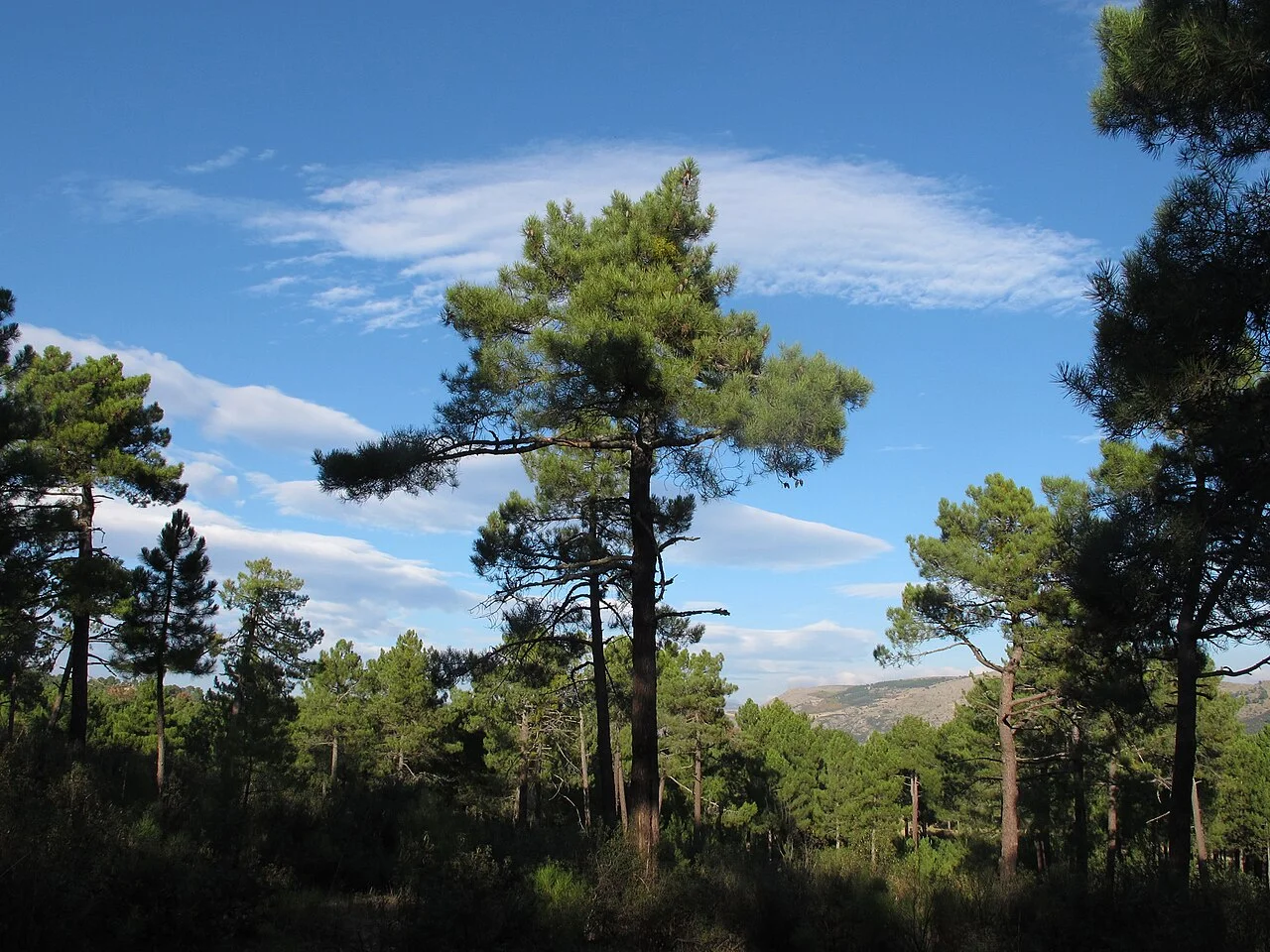
Description
Pine forests — pinhais — are the second largest forest type in Portugal and one of the most productive mushroom habitats. Two main pine species form two distinct ecosystems:
- Pinheiro-bravo (Pinus pinaster, maritime pine) — ~714,000 ha, north and centre of the country
- Pinheiro-manso (Pinus pinea, stone pine) — ~194,000 ha, mainly Alentejo
Pines are obligate ectomycorrhizal symbionts: they cannot grow normally without fungal partners. A study of managed P. pinaster forests identified 35 species in 16 genera of ectomycorrhizal fungi, of which 37% were edible.
Geographic distribution
Pinus pinaster (maritime pine)
- Main regions: Beira Alta, Beira Baixa, Beira Litoral, Ribatejo — ~812,000 ha (62.5% of total pine area)
- Coastal strip from the Tagus and Sado river basins to the Minho
- Interior areas of the North and Centre (on north-facing slopes with Atlantic influence)
- Trend: sharp decline — minus 265,000 ha from 1995 to 2015 (fires, pine wilt nematode, eucalyptus replacement)
Pinus pinea (stone pine)
- Alentejo — 68% of area (~131,500 ha): coastal Alentejo (Alcácer do Sal, Grândola), Lower Alentejo (Beja)
- Algarve — ~40,000 ha
- Tagus Valley (Coruche — best pine nut zone) — ~25,000 ha
- Area is growing (from 120,000 to 194,000 ha between 1995 and 2015)
Soils and climate
- Soils: acidic, loose, sandy (slightly acid to neutral pH)
- Climate: Mediterranean with Atlantic influence on the coast
- Rainfall: 500–1,200 mm/year (higher in the north)
- Key factor for mushrooms: September rainfall — directly correlated with ectomycorrhizal yield
Characteristic mushrooms
The star mushroom of pine forests
Edible species
| Species | Portuguese name | Season |
|---|---|---|
| Saffron milk cap (Lactarius deliciosus) | Míscaros, sanchas | September–December |
| Porcini (Boletus edulis) | Boleto, tortulho | Autumn |
| Boletus pinophilus | Boleto-dos-pinheiros | Summer–autumn |
| Chanterelle (Cantharellus cibarius) | Cantarela, rapazinhos | Autumn |
| Hedgehog mushroom (Hydnum repandum) | Pé-de-carneiro | Autumn–winter |
| Parasol mushroom (Macrolepiota procera) | Frade, parasol | Summer–autumn |
| Hygrophorus hypothejus | Vaquinha-tardia | Late autumn–winter |
Suillus complex — the bolete family of pines
Pine forests are the sole habitat for the genus Suillus:
| Species | Host | Notes |
|---|---|---|
| Suillus luteus | 2-needle pines | Slimy cap, ring on stipe |
| Suillus granulatus | P. pinaster, P. pinea | Milky drops on pores, no ring |
| Suillus collinitus | P. pinea, P. pinaster | Thermophilic, pink mycelium at base |
| Suillus mediterraneensis | P. pinea, P. pinaster | Mediterranean endemic |
| Suillus bellinii | P. pinea, P. pinaster | Mediterranean species |
| Suillus bovinus | Pinus spp. | Triple symbiosis with Gomphidius roseus |
Controversial species
Dangerous species
- Fly agaric (Amanita muscaria) — common in pine forests
- Panther cap (Amanita pantherina) — neurotoxin concentration 2–5× higher than fly agaric
- Honey fungus (Armillaria mellea) — pine parasite
Festival Míscaros
Festival Míscaros is an annual mushroom festival held in the village of Alcaide, municipality of Fundão, Castelo Branco district. It takes place in November on the slopes of Serra da Gardunha, where over 150 species of mushrooms have been recorded.
The festival’s name — míscaros — is the local name for the saffron milk cap (Lactarius deliciosus), the signature mushroom of the surrounding pine forests. The programme includes mycological walks, tastings and tasquinhas (taverns) with mushroom dishes.
Seasonality
| Season | Months | Main species |
|---|---|---|
| Autumn (main) | September–December | Lactarius deliciosus, Boletus pinophilus, Suillus spp., Tricholoma equestre |
| Late autumn–winter | November–February | Hygrophorus hypothejus, Cantharellus (in the Algarve until March) |
| Spring | March–May | Some saffron milk caps (spring flush) |
Threats
Wildfires
- In 2025, over 56,000 ha of maritime pine burned
- High-intensity fires destroy the organic soil horizon and partially sterilise it
- Ectomycorrhizal diversity drops by 43.4% after severe fires and does not recover even after 11 years
- At low–medium intensity, the community is resilient; some species (Rhizopogon olivaceotinctus) even increase in abundance
Pine wilt nematode
Bursaphelenchus xylophilus — detected in Portugal in 1999 (Setúbal Peninsula). Vector: the longhorn beetle Monochamus galloprovincialis. Causes rapid tree death by blocking water movement.
Eucalyptus replacement
Since the mid-20th century, native pine forests have been systematically converted to eucalyptus plantations. Eucalyptus does not form mycorrhizas with pine-forest fungi — replacement leads to loss of fungal biodiversity.
Practical tips
- Best regions for saffron milk caps: Serra da Gardunha, Beira Interior, Trás-os-Montes
- Stone pine in Alentejo — look for Suillus collinitus and S. mediterraneensis (Mediterranean endemics)
- Festival Míscaros (November, Alcaide) — organised mycological walks
- After September rains — optimal time to start the season
- Slippery jacks (Suillus) — peel the cap skin before cooking (slimy, may cause stomach upset)
Image sources
- pine-forests.webp — Maritime pine (Pinus pinaster) — the foundation of Portuguese pine forests. Author: jacilluch. License: CC BY-SA 2.0. Source
Sources
- ICNF — 6.° Inventário Florestal Nacional (IFN6), 2015
- Fernandes P.M. et al. — Wildfire impacts on Pinus pinaster forests // Forest Ecology and Management
- PMC — Molecular approach to characterize ECM fungi from Mediterranean pine stands in Portugal // BMC Microbiology, 2013
- Festival Míscaros — festivalmiscaros.pt
- CCRES — Cogumelos silvestres em Portugal
- Florestas.pt — Pinheiro-bravo: a conífera mais abundante em Portugal
All our knowledge is free. Creating it is not.
☕ Support on Ko-fi