Mushroom Classification
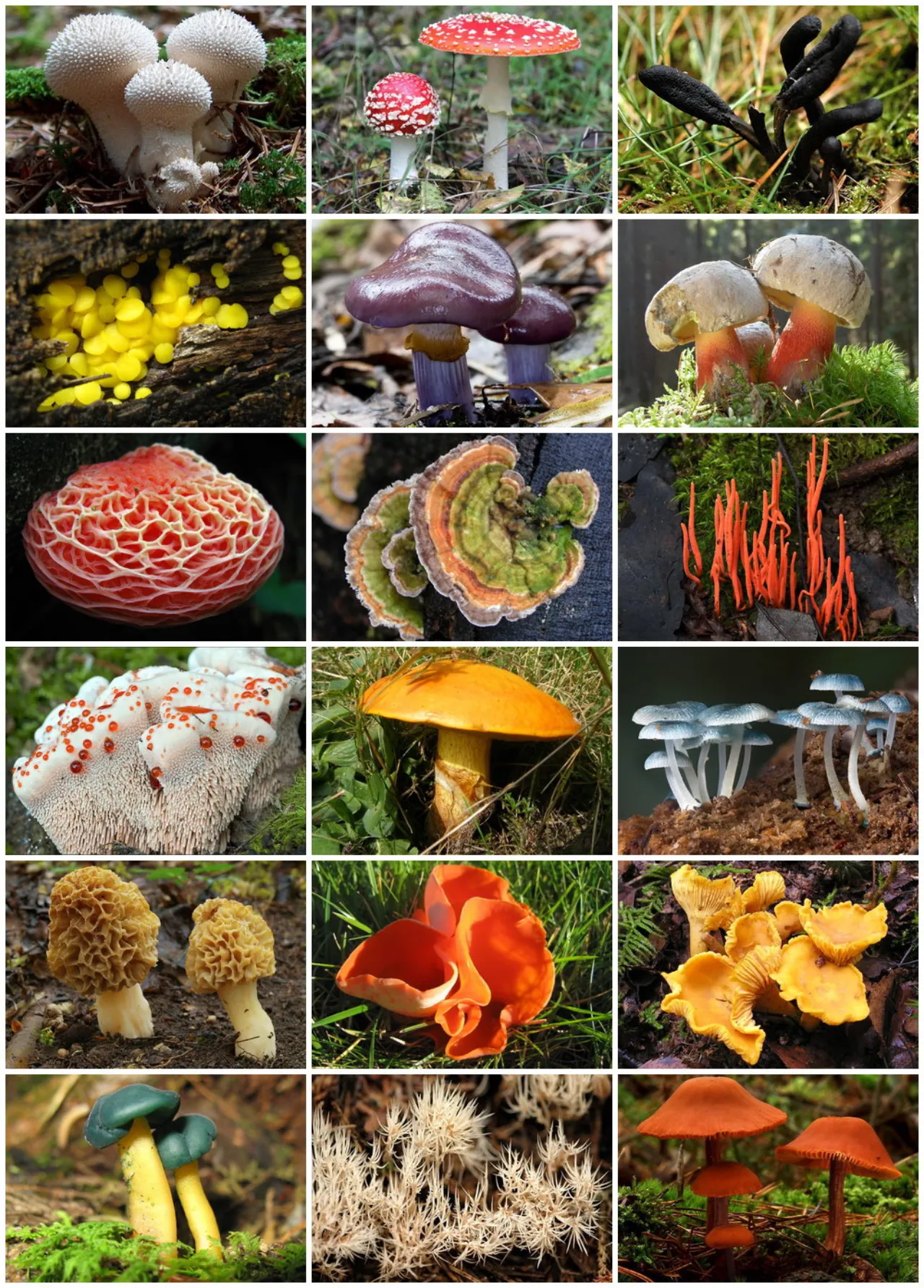
Basics of classification
Fungal classification is based on molecular phylogenetics (DNA analysis) and morphology (structure of fruiting bodies, spores, hyphae). Modern systematics differs significantly from traditional approaches — many species have been reclassified based on genetic data.
Taxonomic hierarchy
Kingdom → Division → Class → Order → Family → Genus → Species
Fungi   → -mycota  → -mycetes → -ales → -aceae → (Latin) → (Latin)
Example: Porcini
Kingdom:    Fungi
Division:   Basidiomycota
Class:      Agaricomycetes
Order:      Boletales
Family:     Boletaceae
Genus:      Boletus
Species:    Boletus edulis
Main divisions of the fungal kingdom
Basidiomycota (basidiomycetes)
The most important division for foragers. Includes the vast majority of cap mushrooms.
Key feature: spores form on specialised structures — basidia (typically 4 spores per basidium).
Main classes and orders:
| Order | What it includes | Examples in Portugal |
|---|---|---|
| Agaricales | Gilled mushrooms (the largest order) | Amanita, Agaricus, Tricholoma, Armillaria, Pleurotus |
| Boletales | Tube mushrooms | Porcini, suillus |
| Cantharellales | Chanterelle-like | Chanterelles, hedgehog mushrooms, horn of plenty |
| Russulales | Russula-like | Milk caps, russulas |
| Polyporales | Bracket fungi | Perennial fungi on trees |
| Phallales | Stinkhorns | Stinkhorns, cage fungi |
Ascomycota (ascomycetes)
The second most important division. Spores form inside specialised structures — asci (sacs), typically 8 spores per ascus.
Examples in Portugal:
- Morels (Morchella) — prized edible fungi
- Truffles (Tuber) — underground fruiting bodies
- False morels (Gyromitra) — dangerous, contain gyromitrin
- Cup fungi (Peziza) — saucer-shaped fungi on soil
Other divisions
- Glomeromycota — arbuscular mycorrhizal fungi (do not produce visible fruiting bodies)
- Chytridiomycota — chytrids (aquatic fungi, parasites)
- Zygomycota (paraphyletic) — zygomycetes (moulds, insect parasites)
Key families for foragers
Amanitaceae (amanitas)
| Species | Edibility | Article |
|---|---|---|
| Amanita phalloides | Deadly | Death cap |
| Amanita muscaria | Toxic | Fly agaric |
| Amanita pantherina | Toxic | Panther cap |
| Amanita caesarea | Edible — delicacy | Caesar’s mushroom |
Key family features: volva at the stem base, ring on the stem, free gills.
Boletaceae (boletes)
Tube mushrooms — one of the “safest” groups for beginners. There are no deadly species among boletes (though some are bitter and inedible).
| Species | Edibility | Article |
|---|---|---|
| Boletus edulis | Edible — one of the finest | Porcini |
| Boletus aereus | Edible — delicacy | Bronze bolete |
Cantharellaceae (chanterelles)
| Species | Edibility | Article |
|---|---|---|
| Cantharellus cibarius | Edible — prized | Chanterelle |
| Craterellus cornucopioides | Edible | Horn of plenty |
Cortinariaceae (webcaps)
- Deadly webcap (Cortinarius orellanus) — deadly, orellanine damages kidneys
Other important families
| Family | Typical fungi | In Portugal |
|---|---|---|
| Agaricaceae | Field mushrooms, parasols | Field mushroom, parasol |
| Russulaceae | Russulas, milk caps | Saffron milk cap |
| Physalacriaceae | Honey fungi | Honey fungus |
| Pleurotaceae | Oyster mushrooms | Oyster mushroom |
| Tuberaceae | Truffles | Black truffle |
| Hydnaceae | Hedgehog mushrooms | Hedgehog mushroom |
| Entolomataceae | Entolomas | Livid pinkgill |
| Omphalotaceae | Jack-o’-lanterns | Jack-o’-lantern |
| Tricholomataceae | Knights | Yellow knight |
| Morchellaceae | Morels | Morel |
Nomenclature: how to read scientific names
Scientific names of fungi follow the International Code of Nomenclature for algae, fungi, and plants (ICN).
Binomial nomenclature
Each species has a two-part Latin name:
- Genus (capitalised, italicised): Boletus
- Species (lower case, italicised): edulis
- Full name: Boletus edulis Bull., 1782
The author of the description and year follow the name:
- Bull. — Jean-Baptiste Bulliard (described the species in 1782)
- Fr. — Elias Fries (Swedish mycologist, “father of mycology”)
- (Vaill. ex Fr.) Quel. — species first described by Vaillant, validated by Fries, reclassified by Quélet
Synonyms
Due to reclassification, many species have synonyms — old names. Check current classification at:
- MycoBank (www.mycobank.org) — official nomenclature database
- Index Fungorum (www.indexfungorum.org) — fungal name database
- Species Fungorum — taxonomic database
Spores and spore prints
A spore print is an essential diagnostic tool. The colour of the spore powder is one of the key features for determining genus and family.
How to make a spore print
- Cut the cap from a mature (but not old) mushroom
- Place the cap gills/tubes-down on white and black paper (half on each)
- Cover with a glass or bowl
- Leave for 4–12 hours
- Carefully lift the cap and examine the print
Typical colours
| Print colour | Families/genera |
|---|---|
| White | Amanita, Russula, Lactarius, Clitocybe |
| Pink | Entoloma, Pluteus |
| Brown | Agaricus, Cortinarius |
| Black / dark brown | Coprinopsis, Psathyrella |
| Olive-brown | Boletus, Suillus |
| Yellow | Laetiporus |
| Lilac | Lepista |
Image sources
- classification.webp — Fungi diversity — representatives of major families. Author: Termininja et al.. License: CC BY-SA 3.0. Source
Sources
- Kirk P.M. et al. — Ainsworth & Bisby’s Dictionary of the Fungi (10th ed.)
- Hibbett D.S. et al. — A higher-level phylogenetic classification of the Fungi // Mycological Research, 2007
- MycoBank — www.mycobank.org
- Index Fungorum — www.indexfungorum.org
- Bon M. — The Mushrooms and Toadstools of Britain and North-western Europe
If this article was useful — help us write the next one.
☕ Support on Ko-fi