Mycorrhiza
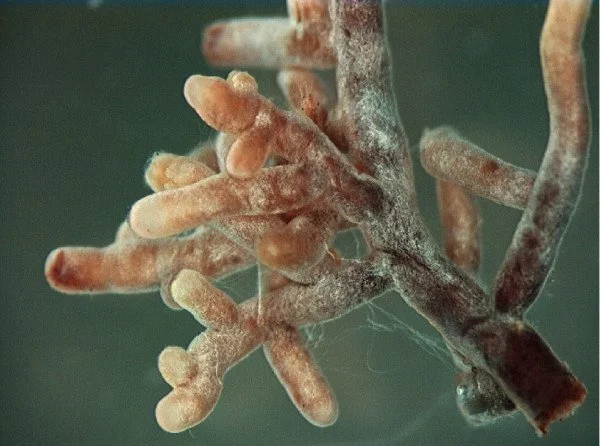
What is mycorrhiza
Mycorrhiza (from Greek mykes — fungus + rhiza — root) is a symbiotic partnership between fungi and plant roots. About 90% of all terrestrial plants form mycorrhizae. For most forest trees, this symbiosis is not merely beneficial — it is essential for survival.
The exchange
| The fungus receives | The tree receives |
|---|---|
| Carbohydrates (sugars) — products of the tree’s photosynthesis | Water and minerals (phosphorus, nitrogen, potassium) through the branching hyphal network |
| Up to 20–30% of carbohydrates produced by the tree | A 10 to 1,000-fold increase in root absorption area |
Types of mycorrhiza
Ectomycorrhiza
Fungal hyphae envelope the tree roots externally, forming a sheath (mantle), and penetrate between cortical cells, creating the Hartig net. They do not enter individual cells.
Typical for:
- Pines (Pinus), oaks (Quercus), birches (Betula), chestnuts (Castanea), spruces (Picea)
- Most prized edible mushrooms are ectomycorrhizal
Examples: porcini, chanterelle, saffron milk cap, Caesar’s mushroom, black truffle
Arbuscular mycorrhiza (AM)
Fungal hyphae penetrate inside root cells, forming tree-like structures called arbuscules. The oldest and most widespread type of mycorrhiza (~450 million years old).
Typical for:
- Most herbaceous plants and shrubs
- Many tropical trees
- Fungal partners: Glomeromycota — do not produce visible fruiting bodies
Other types
- Ericoid — in heaths (Ericaceae)
- Orchid — in orchids (essential for seed germination)
- Monotropoid — in Indian pipe (Monotropa), which receives carbohydrates from trees via fungi
Wood Wide Web: the forest internet
One of the most remarkable aspects of mycorrhiza is mycorrhizal networks, known in science and popular literature as the Wood Wide Web (by analogy with the World Wide Web).
How it works
- A single fungus can be connected to multiple trees simultaneously
- Several fungal species can connect to a single tree
- Through the hyphal network, trees can exchange carbon, nitrogen, phosphorus, and signalling molecules
- Mother trees can nourish young seedlings through the mycorrhizal network
- Trees can warn neighbours about pest attacks through chemical signals
Hub trees
Forests contain so-called “mother trees” (hub trees) — large old trees connected via mycorrhizal networks to dozens or hundreds of neighbours. Their removal can disrupt the connectivity of the entire network.
Important: the Wood Wide Web concept is actively being researched, and not all claims from popular books have been confirmed by rigorous experiments. The scale and significance of resource exchange through mycorrhizal networks remains a subject of ongoing scientific debate.
Mycorrhiza in Portugal
Mycorrhizal associations are of particular importance for Portuguese ecosystems:
Montado (cork oak forests)
Montado is a unique agro-forestry system in southern Portugal. Cork oak (Quercus suber) and holm oak (Q. ilex) form ectomycorrhizae with dozens of fungal species, including:
- Bronze bolete (Boletus aereus)
- Caesar’s mushroom (Amanita caesarea)
- Russula spp., Lactarius spp.
Mycorrhiza helps oaks survive the summer drought characteristic of the Mediterranean climate.
Pine forests
Portugal’s pine forests (predominantly Pinus pinaster) are a key habitat for foragers. Mycorrhizal partners of pines:
- Saffron milk cap (Lactarius deliciosus)
- Porcini and other Boletus
- Suillus spp.
Chestnut forests
In northern Portugal, chestnut forests (Castanea sativa) support a rich ectomycorrhizal community, including porcini and various Amanita species.
Truffles
Black truffle (Tuber melanosporum) is the most valuable mycorrhizal fungus, forming symbiosis with oaks and hazel. Truffle cultivation is developing in Portugal, particularly in the Alentejo region (more details: Truffles of Portugal).
Threats to mycorrhizal networks
- Deforestation — destroys mycorrhizal networks that take decades to recover
- Soil pollution — heavy metals, pesticides, and excess fertilisers suppress mycorrhizal fungi
- Soil compaction — mechanical cultivation and trampling damage the mycelium
- Forest fires — a serious problem in Portugal, destroying the surface soil layer containing mycelium
- Eucalyptus plantations — eucalyptus monoculture supports a far less diverse mycorrhizal community than native forests
Practical relevance for foragers
Understanding mycorrhiza helps in finding mushrooms:
- Search under the “right” trees — each mycorrhizal fungus is associated with specific tree species
- Don’t damage the mycelium — carefully cut or twist the mushroom, avoiding tearing up the soil
- Return to familiar spots — mycelium is perennial; mushrooms appear in the same places year after year
- Protect the forest — healthy forest = healthy mushrooms
Image sources
- mycorrhiza.webp — Mycorrhizal root tips with Amanita fungal mantle. Author: Ellen Larsson. License: CC BY 2.5. Source
Sources
- Smith S.E., Read D.J. — Mycorrhizal Symbiosis (3rd ed.), Academic Press
- Simard S.W. et al. — Net transfer of carbon between ectomycorrhizal tree species in the field // Nature, 1997
- van der Heijden M.G.A. et al. — Mycorrhizal ecology and evolution: the past, the present, and the future // New Phytologist, 2015
- Azul A.M. — Micorrizas em ecossistemas florestais de Quercus suber // Universidade de Coimbra
- Baptista P. et al. — Ectomycorrhizal fungi in Castanea sativa forests in northeast Portugal // Mycorrhiza
All our knowledge is free. Creating it is not.
☕ Support on Ko-fi