What Are Mushrooms
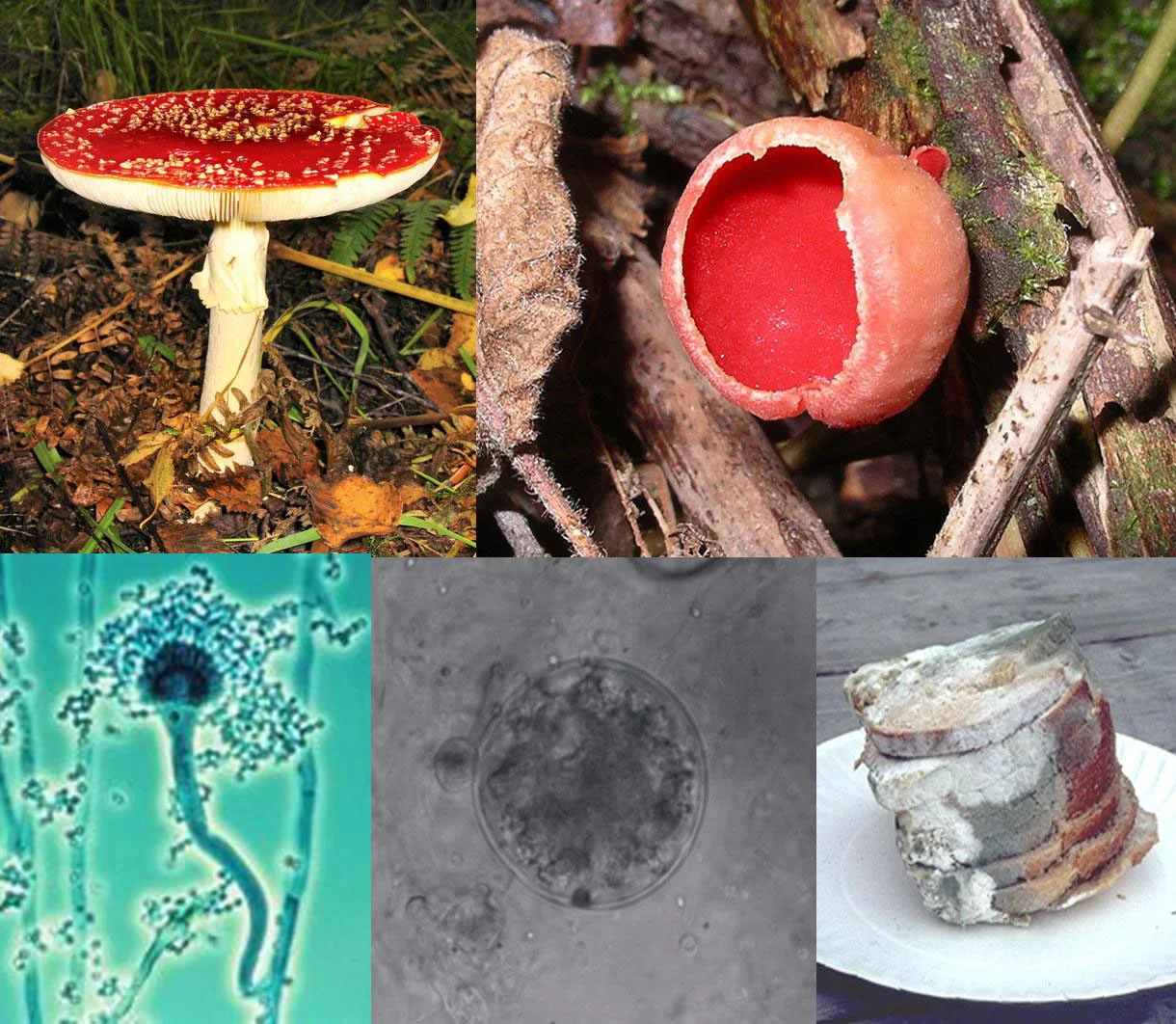
Fungi — a separate kingdom
Fungi are neither plants nor animals. They are a separate kingdom of living organisms, established in 1969 by Robert Whittaker. Molecular data shows that fungi are evolutionarily closer to animals than to plants.
| Feature | Plants | Fungi | Animals |
|---|---|---|---|
| Cell wall | Cellulose | Chitin | None |
| Nutrition | Photosynthesis | Heterotrophic (absorption) | Heterotrophic (ingestion) |
| Chlorophyll | Present | Absent | Absent |
| Storage carbohydrate | Starch | Glycogen (like animals) | Glycogen |
| Motility | None | None (some motile spores) | Present |
Structure of a mushroom
What we commonly call a “mushroom” is merely the fruiting body (carpophore or basidioma), the above-ground part of the organism designed for reproduction. The main body of the fungus is the mycelium, a network of microscopic threads (hyphae) that permeates soil, wood, or other substrate.
Mycelium
- Network of fine threads (hyphae) with a diameter of 2–10 μm
- Can cover an area from a few square centimetres to several hectares
- Lives for years and decades
- Grows continuously, unlike the fruiting body
- Secretes extracellular enzymes to break down organic matter
The largest known organism on Earth is the mycelium of the dark honey fungus (Armillaria ostoyae) in Oregon, USA. It covers approximately 9.6 km² and is estimated to be 2,400–8,650 years old.
Fruiting body
A typical cap mushroom fruiting body consists of:
- Cap (pileus) — protects the spore-bearing layer
- Hymenophore — the spore-bearing layer on the underside of the cap:
- Gills (lamellae) — in most mushrooms (Amanita, Agaricus, Tricholoma)
- Tubes (tubes) — in boletes (porcini, birch bolete)
- Spines (spines) — in hedgehog mushrooms
- Ridges — in chanterelles
- Stem (stipe) — raises the cap above the substrate
- Ring (annulus) — remnant of the partial veil (in Amanita, Agaricus)
- Volva (volva) — remnant of the universal veil at the base of the stem (in the genus Amanita)
For safety: the volva is the key feature of the genus Amanita, which includes both deadly poisonous species (death cap) and prized edible ones (Caesar’s mushroom). See Dangerous look-alikes.
Life cycle
- Spore — a microscopic reproductive cell (analogous to a seed in plants)
- Germination — the spore germinates, producing a primary mycelium
- Fusion — two compatible mycelia fuse, forming a dikaryotic mycelium
- Mycelial growth — the mycelium expands through the substrate, feeding on organic matter
- Fruiting — under favourable conditions (humidity, temperature), the mycelium forms fruiting bodies
- Spore maturation — billions of spores are produced in the hymenophore
- Dispersal — spores are spread by wind, water, insects, or animals
A single field mushroom can produce up to 16 billion spores. However, only a tiny fraction will land in suitable conditions and give rise to a new mycelium.
How fungi feed
Fungi cannot photosynthesise and must obtain organic matter from external sources. Three main nutritional groups exist:
Saprotrophs
Decompose dead organic matter: fallen leaves, wood, dung. They play a key role in nutrient cycling, breaking down cellulose and lignin.
Examples in Portugal: oyster mushroom (Pleurotus ostreatus), field mushroom (Agaricus campestris)
Mycorrhizal (symbionts)
Form mutually beneficial partnerships (mycorrhiza) with tree roots. The fungus receives carbohydrates from the tree, while the tree gains water and minerals through the extensive hyphal network.
Examples in Portugal: porcini (Boletus edulis), chanterelle (Cantharellus cibarius), saffron milk cap (Lactarius deliciosus)
More details: Mycorrhiza
Parasites
Feed on living organisms (trees, insects, other fungi), causing them harm.
Examples in Portugal: honey fungus (Armillaria mellea) — parasitises weakened trees
Diversity of forms
Cap mushrooms are only a small part of the kingdom Fungi. Fungi are incredibly diverse:
- Cap mushrooms (basidiomycetes) — the familiar “stem and cap” mushrooms
- Truffles — underground fruiting bodies (formed below the soil surface)
- Puffballs — spherical, releasing spores as “smoke” when mature
- Coral fungi — branching, resembling corals
- Bracket fungi — perennial, growing on tree trunks
- Yeasts — unicellular fungi (bread, wine, beer)
- Moulds — filamentous fungi (penicillin, cheesemaking)
- Lichens — symbiosis of a fungus and an alga/cyanobacterium
Fungi and humans
Fungi play an enormous role in human life:
- Food — thousands of edible species worldwide
- Medicine — penicillin (from Penicillium), cyclosporine, statins
- Biotechnology — fermentation (bread, beer, wine, cheese, soy sauce)
- Ecology — organic decomposition, mycorrhizal networks, bioremediation
- Threats — fungal diseases of plants, animals, and humans
Mycology in Portugal
The study of fungi in Portugal has a long history (more details: History of mycology). Today, mycological associations are active in the country, festivals are held (see Míscaros Festival), and mushroom tourism is becoming increasingly popular.
Portugal, with its diverse ecosystems — from Atlantic forests in the north to Mediterranean montado in the south — boasts a rich diversity of fungal species.
Image sources
- what-are-mushrooms.webp — Mushroom diversity — from gilled to tubular forms. Author: BorgQueen. License: CC BY-SA 2.5. Source
Sources
- Alexopoulos C.J., Mims C.W., Blackwell M. — Introductory Mycology (4th ed.)
- Whittaker R.H. — New Concepts of Kingdoms of Organisms // Science, 1969
- Kavanagh K. (ed.) — Fungi: Biology and Applications (3rd ed.)
- Sociedade Portuguesa de Micologia
- Hawksworth D.L. — The Fungal Dimension of Biodiversity // Mycological Research
The light is on for free. But someone has to clean the lantern.
☕ Support on Ko-fi