Serra da Arrábida: Mushroom Paradise
Why Arrábida is unique
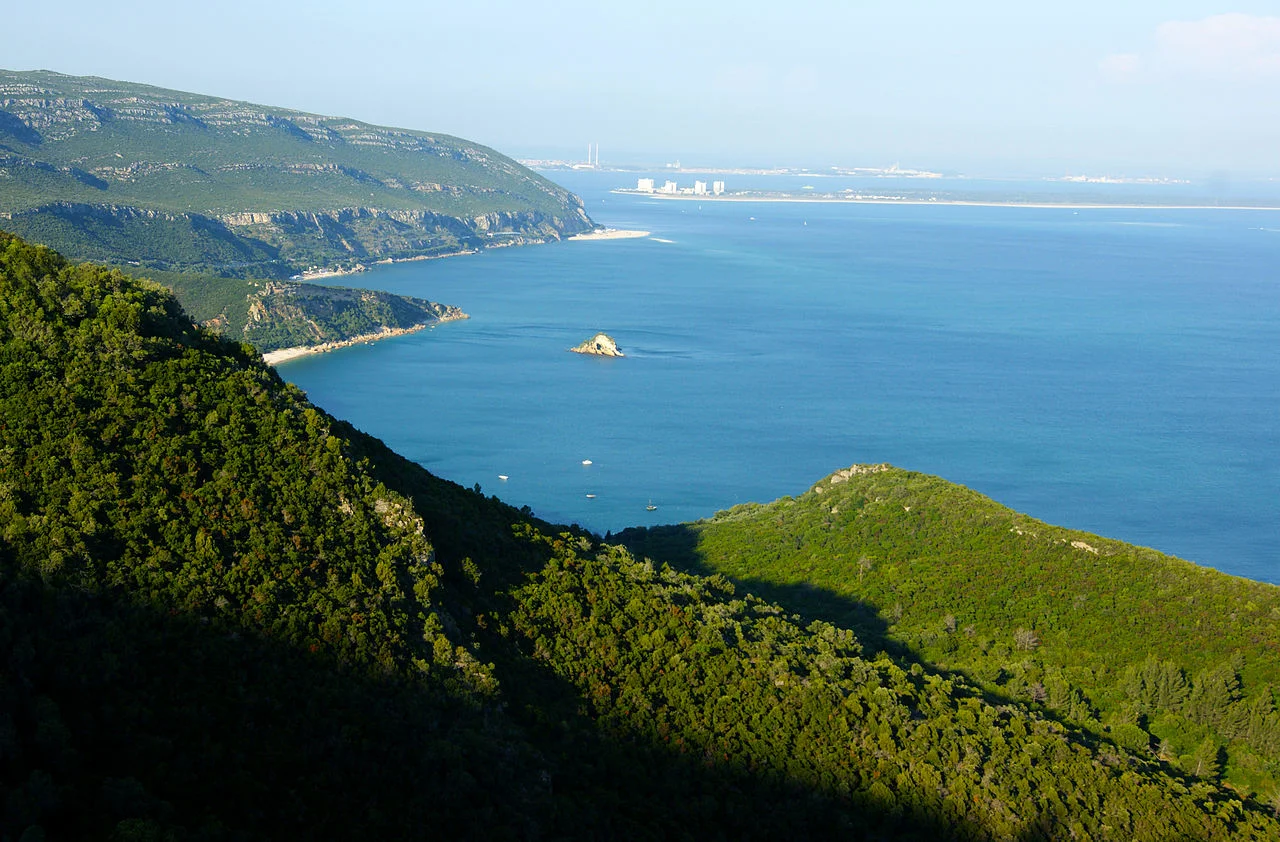
Serra da Arrábida is a mountain range on the southern edge of the Setúbal Peninsula, running east to west parallel to the coast. Its highest point reaches about 500 metres. The natural park covers 17,000 ha.
But it’s not about size. Arrábida is a limestone island in a country of acidic soils.
Almost all of Portugal sits on granite, gneiss and schist — rocks that produce acidic soils (pH 4.5–6.5). Arrábida is the exception: here, Jurassic dolomite limestones create alkaline soils with pH 7.0–8.5. For fungi, this is crucial: many species, including the black truffle (Tuber melanosporum), grow only on limestone.
This makes Arrábida potentially the only natural habitat for black truffle in Portugal.
Vegetation — a “Mediterranean relic”
Arrábida is one of the rarest examples of Mediterranean maquis in Portugal and a recognised international scientific relic. Such vegetation once covered much of southern Europe but has almost disappeared.
Some ~1,450 plant species have been described here — that’s 40% of all Portugal’s flora in a tiny area. Over 70 species are rare or endemic.
Key trees and shrubs (mycorrhizal hosts)
| Species | Portuguese name | Significance for fungi |
|---|---|---|
| Quercus coccifera | Carrasco (kermes oak) | Maquis dominant, host for Russulaceae, Cortinariaceae |
| Quercus faginea | Carvalho-português | Potential host for Tuber melanosporum |
| Arbutus unedo | Medronheiro (strawberry tree) | Shares mycorrhizal partners with oaks |
| Cistus albidus | Esteva (rockrose) | Host for Terfezia (desert truffles) |
| Pistacia lentiscus | Aroeira (mastic tree) | Maquis component |
| Olea europaea | Oliveira (wild olive) | Mediterranean element |
| Juniperus phoenicea | Sabina (Phoenician juniper) | Limestone cliffs |
Two slopes — two worlds
A 2002 study (Microbial Ecology) confirmed that the north and south slopes of Arrábida are two different fungal worlds:
- North slope (humid) — richer diversity, more moisture-loving species
- South slope (dry, facing the sea) — more specialised community, xerophilic species
Researchers collected 1,029 strains of filamentous fungi (at least 36 species) and 540 yeast strains (at least 46 species) from the leaves of just five plant species. Some taxa proved to be previously undescribed species.
Mushrooms of Arrábida
Core mycorrhizal community of limestone oak forests
Studies of Mediterranean oak forests (relevant to Arrábida) reveal:
| Family / Genus | Share of ECM community | Notes |
|---|---|---|
| Thelephoraceae | Up to 73% of root tips (with Russulaceae, Cortinariaceae) | Dominant |
| Russulaceae (Russula, Lactarius) | 34% of fruiting bodies | High species diversity |
| Cortinariaceae (Cortinarius) | 34% of fruiting bodies (jointly with Russula) | 50% of ECM species diversity |
| Cenococcum geophilum | Up to 35% of root tips | Universal dominant |
| Laccaria laccata | — | One of three most abundant ECM species |
| Inocybe tigrina | — | One of three most abundant ECM species |
| Lactarius chrysorrheus | — | One of three most abundant ECM species |
In an old-growth Quercus ilex forest (a close relative of Q. coccifera), 234 species were recorded from 5,382 fruiting bodies: 166 ectomycorrhizal and 68 saprotrophic.
Across the Iberian Peninsula, 605 mycorrhizal taxa have been documented in Mediterranean oak forests.
Black truffle potential
More on truffles: Black truffle
Rare find: Amanita torrendii
In the Metropolitan Biodiversity Park in Seixal (Setúbal district), Amanita torrendii became the thousandth identified species. This is a typically Mediterranean fungus found exclusively in Mediterranean and sub-Mediterranean forests on sandy soils, associated with Quercus suber.
- IUCN status: Near Threatened
- Global records: ~210 GBIF records, of which ~33 from Portugal
- Range: Spain, Portugal, France, Italy, Greece, Cyprus, Morocco, Algeria, Turkey
Edible species expected in Arrábida
| Species | Season | Arrábida habitat |
|---|---|---|
| Caesar’s mushroom (Amanita caesarea) | Summer–autumn | Oak forests, maquis |
| Chanterelle (Cantharellus cibarius) | Autumn | Oak forests |
| Bronze bolete (Boletus aereus) | Summer–autumn | Broadleaf forests |
| Horn of plenty (Craterellus cornucopioides) | Autumn | Damp spots under oaks |
| Beefsteak fungus (Fistulina hepatica) | Autumn | On old oaks (parasitic) |
Dangerous species
Seasonality
| Season | Months | What to look for |
|---|---|---|
| Autumn (main) | October–December | Russula, Cortinarius, Lactarius, Boletus aereus, Cantharellus, Amanita caesarea |
| Winter | December–February | Lactarius (cont.), winter Cortinarius, Helvella |
| Spring | February–May | Potentially Terfezia (rockrose areas), Morchella |
| Summer | June–September | Dry; Amanita caesarea, Boletus aereus after summer rains |
Key factor: maritime influence (morning fog, ocean humidity) can offset autumn dryness, extending the mushroom season compared to inland Alentejo.
Contrast with surroundings
Arrábida’s uniqueness is especially striking when compared with neighbouring ecosystems:
| Ecosystem | Soils | pH | Characteristic fungi |
|---|---|---|---|
| Arrábida (limestone) | Alkaline, calcium-rich | 7.0–8.5 | Russula, Cortinarius, Inocybe, potentially Tuber |
| Tróia (sand) | Acidic, sandy | 4.5–6.0 | Suillus, Lactarius deliciosus, Pisolithus |
| Montado (south) | Moderately acidic | 4.5–7.0 | Amanita caesarea, A. ponderosa, Boletus, Cantharellus |
Within just a few kilometres — three entirely different mushroom worlds.
Read more: Pine forests of Tróia, Sado Estuary
Practical tips
- Natural park — foraging may be restricted. Check regulations with ICNF or the park administration
- Best season: October–November (after the first autumn rains)
- North slope — richer in fungi, more humid
- Look under Quercus faginea and Q. coccifera — the main mycorrhizal hosts
- Maquis — dense and hard to navigate. Stick to trails and open areas
Mycological activities nearby
- EcoFungos (Seixal) — mycological association, founded 2004. Runs walks and tastings at Parque Metropolitano da Biodiversidade. Contact: [email protected]
- CM Sesimbra — the municipality organises mushroom foraging courses (CIPA, Quinta do Conde) and walks at Lagoa Pequena
- Arrábida Walking Festival (March) — 40+ activities including botanical and gastronomic walks
Image sources
- arrabida.webp — Arrábida Natural Park — Mediterranean maquis on limestone cliffs. Author: Senyrah. License: CC BY-SA 3.0. Source
See also
- Arrabida Natural Park — geography, fauna, marine park and conservation status of the protected area (Setubal Encyclopedia)
Sources
- Inácio J. et al. — Estimation of phylloplane fungal diversity on selected plants in Serra da Arrábida // Microbial Ecology, 2002
- Duarte S. et al. — Filamentous fungal diversity in a Mediterranean ecosystem // Fungal Diversity, 2011
- Rinaldi A.C. et al. — Ectomycorrhizal fungal diversity — the state of the art // Plant Biosystems, 2008
- de Vries B.W.L. et al. — Macrofungi of old-growth Quercus ilex forest // Cryptogamie Mycologie, 2003
- Parque Natural da Arrábida — Plano de Ordenamento, ICNF
- CM Seixal — Mil espécies já identificadas no Parque da Biodiversidade, 2024
- BioDiversity4All — Checklist de Parque Natural da Arrábida
If this article was useful — help us write the next one.
☕ Support on Ko-fi