Rare Finds: Amanita torrendii and Terfezia
Beyond porcini and chanterelles
The Setúbal region is not just a place for collecting common mushrooms. Thanks to its unique geology and climate, species grow here that cannot be found in most other parts of Portugal. Some have been described by science only recently.
Amanita torrendii — a Mediterranean relic
The thousandth species of Seixal
In the Parque Metropolitano da Biodiversidade (Seixal, Setúbal district), Amanita torrendii became the thousandth identified species — a symbolic milestone for the park.
What is this mushroom
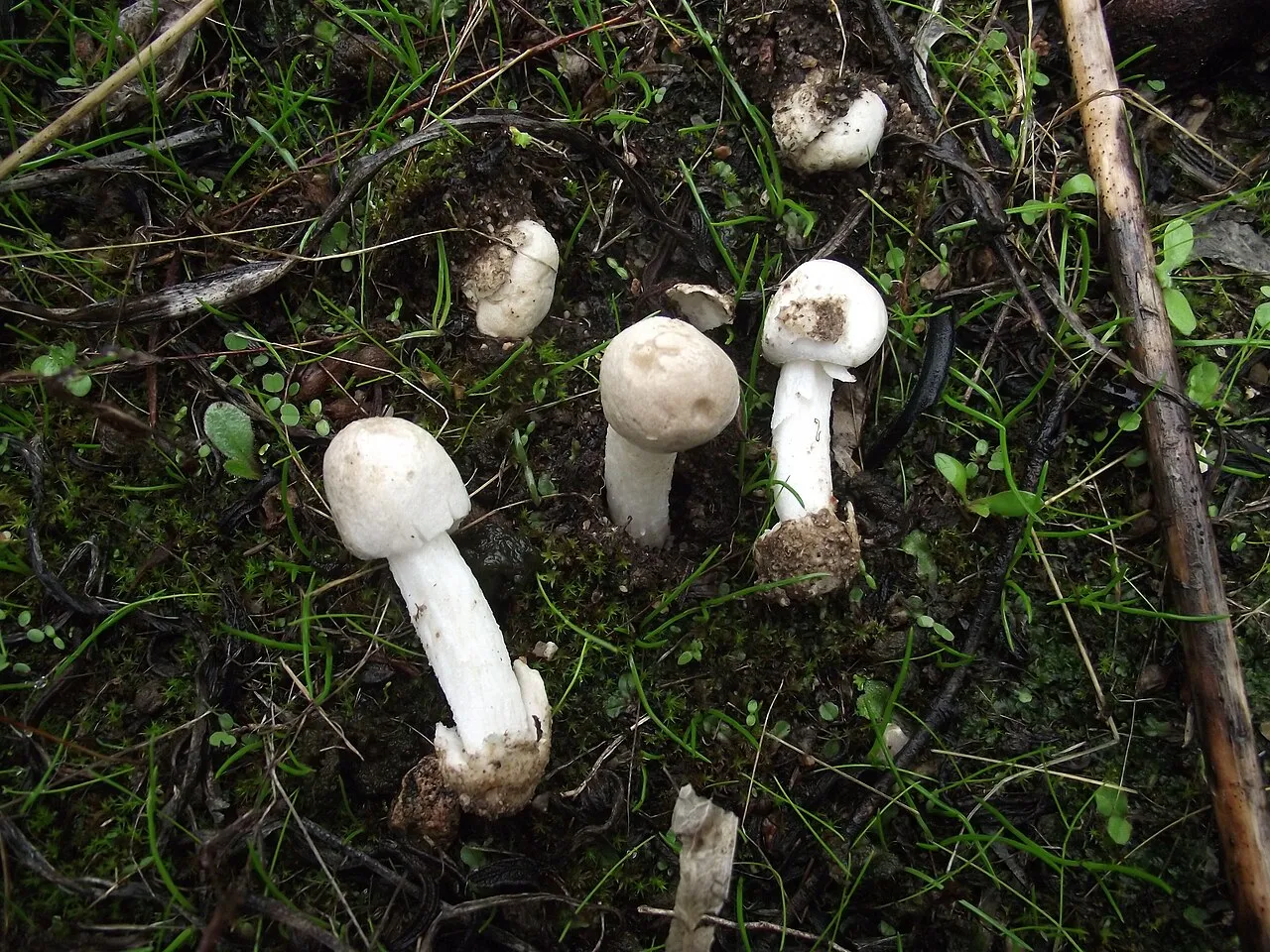
Amanita torrendii is a typically Mediterranean species of the family Amanitaceae. It differs fundamentally from most Amanita:
| Parameter | Description |
|---|---|
| Cap | 5–10 cm, whitish to ochre, with veil remnants |
| Gills | White, free |
| Stem | With volva at base |
| Spores | Globose, amyloid |
| Edibility | Do not consume — insufficiently studied |
Ecology
- Found exclusively in Mediterranean and sub-Mediterranean forests
- Associated with Quercus suber (cork oak) on sandy soils
- Fruits in autumn
- IUCN status: Near Threatened
Distribution
- ~210 GBIF records, of which ~33 from Portugal
- Range: Spain, Portugal, France, Italy, Greece, Cyprus, Morocco, Algeria, Turkey
- In Portugal: mainly south and centre — areas with cork oaks
Terfezia — Portugal’s desert truffles
An unexpected delicacy
“Desert truffles” are subterranean fungi of the genus Terfezia, associated with plants of the rockrose family (Cistaceae). They are not related to “true” truffles (Tuber), but have been used in Mediterranean and North African cuisine for centuries.
In Portugal, the number of known Terfezia species has been updated from 3 to 10 thanks to researchers from the University of Évora.
Terfezia arenaria — sand truffle
| Parameter | Description |
|---|---|
| Fruiting body | Subterranean, 2–7 cm, irregular shape |
| Colour | Beige outside, marbled when cut |
| Host | Tuberaria guttata (spotted rockrose, Cistaceae) |
| Soils | Acidic, sandy, moist, poor in organic matter |
| Season | February–May (spring) |
| Nutrition | Carbohydrates 67%, protein 14%, fibre 10%, Nutri-Score A |
Documented in Alentejo (southern Portugal, bordering the Setúbal region). The Setúbal Peninsula has suitable conditions: Tuberaria guttata occurs in the area, and acidic sandy soils are found on Tróia and the coast.
Probability of finding in Setúbal: high. [UNVERIFIED]
Terfezia lusitanica — the “Portuguese truffle”
Described as a species new to science from Alentejo, Portugal. Also associated with Tuberaria guttata on acidic sandy soils in treeless meadow areas. Fruits in April.
Terfezia solaris-libera
Another new species described from Alentejo. Ecological details are being studied.
How to search for desert truffles
- Find Tuberaria guttata — a low-growing plant with yellow flowers and spotted petals. Grows on open sandy ground
- Look for cracks in the soil around plants (February–May)
- Carefully dig the soil at 5–15 cm depth
- Don’t confuse with Scleroderma (earthballs) — those grow under trees and have a tough skin
Key researchers
If you’re interested in Portuguese desert truffles:
- Celeste Santos-Silva (University of Évora) — leading Terfezia specialist in Portugal
- Rogério Louro (University of Évora) — Terfezia ecology researcher
Black truffle potential in Arrábida
The limestones of Serra da Arrábida are the only naturally alkaline soils in the region. Tuber melanosporum requires pH 7.5–8.5, calcium-rich soils and hosts from Quercus or Corylus. All of this theoretically exists in Arrábida.
However, there is no scientific confirmation of natural Tuber melanosporum populations in Arrábida yet. This remains an open question — and potentially one of the most interesting mycological questions in the region.
Read more: Black truffle, Portuguese truffles
Other interesting species
Amanita ponderosa (silarca)
“White gold of the montado” — a large spring mushroom, endemic to the Iberian Peninsula. Not officially confirmed for Arrábida, but the Setúbal region is within its range. Look in oak groves in March–April.
Read more: Montado
Fistulina hepatica (beefsteak fungus)
Língua-de-boi (ox tongue) — a saprotroph/parasite on old oaks. Forms large red fruiting bodies resembling a piece of meat. Edible, but valued more for its aesthetics.
Pisolithus arhizus
A large subterranean fungus, crucial for dune stabilisation. Fruiting bodies look like “balls” on the sand surface. Inedible but ecologically critical.
Citizen science
If you find an unusual mushroom in the Setúbal area:
- Photograph — cap from above, underside (gills/pores), stem, base with soil
- Mark the location — GPS coordinates, forest type, nearby trees
- Upload to iNaturalist or BioDiversity4All
- Don’t collect rare species — a photograph is more valuable
Active projects:
- BioDiversity4All: Checklist de Parque Natural da Arrábida
- iNaturalist: Cogumelos de Portugal
- EcoFungos: mushroom monitoring at Parque da Biodiversidade (Seixal)
Image sources
- rare-finds.webp — Amanita torrendii — a rare Mediterranean endemic. Author: Mushroom Observer. License: CC BY-SA 3.0. Source
Sources
- CM Seixal — Mil espécies já identificadas no Parque da Biodiversidade, 2024
- Santos-Silva C. et al. — Terfezia lusitanica sp. nov. // Phytotaxa, 2018
- Moreno-Arroyo B. et al. — Terfezia arenaria: a hidden delicacy // PMC, 2023
- Carvalho A. et al. — Terfezia diversity and ecology in the Iberian Peninsula // MycoKeys, 2021
- GBIF — Amanita torrendii distribution data
- Mitra Nature UEvora — Amanita torrendii species page
- BioDiversity4All — Checklist de Parque Natural da Arrábida
All our knowledge is free. Creating it is not.
☕ Support on Ko-fi