Sado Estuary: Salt Marshes and Mushrooms
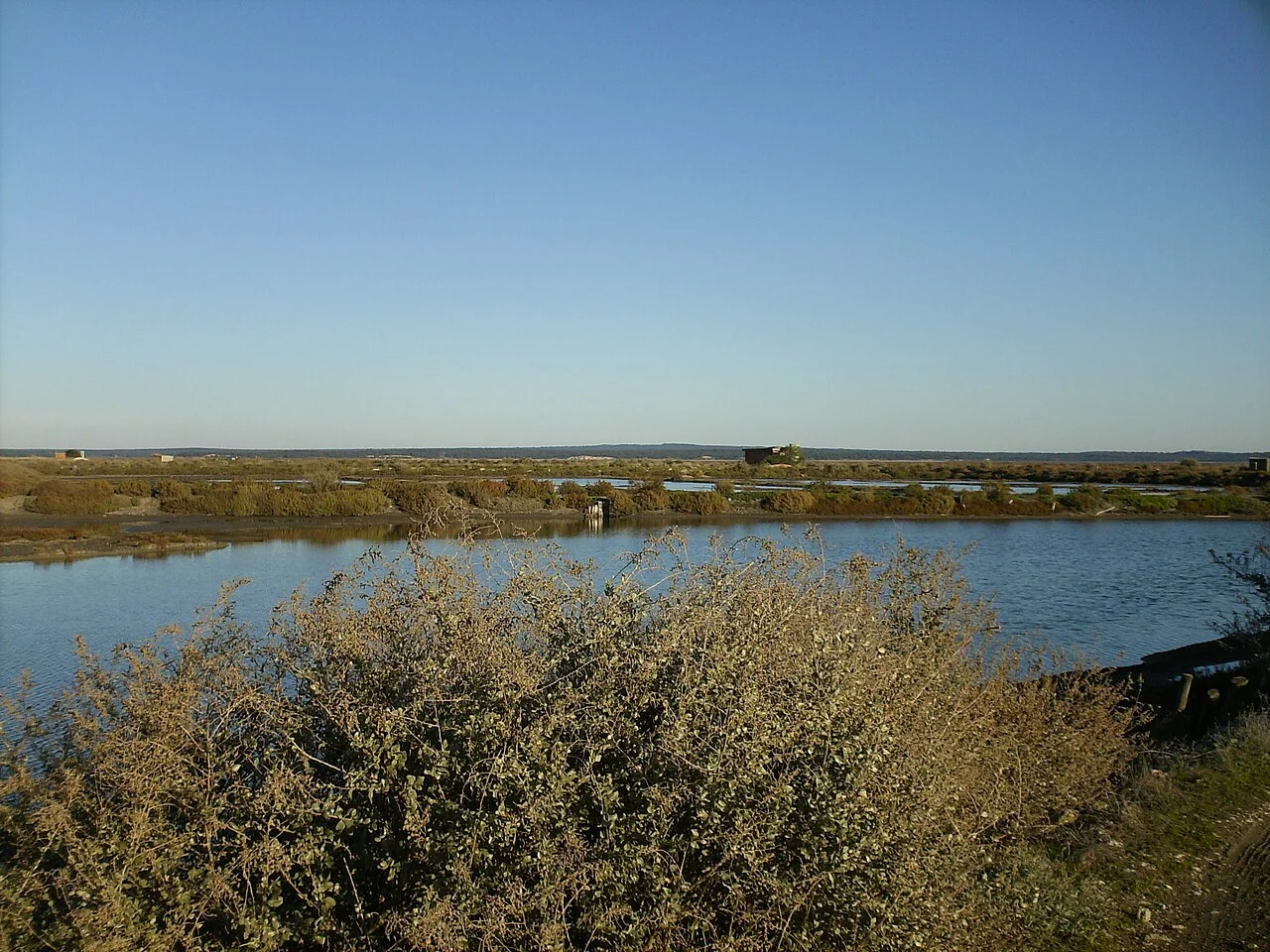
The peninsula’s third ecosystem
The Setúbal Peninsula is not just Arrábida’s limestones and Tróia’s sandy pine forests. There is a third world — the Sado River Estuary (Estuário do Sado), Portugal’s second-largest estuary and one of the biggest in Europe.
This is the Reserva Natural do Estuário do Sado — a protected area with unique wetlands: salt marshes (sapal), tidal zones, rice paddies and flood meadows. It is home to a resident population of bottlenose dolphins — one of the few in Europe.
For mycology, the estuary is fascinating as a transition zone between terrestrial and marine ecosystems, where entirely different fungi are at work.
Salt marshes (sapal) — habitat for saprotrophs
The Sado estuary’s salt marshes are zones of silt, sand and organic matter accumulation. There are no trees and no mycorrhizae. But there is a thick layer of decomposing organic material — an ideal environment for saprotrophic fungi.
Marine fungi
Along Portugal’s coastline, 190 species of marine fungi have been documented — on beaches, salt marshes and in marinas. The Sado estuary, with its transitional zones, is one of the places where terrestrial and marine mycobiota overlap.
Marine fungi:
- Decompose organic matter in tidal zones (seaweed, seagrass, driftwood)
- Participate in the estuary’s nutrient cycles
- Are adapted to salinity and tidal regimes
- Most are microscopic, but some form visible fruiting bodies on driftwood
Armillaria in the reserve
In the Reserva Natural do Estuário do Sado, Armillaria ostoyae (armilária-escura) — the dark honey fungus — has been documented. This species is one of the most widespread pathogenic/saprotrophic fungi in southern European forests.
Armillaria spp. are important for the ecosystem: they decompose dead wood and weakened trees, accelerating nutrient cycling. They do not usually attack healthy trees.
Compare: Honey fungus (Armillaria mellea)
Transition zone: from estuary to land
Around the estuary lies a mosaic of ecosystems:
| Zone | Description | Fungi |
|---|---|---|
| Salt marsh (sapal) | Silt, salt water | Marine saprotrophs |
| Rice paddies | Flooded crops | Soil fungi |
| Flood meadows | Seasonally flooded | Field mushroom (Agaricus campestris), Macrolepiota |
| Pine forests (further inland) | Acidic sandy soils | Suillus, Lactarius deliciosus |
| Montado (hills) | Oak groves | Boletus, Cantharellus, Amanita caesarea |
Mushroom cultivation in the region
In the Sado estuary area, mushroom cultivation is developing as an agricultural sector. Proximity to water, mild climate and availability of agricultural substrates (rice straw, wood waste) create favourable conditions for mushroom farming.
Ponta de Tróia — where worlds meet
The tip of the Tróia Peninsula, facing the estuary, is one of the most fascinating spots. Here, sandy dunes with pines transition into salt marshes and tidal zones. Within a few hundred metres, you can observe the shift from mycorrhizal fungi (under pines) to purely saprotrophic ones (salt marsh).
Seasonality
| Season | What happens |
|---|---|
| Autumn | Main mushroom season on adjacent land (pine forests, meadows) |
| Winter | Peak activity of salt marsh saprotrophs (moisture + decomposition) |
| Spring | Field mushrooms on flood meadows; potentially Terfezia on sandy patches |
| Summer | Salt marsh dries out; marine fungi on driftwood |
Practical tips
- Nature reserve — foraging in the Reserva Natural is likely prohibited. Enjoy observation instead
- Flood meadows outside the reserve — look for field mushrooms and parasols in autumn
- Pine forests north and south of the estuary — classic saffron milk caps and slippery jacks
- Photography — the estuary is magnificent for mushroom photography: fungi against water and reeds
- Tides — check the tide schedule when walking along the estuary
For researchers
The Sado Estuary is an understudied area from a mycological perspective. Potential research directions:
- Inventory of marine fungi in the transition zone (sapal)
- Rice paddy mycobiota
- Links between fungal communities of salt marshes and adjacent forests
- Effects of salinity on fungal diversity
Image sources
- sado-estuary.webp — Sado River estuary — wetlands of the Setúbal Peninsula. Author: Epinheiro. License: CC BY 3.0. Source
Sources
- ICNF — Reserva Natural do Estuário do Sado: Plano de Ordenamento
- Jones E.B.G. et al. — Marine fungi and fungal-like organisms // De Gruyter, 2015
- Palmela Municipality — Roteiro de Biodiversidade do Parque Natural da Arrábida
- BioDiversity4All — Sesimbra region observations
- CCRES — Cogumelos silvestres em Portugal
The light is on for free. But someone has to clean the lantern.
☕ Support on Ko-fi