Field Mushroom
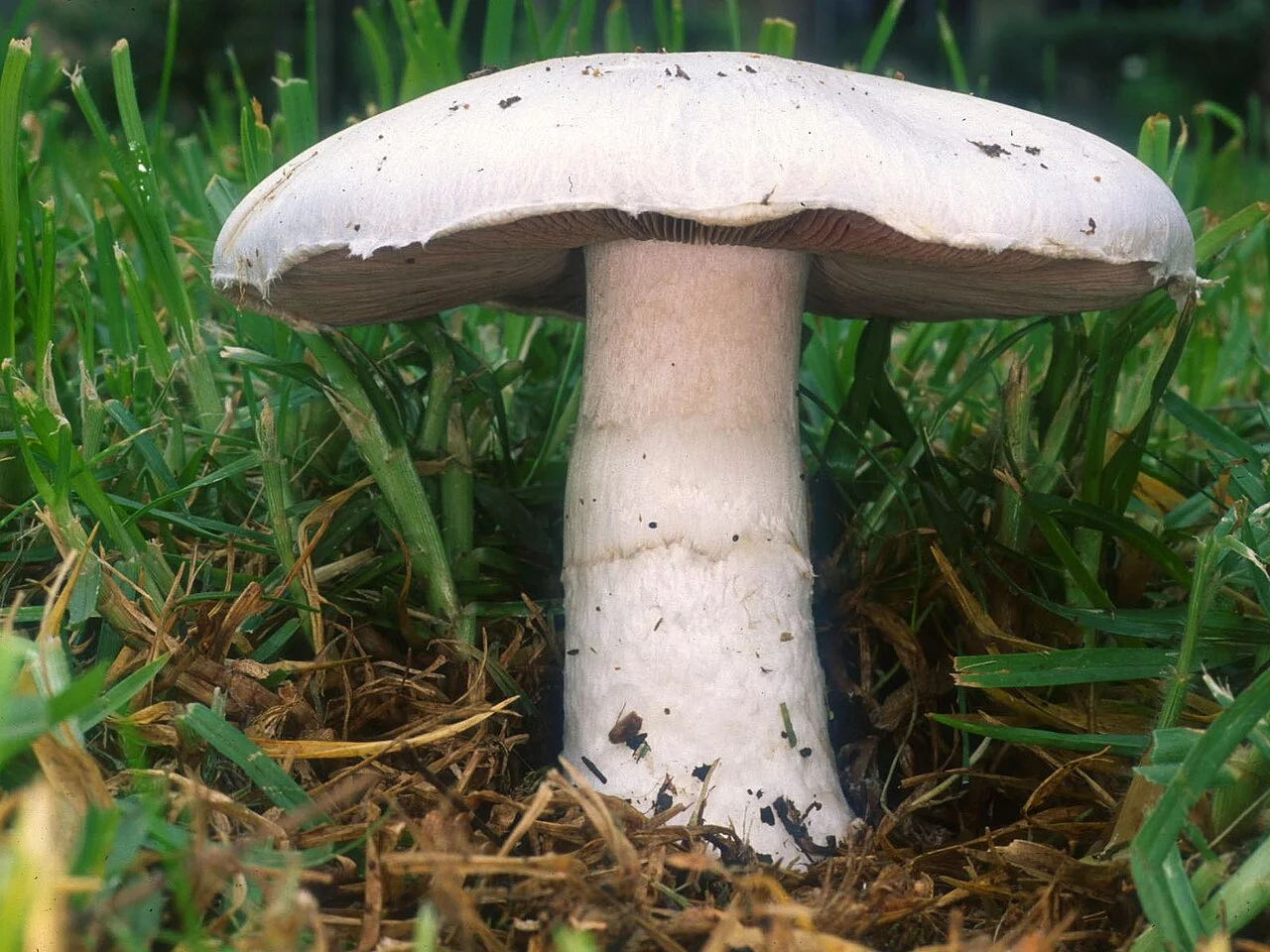 Edible
| Scientific name | Agaricus campestris |
| Family | Agaricaceae |
| Portuguese name | Rosa-dos-prados, Cogumelo-do-campo, Cogumelo-silvestre |
| English name | Field mushroom, Meadow mushroom |
| Season | September, October, November |
| Habitat | Meadow, Pasture |
| Look-alikes | Death Cap, Yellow-Staining Mushroom |
Description
Agaricus campestris (field mushroom, meadow mushroom) is one of the best-known edible mushrooms, a close relative of the cultivated button mushroom (Agaricus bisporus). It grows in meadows, pastures, and parks. Despite its popularity, it requires careful identification, as young specimens may be confused with the death cap.
Cap
- Diameter: 3–10 cm
- Shape: hemispherical when young, later convex, then flattened
- Colour: white, sometimes with a cream or brownish tinge, with fine silky scales
- Surface: dry, silky-fibrous
- Margin: with remnants of the partial veil when young
Stem
- Height: 3–10 cm
- Width: 1–2 cm
- Colour: white
- Ring: thin, white, ephemeral (often disappears in mature specimens)
- Volva: ABSENT — the key difference from the death cap
- Base: even, without swelling or sac-like wrapper
Flesh
- Colour: white, turns pink when cut (especially in the cap) — an important diagnostic feature
- Smell: pleasant, mushroomy (with an anise note)
- Taste: mild, pleasant
Spore print
Dark brown to chocolate — the key difference from the death cap (white spore print).
Gills
- Colour: changes with age — another critical diagnostic feature:
- Young: pink → middle-aged: brown → mature: dark chocolate
- Attachment: free (not attached to the stem)
- Spacing: crowded, thin
Where and when
Season in Portugal
- Main season: September–November
- Appears after autumn rains
- Occasionally a spring season (March–May) on irrigated meadows
Habitats in Portugal
- Meadows and pastures — primary habitat
- Parks and gardens — on lawns
- Roadsides (collection not recommended — heavy metal accumulation)
- Grazed fields — often on well-manured areas
- Saprotroph — does not form mycorrhiza, grows on organic-rich soils
Ecology
Prefers open, well-lit locations. Unlike many forest mushrooms, the field mushroom does not grow in forests but occurs in open spaces.
Look-alikes
Comparison with the death cap
| Feature | Field mushroom | Death cap |
|---|---|---|
| Gills | Pink → brown → chocolate | White (always!) |
| Spore print | Dark brown | White |
| Volva | ABSENT | Sac-like white wrapper at the base |
| Ring | Thin, ephemeral | Membranous, persistent |
| Cap | White, silky | Pale green to olive |
| Flesh when cut | Turns pink | Remains white |
| Habitat | Meadows, pastures, parks | Forests (under oaks, chestnuts) |
| Smell | Pleasant, mushroomy | Faint; sickly sweet when old |
Other look-alikes
| Species | How to distinguish |
|---|---|
| Yellow-staining mushroom (Agaricus xanthodermus) | Flesh turns bright yellow when cut (especially at the stem base). Unpleasant “inky” or “phenolic” smell. Poisonous (causes GI upset) |
| Wood mushroom (Agaricus silvicola) | Edible. Grows in forests (not meadows). Flesh may slightly yellow, but smell is pleasant, anise-like |
| Livid pinkgill (Entoloma sinuatum) | Spore print pink. Larger. Grows in forests |
Rules for safe field mushroom collecting
- Always dig up the entire mushroom — check for the absence of a volva at the base
- Check gill colour — in field mushrooms they are pink/brown, NEVER white
- Check flesh colour when cut — field mushroom turns pink; death cap does not
- Do not collect in forests — field mushrooms grow in open spaces
- When in any doubt — do not take the mushroom
Culinary use
The field mushroom is an excellent table mushroom with a delicate flavour similar to the cultivated button mushroom.
Preparation methods
- Frying — the most common method
- Soups and sauces — creamy mushroom soups
- Mushroom fillings — for pies, crepes, casseroles
- Pickling — young specimens with closed caps
- Raw — young specimens can be used in salads (unlike most wild mushrooms)
Notes
- Young specimens with closed caps and pink gills are the most prized
- Older specimens with dark gills — coarser flavour but still usable
- Do not collect near roads, industrial zones, or treated fields
Image sources
- agaricus-campestris.webp — Field mushroom (Agaricus campestris). Author: Wikimedia Commons. License: CC BY-SA 3.0. Source
See Also
Habitats:
Related articles:
Sources
- Museu Virtual da Biodiversidade — Universidade de Évora
- BioDiversity4All / GBIF Portugal — species records
- Sociedade Portuguesa de Micologia
- ASAE — Consumo de Cogumelos Silvestres
- Fungipedia Portugal — Agaricus campestris
Disclaimer: Identifying mushrooms from descriptions and photographs on the internet is not a substitute for consulting an experienced mycologist. The authors assume no responsibility for the consequences of collecting and consuming mushrooms. If you suspect mushroom poisoning, call 112 immediately.
All our knowledge is free. Creating it is not.
☕ Support on Ko-fi