Yellow-Staining Mushroom
 Toxic
Toxic| Scientific name | Agaricus xanthodermus |
| Family | Agaricaceae |
| Portuguese name | Cogumelo-amarelecente |
| English name | Yellow-staining mushroom |
| Season | September, October, November |
| Habitat | Meadow, Pasture, Mixed forest |
| Look-alikes | Field Mushroom, Parasol Mushroom |
Description
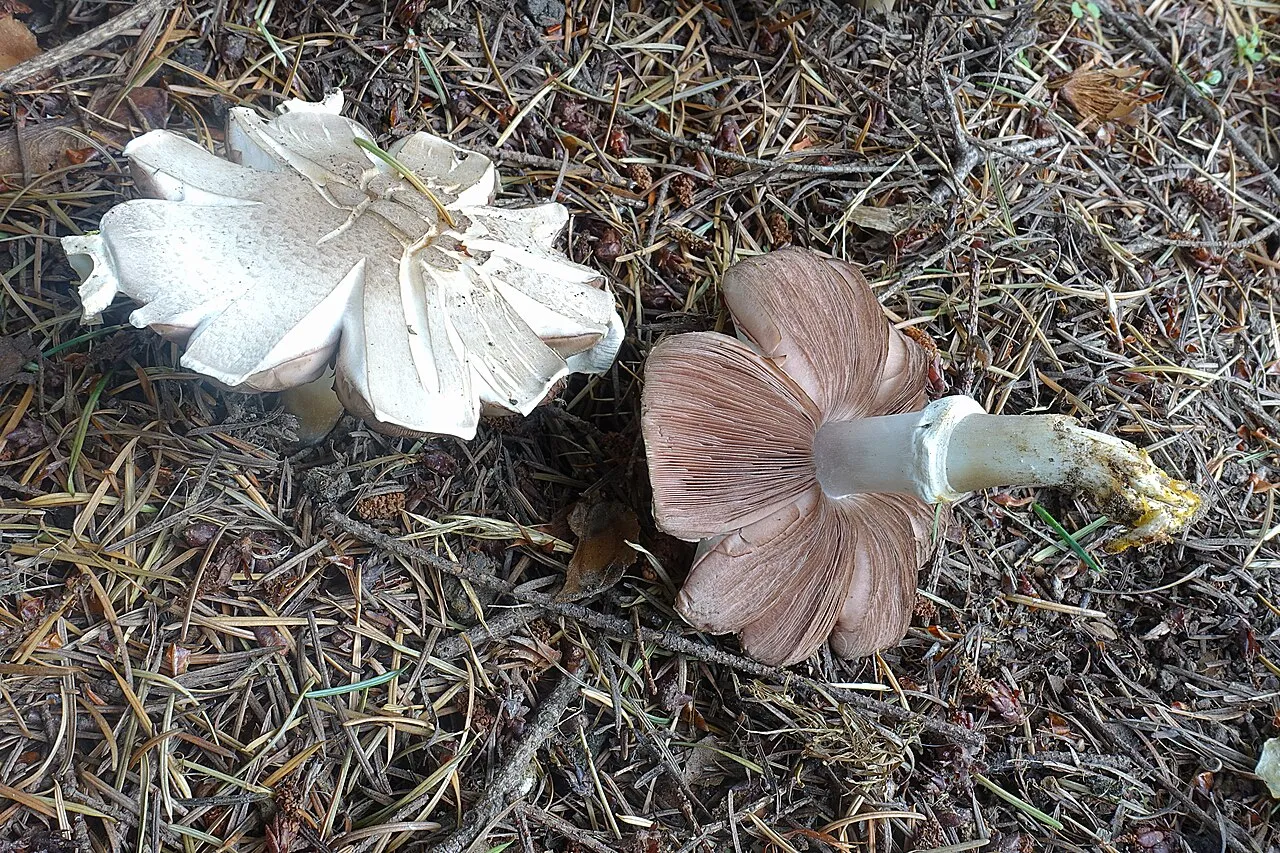
Agaricus xanthodermus (yellow-staining mushroom) is a poisonous species of Agaricus, responsible for the greatest number of mushroom poisonings in Western Europe. It resembles edible Agaricus species but is distinguished by the bright chrome-yellow staining of its flesh when damaged and its unpleasant phenolic (inky) smell.
Described by Joseph-Henri Léveillé in 1855. The species name xanthodermus comes from Greek ξανθός (yellow) + δέρμα (skin).
Cap
- Diameter: 5–15 cm
- Shape: hemispherical, then convex, often with an angular profile (trapezoid in cross-section)
- Colour: white, sometimes with a greyish-brown tinge in the centre
- Key feature: when damaged or pressed, the flesh turns bright chrome-yellow
Gills
- Young: pink
- Mature: dark brown to chocolate
- Attachment: free
Stem
- Height: 5–15 cm
- Width: 1–2.5 cm
- Colour: white
- Ring: double, persistent
- Key feature: when cut, the flesh at the stem base instantly turns chrome-yellow
Flesh
- Colour: white; when damaged — bright chrome-yellow (especially at the stem base and cap surface)
- Smell: unpleasant, phenolic (inky, “carbolic”, like printer’s ink) — intensifies when cooked
- Taste: unpleasant
Spore print
Dark brown.
Where and when
Season in Portugal
- Main season: September–November
- One of the most common Agaricus species in Portugal
Habitats in Portugal
- Meadows and pastures — alongside edible field mushrooms
- Parks, gardens, lawns — an urban saprotroph
- Forest edges — on organic-rich soils
- Mixed forests — less typical but encountered
- Saprotroph — does not form mycorrhiza
Look-alikes
Comparison with edible species
| Feature | Yellow-staining mushroom | Field mushroom |
|---|---|---|
| Flesh when cut | Bright chrome-yellow | Turns pink |
| Smell | Phenolic, inky | Pleasant, mushroomy/anise |
| Cap profile | Angular (trapezoid) | Rounded |
| When cooked | Smell intensifies | Smell pleasant |
Testing rules
- Press your fingernail into the cap — the yellow-staining mushroom instantly develops a chrome-yellow spot
- Cut the stem base — the flesh turns bright yellow
- Smell the cut — the smell is phenolic, unpleasant
- If any test is positive — do not collect the mushroom
Poisoning
Symptoms
- Nausea, vomiting, diarrhoea
- Abdominal cramps
- Sweating
- Symptoms appear within 1–3 hours of consumption
- Duration: 24–48 hours
First aid
- Call 112 or CIAV (808 250 143)
- Do not induce vomiting
- Save remaining mushrooms for identification
- Drink water in small sips
Prognosis
Poisoning is not fatal but extremely unpleasant. Recovery is usually complete.
See Also
Safety:
Related articles:
Image sources
- agaricus-xanthodermus.webp — Yellow-staining mushroom (Agaricus xanthodermus). Author: Strobilomyces. License: CC BY-SA 3.0. Source
Sources
- Léveillé J.H. — description of Agaricus xanthodermus (1855)
- Beug M.W. et al. — Mushroom Poisoning in the Pacific Northwest (2006)
- BioDiversity4All / GBIF Portugal — occurrence records
- CIAV (Centro de Informação Antivenenos) — mushroom poisoning statistics
- First-Nature — Agaricus xanthodermus, Yellow-staining Mushroom
Disclaimer: Identifying mushrooms from descriptions and photographs on the internet is not a substitute for consulting an experienced mycologist. The authors assume no responsibility for the consequences of collecting and consuming mushrooms. If you suspect mushroom poisoning, call 112 immediately.
The light is on for free. But someone has to clean the lantern.
☕ Support on Ko-fi