Caesar's Mushroom
 Edible
| Scientific name | Amanita caesarea |
| Family | Amanitaceae |
| Portuguese name | Amanita-dos-césares, Laranjinha |
| English name | Caesar's mushroom |
| Season | September, October, November |
| Habitat | Oak forest, Cork oak, Chestnut forest, Montado |
| Look-alikes | Fly Agaric, Death Cap |
Description
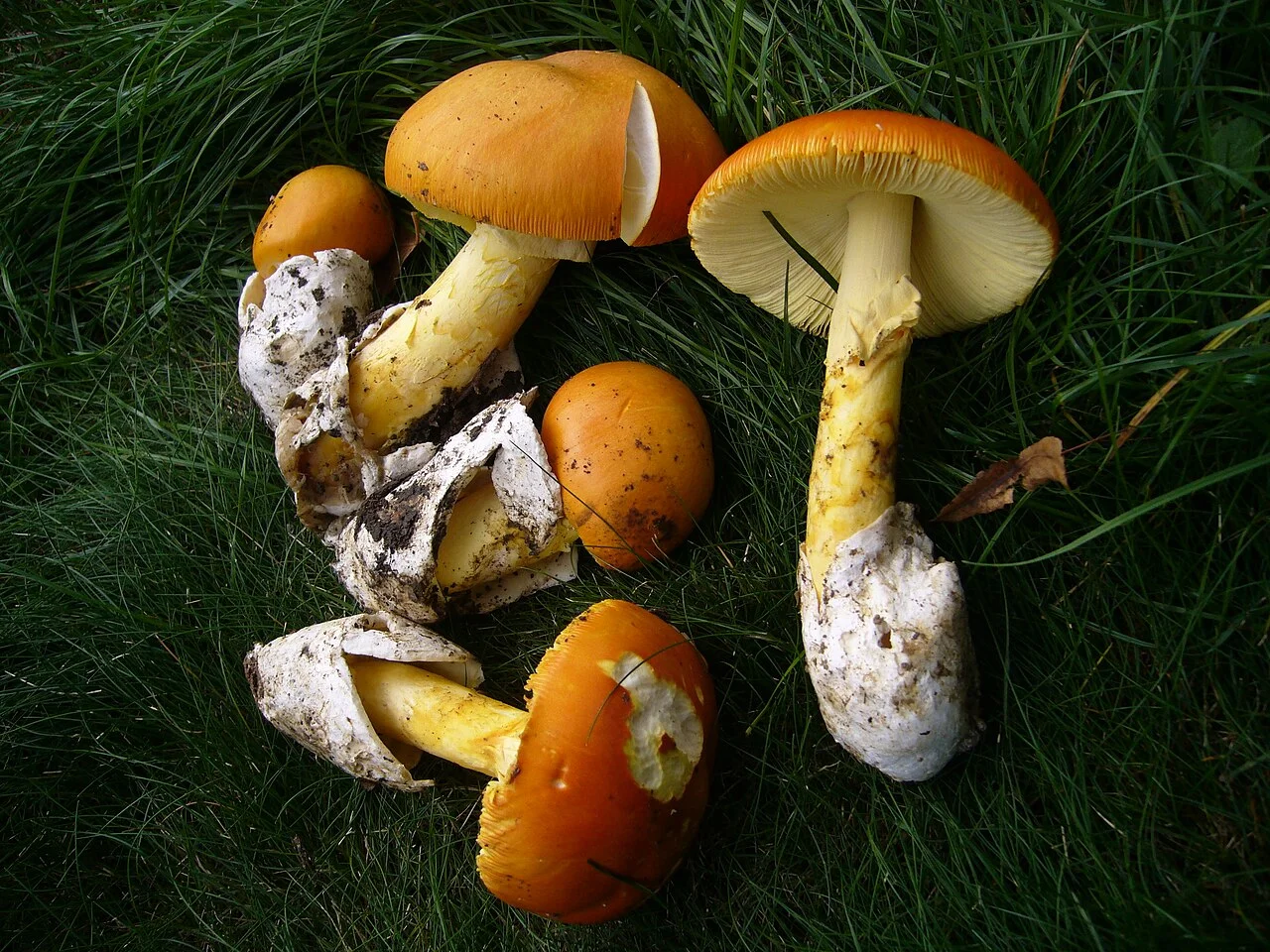
Amanita caesarea (Caesar’s mushroom) is one of the most prized and expensive edible mushrooms of the Mediterranean. Known since the Roman Empire — the mushroom is said to have been a favourite dish of the Roman caesars (hence the name). In Portugal it is known as “amanita-dos-césares” and affectionately “laranjinha” (little orange — after the colour of the cap).
Cap
- Diameter: 8–20 cm
- Shape: hemispherical when young, later convex, then flat
- Colour: bright orange, from yellow-orange to red-orange
- Surface: smooth, without white warts (unlike the fly agaric)
- Margin: striate (with radial grooves) — an important distinguishing feature
Stem
- Height: 8–15 cm
- Width: 2–3 cm
- Colour: yellow — a key difference from poisonous Amanita species (which have white stems!)
- Ring: yellow, pendant, in the upper part of the stem
- Volva: large, sac-like, white, free at the base — a remnant of the universal veil
- Surface: smooth, yellow
Flesh
- Colour: white, yellow beneath the cuticle
- Smell: pleasant, faint
- Taste: mild, delicate
Gills
- Colour: yellow (not white!) — the most important diagnostic feature
- Attachment: free
- Spacing: crowded
Spore print
White to pale yellow.
The “egg” stage
Caesar’s mushroom develops from a white “egg” — a spherical body covered by the universal veil (volva). When the “egg” ruptures, the orange cap emerges. At this stage, the mushroom can be confused with the death cap.
Where and when
Season in Portugal
- Main season: September–November
- Prefers warm autumn — appears after rains when temperatures are above 15°C
- A typical thermophilic (warmth-loving) species
Habitats in Portugal
- Montado — under cork oak (Quercus suber) — main habitat in Portugal
- Oak forests — under holm oak (Quercus ilex)
- Chestnut forests — in Trás-os-Montes
- Forms ectomycorrhiza with broadleaf trees
- A Mediterranean species — Portugal lies within its optimal climate zone
- Found from central to southern Portugal
- Prefers acidic soils, warm sunny slopes
Economic importance
Caesar’s mushroom is one of the most expensive wild mushrooms. Prices on European markets can reach 50–100 EUR/kg. In Portugal it is collected for local consumption and sale to restaurants.
Look-alikes
| Feature | Caesar’s mushroom | Fly agaric | Death cap |
|---|---|---|---|
| Gills | YELLOW | White | White |
| Stem | YELLOW | White | White (greenish tinge) |
| Volva | White sac | Warty scales | White sac |
| Cap | Orange, smooth | Red with white warts | Greenish to white |
| Cap margin | Striate | Slightly striate | Smooth |
| Ring | Yellow | White | White |
Three golden rules
- Yellow gills — Caesar’s always has yellow gills; poisonous Amanita species have white
- Yellow stem — Caesar’s has a yellow stem; poisonous Amanita species have white
- Sac-like volva — a complete white sac at the base
If any of these features does not match — do not collect the mushroom.
Culinary use
Caesar’s mushroom is a delicacy of the highest order in Mediterranean cuisine.
Preparation methods
- Raw — thinly sliced young caps in salads with olive oil, lemon juice and Parmesan. The classic Italian recipe
- Pan-frying — in olive oil with garlic
- Grilling — whole caps on the grill
- With pasta — sliced in risotto or pasta
Notes
- One of the few mushrooms traditionally eaten raw
- Young specimens with firm flesh are the most prized
- The delicate flavour is lost with excessive cooking — minimal preparation is best
Image sources
- amanita-caesarea.webp — Caesar’s mushroom (Amanita caesarea). Author: Yaqui. License: CC BY-SA 3.0. Source
See Also
Habitats:
Related articles:
Sources
- Fungipedia Portugal — Amanita caesarea
- Naturdata — Amanita caesarea em Portugal
- BioDiversity4All / GBIF Portugal — species records
- First-Nature — Amanita caesarea identification
- Museu Virtual da Biodiversidade — Universidade de Évora
Disclaimer: Identifying mushrooms from descriptions and photographs on the internet is not a substitute for consulting an experienced mycologist. The authors assume no responsibility for the consequences of collecting and consuming mushrooms.
All our knowledge is free. Creating it is not.
☕ Support on Ko-fi