Fly Agaric
 Toxic
Toxic| Scientific name | Amanita muscaria |
| Family | Amanitaceae |
| Portuguese name | Agário-das-moscas, Mata-moscas, Mata-bois |
| English name | Fly agaric |
| Season | September, October, November, December |
| Habitat | Pine forest, Mixed forest, Eucalyptus |
| Look-alikes | Caesar's Mushroom |
Description
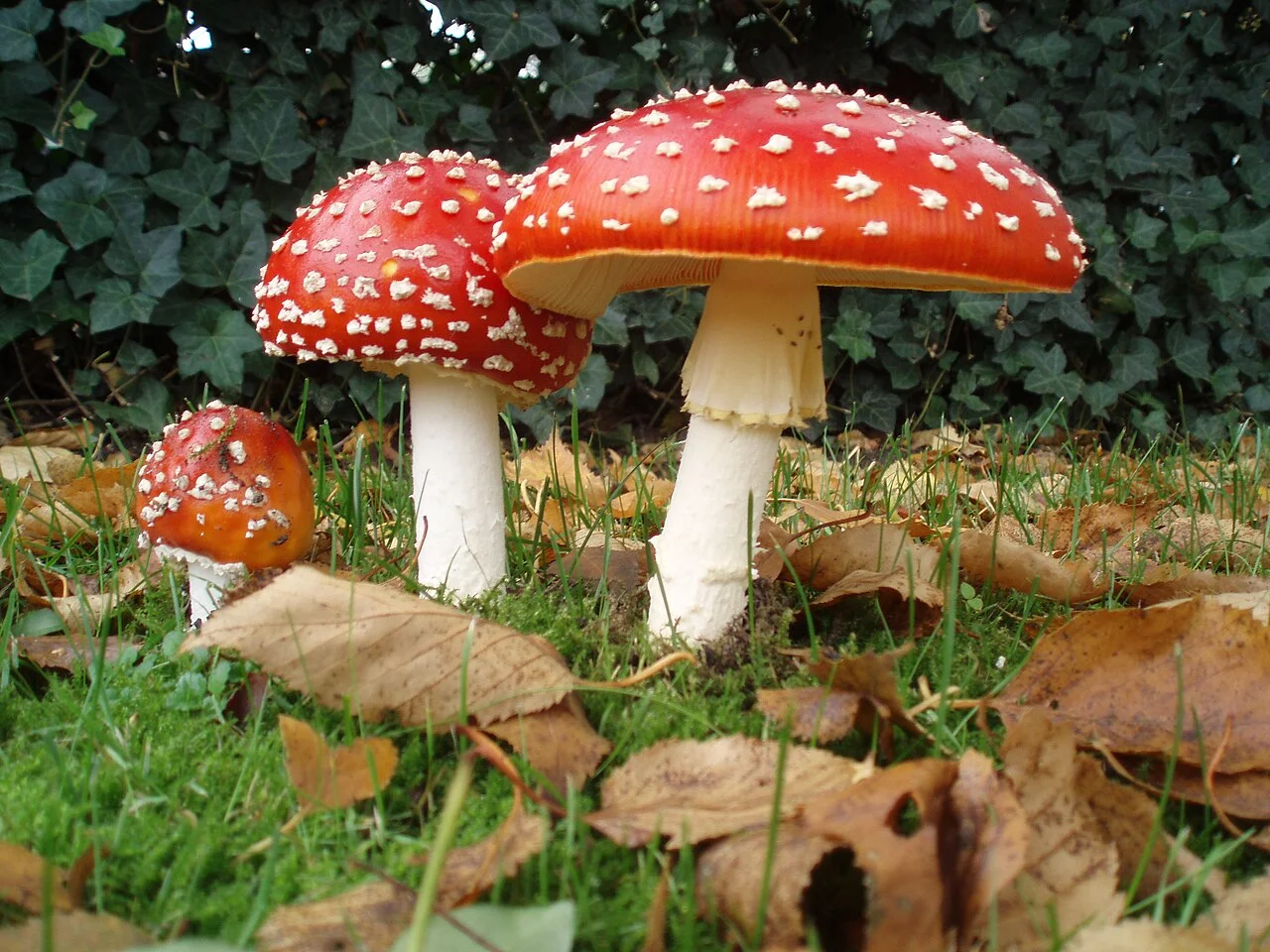
Amanita muscaria (fly agaric) is perhaps the most recognisable mushroom in the world. Its bright red cap with white spots has become a cultural icon, adorning fairy tales and video games. Yet behind the attractive appearance lies a seriously poisonous fungus containing neurotoxins.
Cap
- Diameter: 8–20 cm
- Shape: hemispherical when young, later convex, then flattened
- Colour: bright red, orange-red. May fade to orange with age
- Surface: covered with white warts (remnants of the universal veil). Warning: after rain, warts may be washed off, making the mushroom resemble Caesar’s mushroom
- Margin: slightly striate in mature specimens
Stem
- Height: 10–25 cm
- Width: 1.5–3 cm
- Colour: white
- Ring: white, pendant, in the upper part of the stem
- Volva: warty, not sac-like — remnants as concentric rows of scales around the swollen base
- Base: bulbous
Flesh
- Colour: white; orange beneath the cap skin
- Smell: faint, unremarkable
- Taste: do not taste!
Spore print
White.
Toxicity
Toxins
- Ibotenic acid — NMDA glutamate receptor agonist (excitatory neurotoxin)
- Muscimol — potent GABA-A receptor agonist (neuronal depressant)
- Muscarine is present only in trace amounts and plays no significant role (contrary to popular myth)
Mechanism: upon drying, ibotenic acid undergoes decarboxylation to muscimol (5–10 times more potent). Ibotenic acid causes CNS excitation; muscimol causes CNS depression.
Poisoning symptoms
| Parameter | Description |
|---|---|
| Onset | 30 minutes – 2 hours after ingestion |
| Peak | 1–3 hours |
| Duration | 4–8 hours (full recovery — 5–24 hours) |
Manifestations:
- Nausea, vomiting, dizziness
- Drowsiness, confusion
- Visual and auditory hallucinations
- Euphoria or dysphoria
- Ataxia (loss of coordination)
- Myoclonic jerks, seizures
- In severe cases — coma
Fatality: extremely rare with timely medical care. The main dangers are injuries during disorientation and seizures, and aspiration of vomit.
Where and when
Season
- Main season: September–December
- Mass fruiting after autumn rains
Habitats in Portugal
- Throughout continental Portugal, from north to south
- Pine forests — primary habitat
- Mixed forests — with birch, oaks
- Eucalyptus plantations
- Forms ectomycorrhiza primarily with conifers
- Documented in Arouca Geopark and many other locations
Ecology
Cosmopolitan species — found on every continent except Antarctica. In Portugal — one of the most common Amanita species.
Look-alikes
| Species | Difference from fly agaric |
|---|---|
| Caesar’s mushroom (Amanita caesarea) | Gills and stem yellow (not white!). Volva is a complete white sac (not scales). Cap orange without warts |
| Panther cap (Amanita pantherina) | Cap brown (not red). More toxic! |
Safety rule
If a mushroom cap lacks white warts (washed off by rain) — be particularly cautious. Check the colour of the gills and stem: in fly agaric they are white; in Caesar’s mushroom they are yellow.
Cultural significance
The fly agaric is one of the few mushrooms to become a cultural symbol, from Christmas cards to video games. Historically used as:
- Insecticide — hence the name “fly agaric” (port. mata-moscas — “fly killer”)
- Entheogen — in shamanic practices of Siberian peoples
Image sources
- amanita-muscaria.webp — Fly agaric (Amanita muscaria). Author: Onderwijsgek. License: CC BY-SA 3.0 NL. Source
See Also
Habitats:
Related articles:
Sources
- Michelot D., Melendez-Howell L.M. — Amanita muscaria: chemistry, biology, toxicology, and ethnomycology // Mycological Research, 2003
- CDC MMWR — Acute Intoxications from Amanita muscaria, 2019
- Naturdata — registos de Amanita muscaria em Portugal
- Arouca Geopark — Amanita muscaria biodiversity record
- Museu Virtual da Biodiversidade — Universidade de Évora
- BioDiversity4All / GBIF Portugal — species records
Disclaimer: Identifying mushrooms from descriptions and photographs on the internet is not a substitute for consulting an experienced mycologist. The authors assume no responsibility for the consequences of collecting and consuming mushrooms.
All our knowledge is free. Creating it is not.
☕ Support on Ko-fi