Panther Cap
 Toxic
Toxic| Scientific name | Amanita pantherina |
| Family | Amanitaceae |
| Portuguese name | Amanita-pantera, Pantera |
| English name | Panther cap |
| Season | August, September, October, November |
| Habitat | Pine forest, Cork oak, Mixed forest |
| Look-alikes | Fly Agaric |
Description
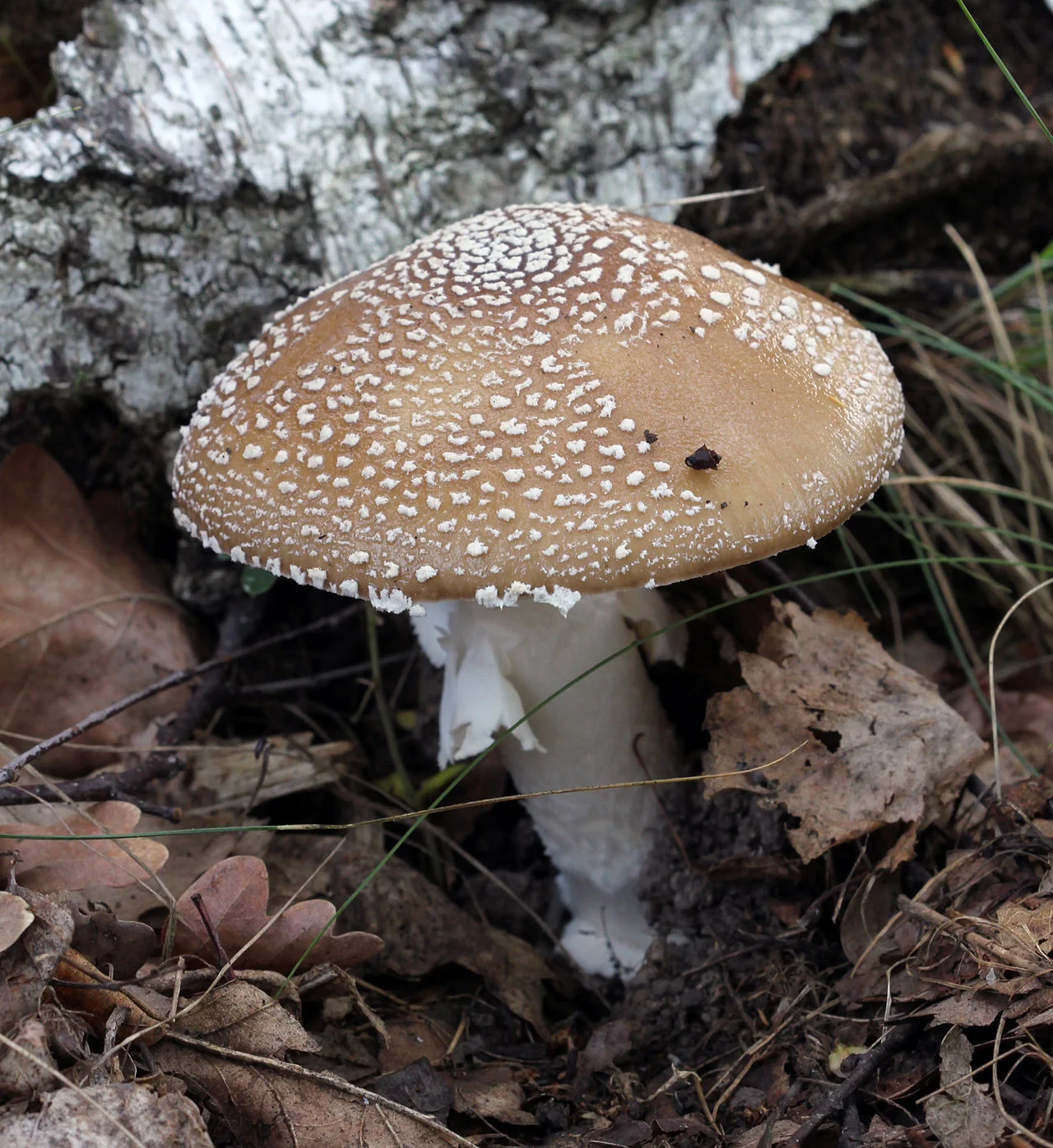
Amanita pantherina (panther cap) is a seriously poisonous mushroom that is often underestimated. Less visually striking than the fly agaric, it is more dangerous in practice — it is more frequently confused with edible species. Its neurotoxin content exceeds that of the fly agaric, leading to more severe poisonings.
Cap
- Diameter: 5–12 cm
- Shape: hemispherical when young, later convex to flattened
- Colour: dark brown, olive-brown, greyish-brown
- Surface: covered with small, pure white warts (unlike the greyish scales of the blusher)
- Margin: striate (grooved) — important identifying feature
Stem
- Height: 6–12 cm
- Width: 1–2 cm
- Colour: white
- Ring: white, smooth (without striations), positioned low on the stem
- Base: with a bulbous swelling and a characteristic “gutter” (marginate bulb) — a ring-like groove at the very base
- Volva: attached, as 1–2 rows of scales around the swollen base
Flesh
- Colour: white, does not change colour when damaged — key difference from the blusher
- Smell: faint, unremarkable
- Taste: do not taste!
Spore print
White.
Toxicity
Toxins
- Ibotenic acid — NMDA receptor agonist
- Muscimol — GABA-A receptor agonist
Toxin concentrations are up to 5 times higher than in Amanita muscaria, resulting in more severe poisonings.
Poisoning symptoms
| Parameter | Description |
|---|---|
| Onset | 30 minutes – 3 hours after ingestion |
| Peak | 1–3 hours |
| Duration | 4–12 hours |
Manifestations:
- Confusion, dizziness
- Visual and auditory hallucinations
- Muscle twitching, tremor
- Nausea, vomiting
- Seizures, in severe cases — deep coma
- Muscular hypotonia, hyporeflexia
- Possible respiratory depression
Fatality: rare but documented. A case of refractory status epilepticus with fatal outcome has been described. Particularly dangerous for children and the elderly.
Where and when
Season
- Main season: August–November
- Fruits after rains, often somewhat earlier than the fly agaric
Habitats in Portugal
- Throughout the country, from north to south
- Pine forests — most characteristic habitat
- Cork oak forests — documented in southwestern Portugal (Aljezur area)
- Mixed forests
- Forms ectomycorrhiza with both conifers and broadleaf trees
- Documented in natural parks: Alentejo SW and Costa Vicentina, Sado Estuary, Peneda-Gerês, Serra de São Mamede, Montesinho, Vale do Guadiana
Look-alikes
| Species | How to distinguish |
|---|---|
| Blusher (Amanita rubescens) | Reddens/pinkens when flesh is damaged (panther cap does NOT redden). Ring is striate (panther cap’s ring is smooth). Warts are greyish (panther cap’s are pure white) |
| Fly agaric (Amanita muscaria) | Cap red (not brown). Less toxic |
| Grey-spotted amanita (Amanita excelsa) | Warts grey, not white. No pronounced “gutter” at the base of the stem |
Key rule
If the mushroom flesh does not redden when damaged — it is NOT a blusher. Do not collect it.
Image sources
- amanita-pantherina.webp — Panther cap (Amanita pantherina). Author: George Chernilevsky. License: Public domain. Source
See Also
Habitats:
Related articles:
Sources
- Satora L. et al. — Panther cap Amanita pantherina poisoning case report and review // Toxicon, 2005
- Museu Virtual da Biodiversidade — Universidade de Évora
- Fungipedia Portugal — Amanita pantherina
- GBIF / BioDiversity4All — species records for Portugal
- First-Nature — Amanita pantherina identification
Disclaimer: Identifying mushrooms from descriptions and photographs on the internet is not a substitute for consulting an experienced mycologist. The authors assume no responsibility for the consequences of collecting and consuming mushrooms.
The light is on for free. But someone has to clean the lantern.
☕ Support on Ko-fi