Death Cap
 Deadly
| Scientific name | Amanita phalloides |
| Family | Amanitaceae |
| Portuguese name | Cicuta-verde, Chapéu-da-morte, Rebenta-bois |
| English name | Death cap |
| Season | September, October, November, December |
| Habitat | Oak forest, Cork oak, Chestnut forest, Mixed forest |
| Look-alikes | Field Mushroom, Caesar's Mushroom, Russula virescens |
Description
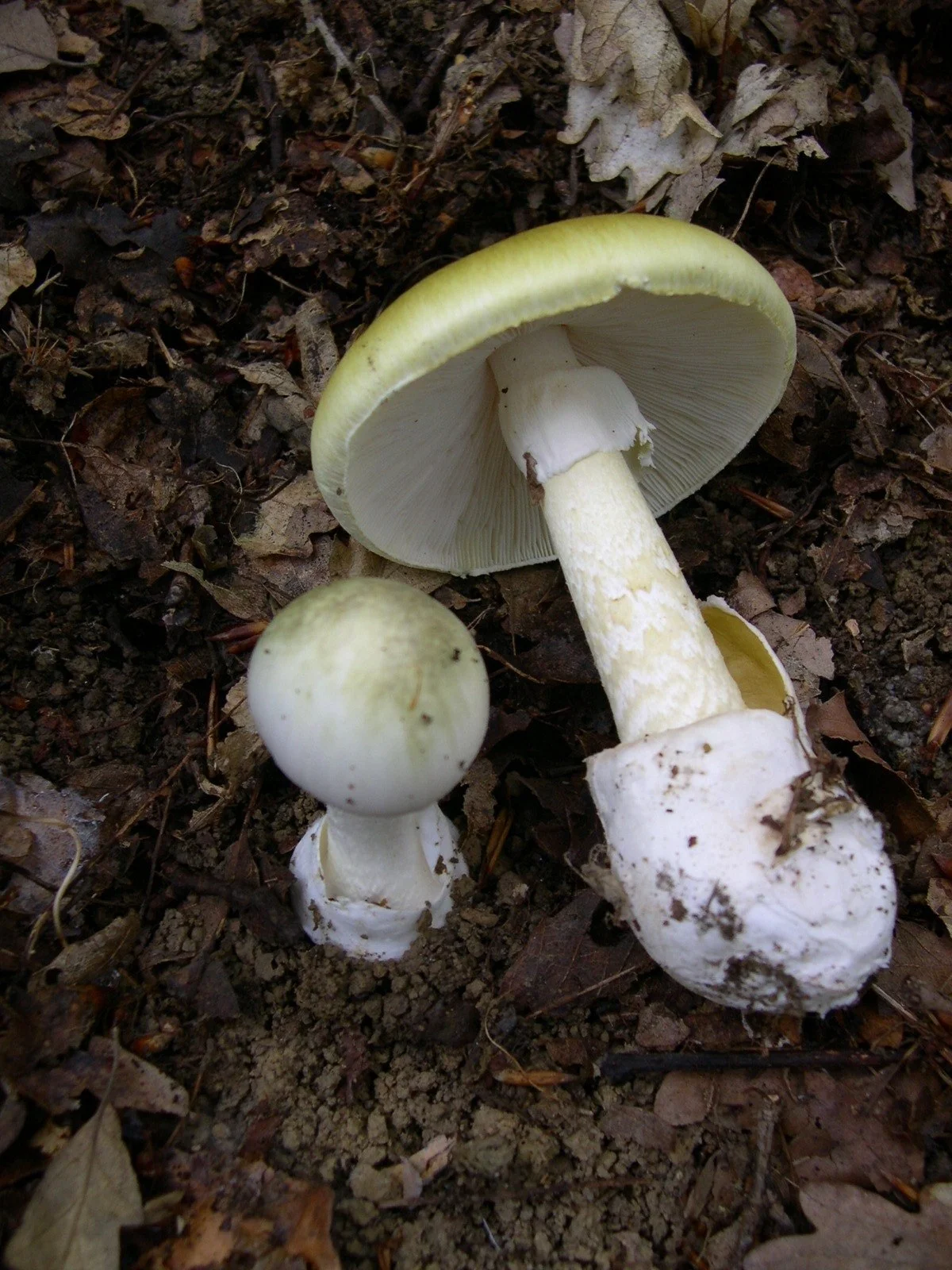
Amanita phalloides (death cap) is the deadliest mushroom in the world, responsible for over 90% of all fatal mushroom poisonings in Europe. It is widespread throughout Portugal. The fruiting body is medium to large, with a characteristic pale green or olive cap, white gills, and a sac-like volva at the base of the stem.
Cap
- Diameter: 5–15 cm
- Shape: hemispherical when young, later convex to flattened
- Colour: pale green to olive-yellow, sometimes almost white. Uneven colouration with radial fibres
- Surface: smooth, slightly sticky in wet weather
- Margin: smooth, without striations
Stem
- Height: 8–15 cm
- Width: 1–2.5 cm
- Colour: white or with a faint greenish tinge
- Ring: white, membranous, in the upper part of the stem
- Volva: sac-like, white, at the base of the stem — key identifying feature. Often hidden in the soil
- Surface: with a moiré (zigzag) pattern
Flesh
- Colour: white, no colour change when cut
- Smell: faint and neutral in young specimens; unpleasant and sickly sweet in older ones (described as “honey-like” or “rose-like”)
- Taste: pleasant, which makes this mushroom particularly dangerous — poisoning occurs unnoticed
Spore print
White.
Toxicity
Toxins
- Amatoxins (primarily α-amanitin) — heat-stable, not destroyed by boiling, frying, drying, pickling, or freezing
- Phallotoxins — damage hepatocyte membranes
- Virotoxins — less significant, poorly absorbed from the GI tract
Mechanism of action: α-amanitin inhibits RNA polymerase II, blocking mRNA synthesis. This halts protein production and leads to cell death. Primary target — the liver (hepatocytes); kidneys are also affected.
Phases of poisoning
| Phase | Time | Symptoms |
|---|---|---|
| 1. Latent | 6–24 h | Asymptomatic. Toxins are already being absorbed |
| 2. Gastrointestinal | 6–24 h | Sudden severe vomiting, profuse watery diarrhoea, abdominal cramps, dehydration |
| 3. False recovery | 24–72 h | Symptoms subside. Patient feels better, but toxins continue destroying the liver |
| 4. Liver failure | 3–5 days | Jaundice, coagulopathy, encephalopathy, multi-organ failure |
Mortality: 10–20% with modern treatment. Without treatment — up to 50–90%. In fatal cases, death occurs within 7–10 days.
Treatment
There is no specific antidote. Treatment is supportive:
- Activated charcoal (if early presentation)
- N-acetylcysteine (liver protection)
- Penicillin G in high doses (competes with hepatic uptake of amatoxins)
- Silibinin (hepatoprotective)
- For fulminant liver failure — liver transplantation
In 2023, researchers (Nature Communications) discovered a potential antidote — indocyanine green (ICG), an STT3B inhibitor that doubled survival rates in mouse experiments, though it remains at the research stage.
Where and when
Season
- Main season: October–December
- Onset: sometimes from late September, after the first autumn rains
- Mass fruiting after warm, abundant rains
Habitats in Portugal
- Throughout the country, from north to south, coast to interior
- Oak forests — under holm oak (Quercus ilex), cork oak (Quercus suber)
- Chestnut forests — especially in Trás-os-Montes
- Mixed forests — with beech, hornbeam
- Parks and gardens — may appear in cultivated landscapes with imported trees
- Forms ectomycorrhiza with broadleaf trees
Ecology
The species continues to expand its range — it has been introduced to Australia, North and South America, and South Africa via tree saplings.
Look-alikes
Common confusions
| Species | Difference from death cap |
|---|---|
| Field mushroom (Agaricus campestris) | Gills pink → brown (not white!). No volva |
| Caesar’s mushroom (Amanita caesarea) | Gills and stem yellow (not white). More vivid orange cap |
| Green-cracking russula (Russula virescens) | No ring or volva. Brittle gills. Cap with fine cracks |
| Paddy straw mushroom (Volvariella volvacea) | Pink gills when mature. Common cause of poisoning in Asian communities |
| False death cap (Amanita citrina) | Smell of raw potatoes. Volva closely attached, not sac-like |
Safety rule
Always dig up the entire mushroom — the volva may be hidden underground. The volva is the key distinguishing feature of the death cap.
Poisoning cases in Portugal
- According to CIAV, the death cap is the cause of most severe mushroom poisonings in Portugal
- Immigrants and tourists are at greatest risk, confusing local species with mushrooms from their home countries
- According to a study in Acta Medica Portuguesa (1990–2008): of 93 mushroom poisoning cases, 63.4% involved hepatotoxic syndrome (amatoxins), with a mortality rate of 11.8%
Image sources
- amanita-phalloides.webp — Death cap (Amanita phalloides) — deadly poisonous mushroom. Author: Archenzo. License: CC BY-SA 3.0. Source
See Also
Habitats:
Related articles:
Sources
- Wang Q. et al. — Identification of indocyanine green as a STT3B inhibitor against mushroom α-amanitin cytotoxicity // Nature Communications, 2023
- Brandão J.L. et al. — Intoxicação por cogumelos em Portugal // Acta Medica Portuguesa, 2011
- Garcia J. et al. — Amatoxins and phallotoxins in Amanita phalloides from northeastern Portugal // Toxicology, 2015
- CIAV — Centro de Informação Antivenenos, INEM Portugal
- Museu Virtual da Biodiversidade — Universidade de Évora
- BioDiversity4All / GBIF Portugal — species records
- Sociedade Portuguesa de Micologia
Disclaimer: Identifying mushrooms from descriptions and photographs on the internet is not a substitute for consulting an experienced mycologist. The authors assume no responsibility for the consequences of collecting and consuming mushrooms. If you suspect mushroom poisoning, call 112 immediately.
The light is on for free. But someone has to clean the lantern.
☕ Support on Ko-fi