Honey Fungus
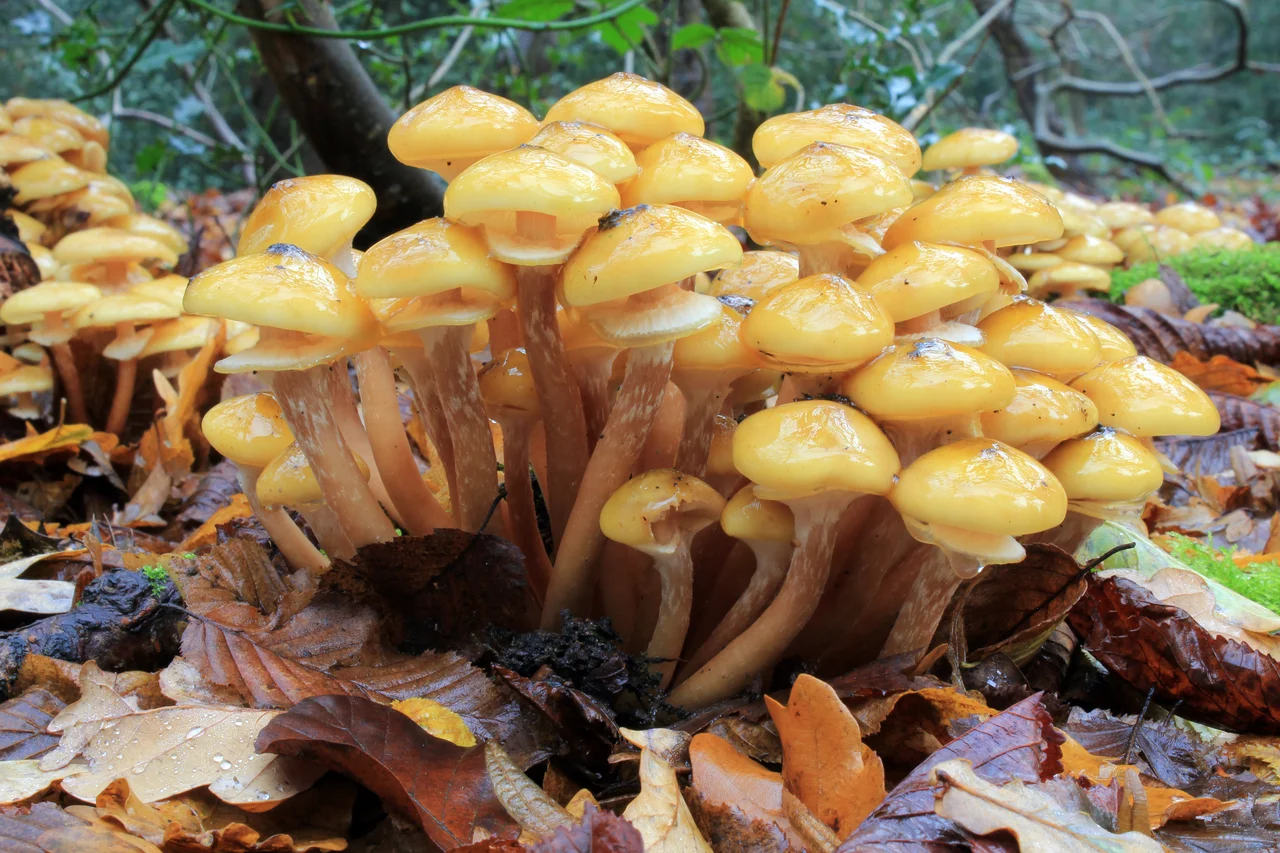 Conditionally edible
| Scientific name | Armillaria mellea |
| Family | Physalacriaceae |
| Portuguese name | Armilária-cor-de-mel, Cogumelo-de-mel |
| English name | Honey fungus |
| Season | October, November, December |
| Habitat | Oak forest, Cork oak, Pine forest, Eucalyptus, Mixed forest |
Description
Armillaria mellea (honey fungus) is one of the most widespread mushrooms in Portugal and across Europe. It grows in large clusters on tree trunks and at the base of trees. Besides its culinary value, the honey fungus is known as a serious phytopathogen — a parasite that causes root rot in trees.
Cap
- Diameter: 3–15 cm
- Shape: convex when young, later flattened, sometimes with a central umbo
- Colour: honey-yellow, ochre-brown (Latin mellea — “honey-coloured”)
- Surface: with small dark scales, especially in the centre
- Margin: thin, inrolled when young
Stem
- Height: 5–15 cm
- Width: 1–2 cm
- Colour: light in the upper part, darkening downwards
- Ring: well-developed, white, cottony — key identifying feature
- Surface: fibrous
- Base: often fused with stems of neighbouring mushrooms in the cluster
Flesh
- Colour: white
- Smell: pleasant, mushroomy
- Taste: mild (in caps); stems are tough and fibrous — unsuitable for eating
- Feature: stem flesh is firm, stringy
Spore print
White to cream.
Raw toxicity
- Contains thermolabile toxins that cause gastrointestinal upset
- Symptoms when eaten raw/undercooked: nausea, vomiting, diarrhoea, cramps
- Toxins are not amatoxins — no mortal danger
- Destroyed by boiling for 15–25 minutes
Where and when
Season in Portugal
- Main season: October–December
- Mass fruiting after autumn rains
- May fruit until January in mild winters
Habitats in Portugal
- Throughout continental Portugal — one of the most common mushrooms
- Documented in 7+ natural parks: Peneda-Gerês, Montesinho, Litoral Norte, Serra de São Mamede, SW Alentejano e Costa Vicentina, Reserva Natural do Estuário do Sado, Vale do Guadiana
- Oak forests — under cork oak and holm oak
- Pine forests — under maritime pine
- Eucalyptus plantations
- Grows in clusters on trunks, stumps, and tree roots
- May grow on buried roots (appearing to grow on soil)
Ecology: parasite and saprotroph
- Parasite: attacks living, weakened trees (drought, stress, other diseases)
- Saprotroph: decomposes dead wood
- Spreads via rhizomorphs — black, bootlace-like structures in the soil
- Causes growth decline, wood decay, and tree death
- Control is difficult: fungicides are largely ineffective
Look-alikes
| Feature | Honey fungus | Sulphur tuft (H. fasciculare) |
|---|---|---|
| Ring | Present — well-developed, cottony | Absent (only traces of partial veil) |
| Cap colour | Honey-brown, with scales | Sulphur-yellow, orange-brown centre |
| Gills | White → pinkish | Yellow → greenish (key difference!) |
| Spore print | White | Purple-brown |
| Taste | Mild | Bitter (reliable test!) |
Safety rule
Check for the ring — the true honey fungus has a well-developed one. If there is no ring and the gills are greenish — it may be a poisonous sulphur tuft.
Culinary use
Preparation (mandatory!)
- Collect only young caps (stems are tough — discard)
- Boil for 15–25 minutes in plenty of water
- Discard the water — toxins dissolve into it
- After this, you can fry, pickle, or salt
Preparation methods
- Frying — after boiling, with onion and herbs
- Pickling — one of the best mushrooms for pickling
- Salting — a traditional preservation method
- Soups and stews — adds a rich mushroom flavour
Notes
- Consume in moderate quantities — even properly cooked honey fungus can cause discomfort if eaten excessively
- Some sources suggest avoiding combination with alcohol (may exacerbate GI symptoms)
Image sources
- armillaria-mellea.webp — Honey fungus (Armillaria mellea). Author: Stu’s Images. License: CC BY-SA 3.0. Source
See Also
Habitats:
Related articles:
Sources
- Museu Virtual da Biodiversidade — Universidade de Évora
- Biodiversidade da Mitra — Universidade de Évora
- Fungipedia Portugal — Armillaria mellea
- Fernandes C. et al. — Chemical composition of Armillaria mellea from Morocco and Portugal // Food Chemistry, 2021
- ResearchGate — Pests and Diseases in Portuguese Forestry
- BioDiversity4All / GBIF Portugal — species records
Disclaimer: Identifying mushrooms from descriptions and photographs on the internet is not a substitute for consulting an experienced mycologist. The authors assume no responsibility for the consequences of collecting and consuming mushrooms.
If this article was useful — help us write the next one.
☕ Support on Ko-fi