Bronze Bolete
 Edible
| Scientific name | Boletus aereus |
| Family | Boletaceae |
| Portuguese name | Boleto-negro, Tortulho-preto, Boleto-de-bronze |
| English name | Bronze bolete, Dark cep |
| Season | September, October, November |
| Habitat | Oak forest, Cork oak, Chestnut forest, Montado |
| Look-alikes | Porcini |
Description
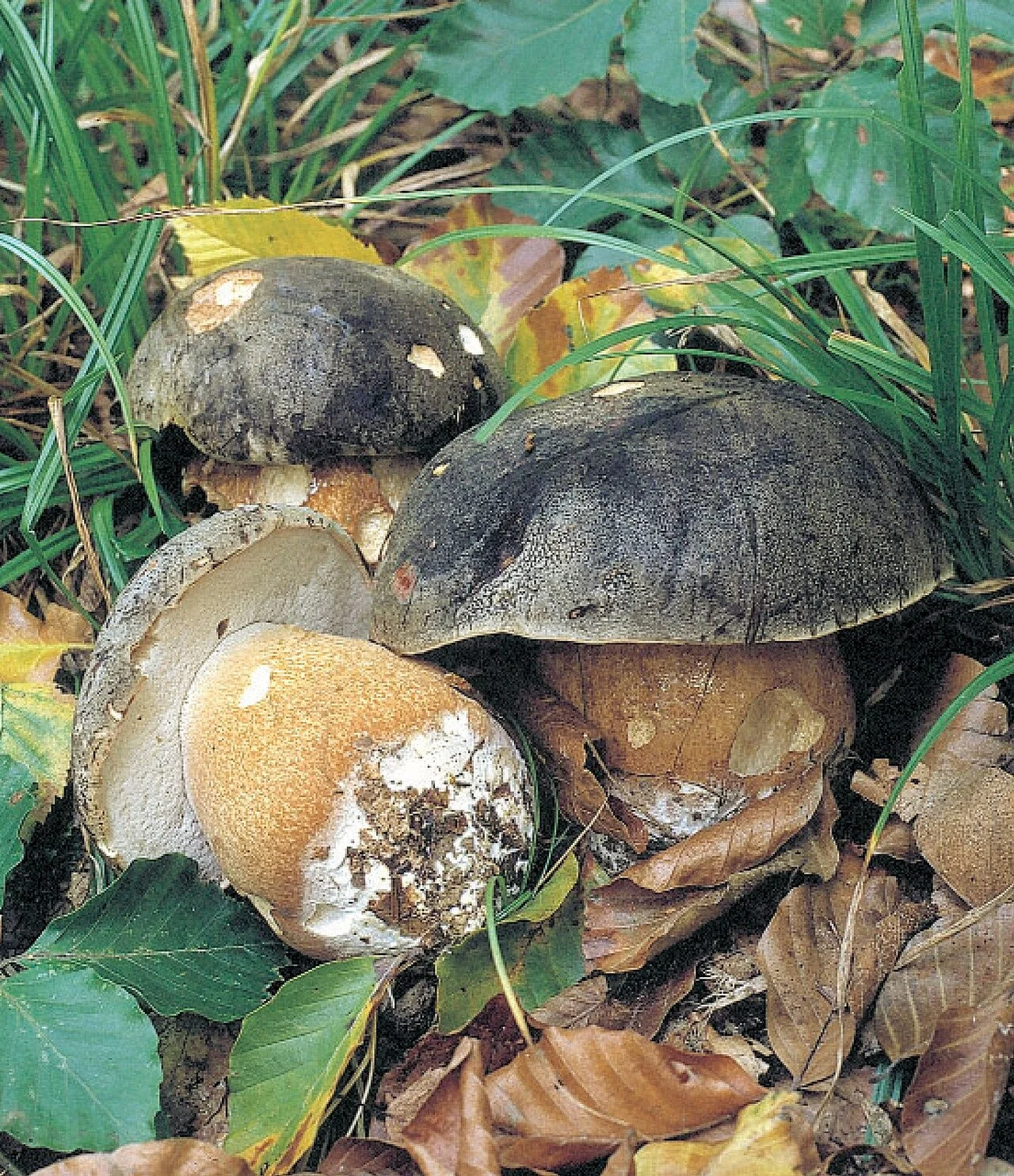
Boletus aereus (bronze bolete, dark cep) is a Mediterranean relative of the porcini (B. edulis), distinguished by its darker, bronze-brown cap. Many foragers consider it equal to or even superior to B. edulis in flavour — the flesh is firmer and more aromatic. In Portugal it is known as “boleto-negro” or “tortulho-preto” (black tortulho).
Cap
- Diameter: 7–30 cm
- Shape: hemispherical when young, later cushion-shaped
- Colour: dark brown, bronze, chocolate — significantly darker than B. edulis
- Surface: smooth or slightly velvety, may be slightly wrinkled
- Cuticle: does not peel off
Stem
- Height: 8–15 cm
- Width: 3–7 cm
- Colour: brownish, lighter than the cap
- Surface: with a fine network pattern (reticulum), as in B. edulis, but usually lighter against the darker background
- Shape: barrel-shaped when young, later cylindrical
Flesh
- Colour: white, does not change colour when cut — same as B. edulis
- Smell: pleasant, mushroomy, pronounced
- Taste: mild, nutty, richer than B. edulis
- Texture: firmer than B. edulis — less often spongy
Spore print
Olive-brown.
Hymenophore
- Type: tubular (spongy)
- Colour: white when young → greenish-yellow → olive when mature
- Pores: small, round
Where and when
Season in Portugal
- Main season: September–November
- May begin fruiting earlier than B. edulis — sometimes in late summer
- Prefers warmer conditions than B. edulis
Habitats in Portugal
- Oak forests — main habitat. Forms ectomycorrhiza with oaks
- Montado — under cork oak (Quercus suber) — typical Mediterranean habitat
- Holm oak (Quercus ilex) — throughout southern Portugal
- Chestnut forests — in Trás-os-Montes
- More common in southern and central Portugal than B. edulis
- Prefers warm, dry habitats — a typical Mediterranean species
- At forest edges, along paths, in clearings of oak woodlands
Comparison with B. edulis
| Feature | B. aereus | B. edulis |
|---|---|---|
| Cap | Dark bronze, chocolate | Light brown to chestnut |
| Flesh | Firmer | Less firm |
| Range | Southern Europe, Mediterranean | All of Europe |
| Habitat | Mainly oak forests | Coniferous and broadleaf forests |
| Season | May start earlier | Mainly autumn |
Look-alikes
| Species | How to distinguish |
|---|---|
| Porcini (Boletus edulis) | Edible. Lighter cap. Not a look-alike but a related species |
| Bitter bolete (Tylopilus felleus) | Bitter taste. Network pattern on stem dark. Hymenophore pinkish |
| Satan’s bolete (Rubroboletus satanas) | Hymenophore red. Stem with red network pattern. Flesh turns blue. Poisonous |
Culinary use
The bronze bolete is a superb culinary mushroom, equal to or surpassing B. edulis.
Preparation methods
- Fresh: frying, stewing, soups, risotto
- Dried: aroma intensifies. Soak in warm water for 20–30 minutes
- Raw: young specimens can be thinly sliced into salads (porcini carpaccio)
- Pickled: young, firm specimens
Notes
- Flesh is firmer and more resistant to insect larvae than B. edulis
- Particularly good for drying — pronounced nutty aroma
Image sources
- boletus-aereus.webp — Bronze bolete (Boletus aereus). Author: Achim Bollmann. License: Copyrighted free use. Source
See Also
Habitats:
Related articles:
Sources
- Fungipedia Portugal — Boletus aereus
- Naturdata — Boletus aereus em Portugal
- BioDiversity4All / GBIF Portugal — species records
- First-Nature — Boletus aereus identification
- Museu Virtual da Biodiversidade — Universidade de Évora
Disclaimer: Identifying mushrooms from descriptions and photographs on the internet is not a substitute for consulting an experienced mycologist. The authors assume no responsibility for the consequences of collecting and consuming mushrooms.
If this article was useful — help us write the next one.
☕ Support on Ko-fi