Porcini
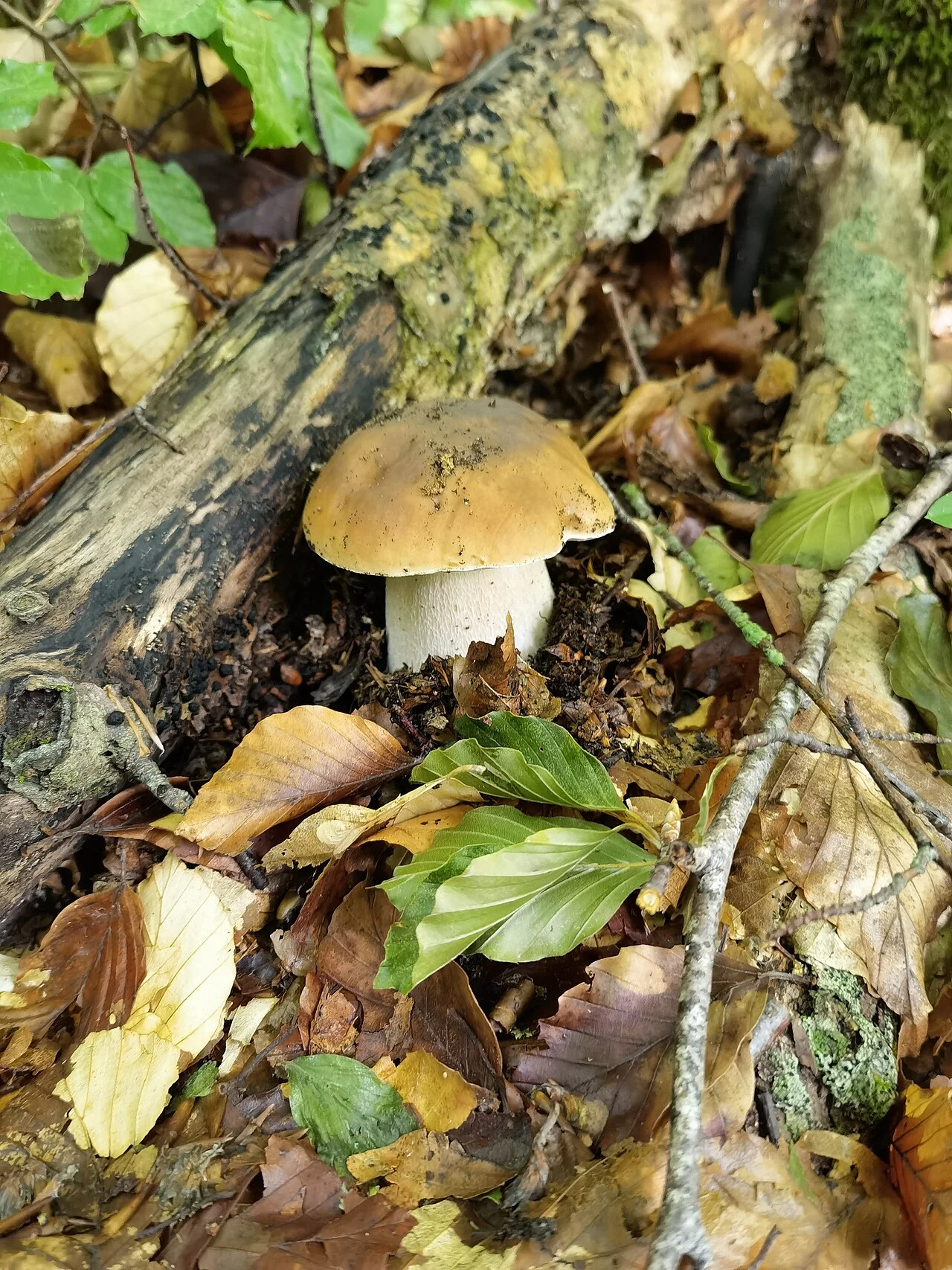 Edible
| Scientific name | Boletus edulis |
| Family | Boletaceae |
| Portuguese name | Boleto, Tortulho, Porcini |
| English name | Porcini, Cep, Penny bun |
| Season | September, October, November, December |
| Habitat | Pine forest, Oak forest, Chestnut forest, Mixed forest |
| Look-alikes | Bronze Bolete |
Description
Boletus edulis (porcini, cep, penny bun) is one of the most prized and recognisable edible mushrooms in the world. In Portugal, as across Europe, it is highly valued for its superb flavour and aroma. A large, fleshy mushroom with a spongy (tubular) hymenophore instead of gills.
Cap
- Diameter: 7–30 cm
- Shape: hemispherical when young, later cushion-shaped
- Colour: light brown to dark chestnut, sometimes with a lighter margin
- Surface: smooth or slightly velvety, sticky in wet weather
- Cuticle: does not peel off
Stem
- Height: 8–25 cm
- Width: 2–7 cm
- Colour: pale, from white to light brown
- Surface: with a fine white network pattern (reticulum) — characteristic feature, especially visible in the upper part
- Shape: barrel-shaped when young, later cylindrical
Flesh
- Colour: white, does not change colour when cut — a key difference from many other boletes
- Smell: pleasant, mushroomy, intensifies when dried
- Taste: mild, nutty, without bitterness
- Texture: firm in young specimens, spongy in older ones
Spore print
Olive-brown.
Hymenophore
- Type: tubular (spongy), not gilled
- Colour: white when young → greenish-yellow → olive when mature
- Tubes: free or slightly attached to the stem
- Pores: small, round
Where and when
Season in Portugal
- Main season: September–December
- Mass fruiting after autumn rains
- Occasionally a second short season in spring (April–May) in mountain areas
Habitats in Portugal
- Chestnut forests — Trás-os-Montes, Serra da Estrela (main collection areas)
- Pine forests — under maritime pine (Pinus pinaster) throughout the country
- Oak forests — under holm oak (Quercus ilex)
- Mixed forests — mountain areas of central and northern Portugal
- Forms ectomycorrhiza with conifers and broadleaf trees
- Prefers acidic to neutral soils
Economic importance
The porcini is one of the most commercially valuable mushrooms in Portugal. Collected for both personal consumption and sale at local markets and restaurants. Dried porcini are a traditional delicacy.
Look-alikes
| Species | How to distinguish |
|---|---|
| Bitter bolete (Tylopilus felleus) | Bitter taste (even a small piece is bitter). Network pattern on stem dark (white in porcini). Hymenophore pinkish. Not toxic but inedible — ruins the dish |
| Bronze bolete (Boletus aereus) | Not a look-alike but a related edible species. Cap darker, bronze-brown. Equally prized |
| Satan’s bolete (Rubroboletus satanas) | Hymenophore red. Stem with red network pattern. Flesh turns blue when cut. Poisonous |
| Lurid bolete (Suillellus luridus) | Hymenophore red-orange. Flesh strongly blues when cut. Conditionally edible after boiling |
Safety rule for boletes
If the flesh or hymenophore turns blue, reddens, or is red/orange in colour — be cautious. In the true porcini, the flesh always remains white and the hymenophore ranges from white to olive.
Culinary use
The porcini is a versatile culinary mushroom with outstanding flavour qualities.
Preparation methods
- Fresh: frying, stewing, soups, risotto, pasta
- Dried: aroma intensifies several times. Pre-soak in warm water for 20–30 minutes; use the soaking liquid for stock
- Pickled: young specimens with firm flesh
- Frozen: pre-boil or fry before freezing
Notes
- Young specimens with white, firm hymenophore are the most prized
- Older mushrooms with greenish, spongy hymenophore have inferior flavour and texture
- Often infested with larvae — check for worm damage when collecting
Image sources
- boletus-edulis.webp — Porcini mushroom (Boletus edulis) in natural habitat. Author: ReddishClover. License: CC BY-SA 4.0. Source
See Also
Habitats:
Related articles:
Sources
- Museu Virtual da Biodiversidade — Universidade de Évora
- BioDiversity4All / GBIF Portugal — species records
- Sociedade Portuguesa de Micologia
- Fungipedia Portugal — Boletus edulis
- DGADR — Recursos Micológicos
Disclaimer: Identifying mushrooms from descriptions and photographs on the internet is not a substitute for consulting an experienced mycologist. The authors assume no responsibility for the consequences of collecting and consuming mushrooms.
If this article was useful — help us write the next one.
☕ Support on Ko-fi