Chanterelle
 Edible
| Scientific name | Cantharellus cibarius |
| Family | Cantharellaceae |
| Portuguese name | Cantarelo, Rapazinho, Cantarela |
| English name | Chanterelle, Golden chanterelle |
| Season | September, October, November, December |
| Habitat | Pine forest, Oak forest, Cork oak, Mixed forest |
| Look-alikes | Jack-o'-Lantern Mushroom |
Description
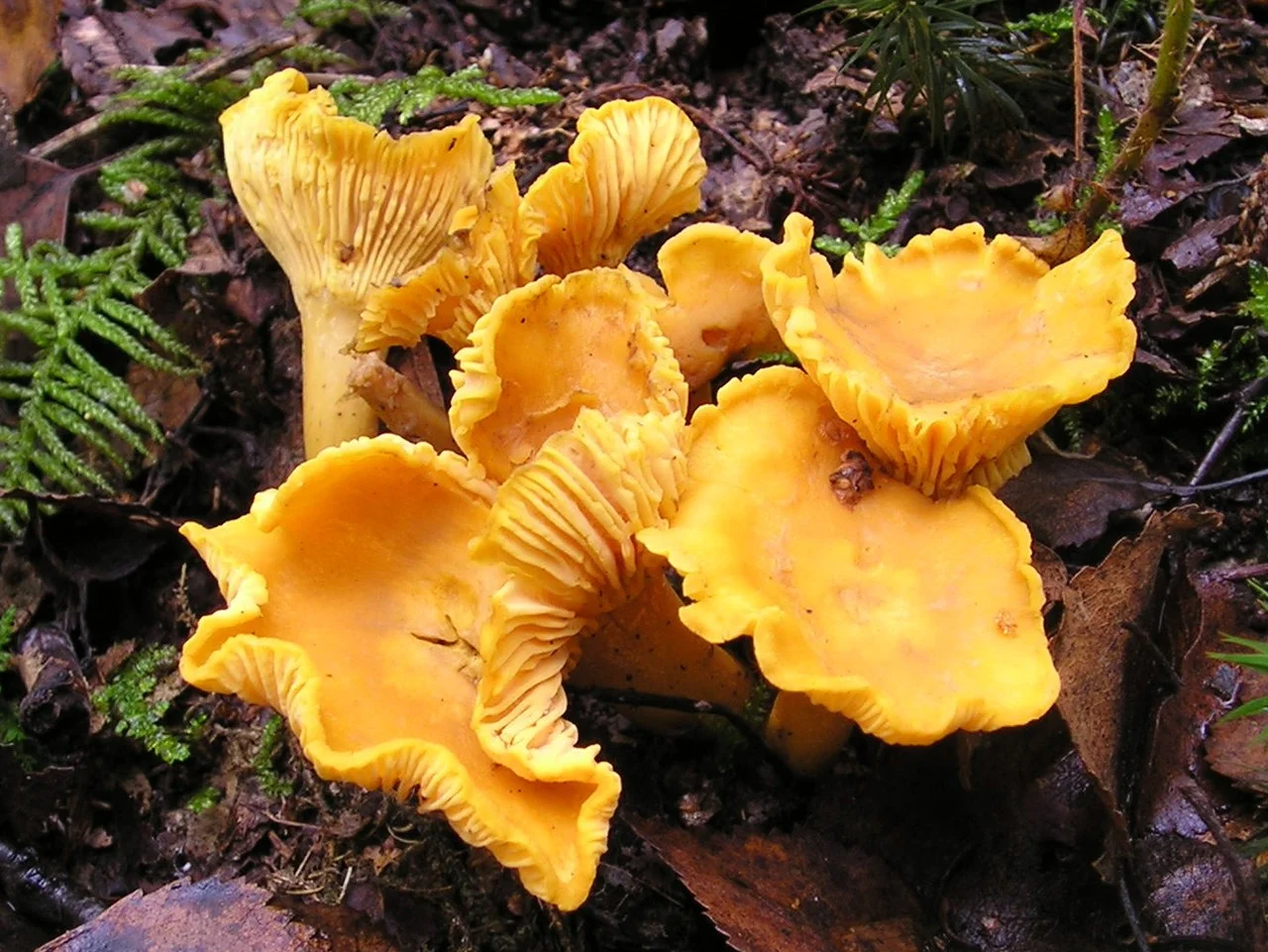
Cantharellus cibarius (chanterelle, golden chanterelle) is one of the most popular and recognisable edible mushrooms in Europe. Bright yellow, with a characteristic fruity (apricot) aroma and unique texture. Its key feature — instead of true gills, it has false ridges (folds), which distinguishes the chanterelle from poisonous look-alikes.
Cap
- Diameter: 3–10 cm
- Shape: convex when young; funnel-shaped with a wavy, irregular margin when mature
- Colour: egg-yellow, golden yellow. Flesh inside is lighter than the surface
- Surface: smooth, matte
Stem
- Height: 3–8 cm
- Width: 1–2 cm
- Colour: same colour as the cap or slightly lighter
- Shape: tapers downward, merges gradually into the cap (no sharp boundary)
- Flesh: firm, fibrous
Hymenophore
- Type: false ridges (folds) — key identifying feature
- Characteristics: blunt (not sharp), forked (bifurcating), decurrent far down the stem
- Colour: same colour as the cap
Flesh
- Colour: pale yellow, lighter than the surface
- Smell: pleasant, fruity — often described as apricot-like
- Taste: mild, slightly peppery
- Special feature: very firm, rarely infested by insect larvae (due to chitinomannose content)
Spore print
Pale yellow to cream.
Where and when
Season in Portugal
- Main season: September–December (after autumn rains)
- May appear from late August in wetter years
- In mountain areas — until January
Habitats in Portugal
- Pine forests — under maritime pine (Pinus pinaster)
- Oak forests — under holm oak and cork oak
- Chestnut forests — in the north of the country
- Mixed forests — throughout continental Portugal
- Forms ectomycorrhiza with trees
- Grows on soil, often among moss and leaf litter
Economic importance
The chanterelle is one of the most sought-after mushrooms at Portuguese markets and restaurants. Collected in large quantities in the northern and central regions.
Look-alikes
Comparison with dangerous look-alikes
| Feature | Chanterelle | Jack-o’-lantern | False chanterelle (H. aurantiaca) |
|---|---|---|---|
| Hymenophore | False ridges — blunt, forked, decurrent | True gills — sharp, not forked | True gills — thin, crowded |
| Growth | On soil, singly or in groups | On wood (stumps, roots), in clusters | On soil and decaying wood |
| Colour | Egg-yellow, lighter inside | Pumpkin-orange, uniform | Orange, brighter than chanterelle |
| Smell | Pleasant, apricot-like | Unpleasant, sweetish | No distinctive smell |
| Flesh | Pale yellow, firm | Orange-yellow | Orange, soft |
| Glow | No | Glows in the dark | No |
| Edibility | Edible | Poisonous | Inedible (not toxic) |
Safety rules
- Chanterelles always grow on soil, never on wood
- Chanterelles have false ridges (blunt, forking), not true gills
- If a “chanterelle” grows in a cluster on a stump — it is a jack-o’-lantern
Culinary use
The chanterelle is one of the finest culinary mushrooms with a unique peppery-fruity flavour.
Preparation methods
- Pan-fried in butter — the classic method that reveals the aroma
- Stewed in cream — a traditional recipe
- Omelettes and scrambled eggs — an excellent combination
- Soups and sauces — for pasta, meat, fish
- Dried: preserves aroma well, but texture becomes tough when dried
- Pickled: retains shape and texture excellently
Notes
- Not recommended raw (tough texture, poorly digested)
- Young, firm specimens are the most prized
- Virtually never wormy (contains chitinomannose — a natural anthelmintic)
Image sources
- cantharellus-cibarius.webp — Chanterelle (Cantharellus cibarius). Author: Wikimedia Commons. License: CC BY-SA 3.0. Source
See Also
Habitats:
Related articles:
Sources
- Museu Virtual da Biodiversidade — Universidade de Évora
- BioDiversity4All / GBIF Portugal — species records
- Sociedade Portuguesa de Micologia
- Fungipedia Portugal — Cantharellus cibarius
- DGADR — Recursos Micológicos
Disclaimer: Identifying mushrooms from descriptions and photographs on the internet is not a substitute for consulting an experienced mycologist. The authors assume no responsibility for the consequences of collecting and consuming mushrooms.
The light is on for free. But someone has to clean the lantern.
☕ Support on Ko-fi