Shaggy Ink Cap
 Edible
| Scientific name | Coprinus comatus |
| Family | Agaricaceae |
| Portuguese name | Coprino-barbudo, Cogumelo-tinteiro |
| English name | Shaggy ink cap, Lawyer's wig, Shaggy mane |
| Season | September, October, November |
| Habitat | Meadow, Pasture |
Description
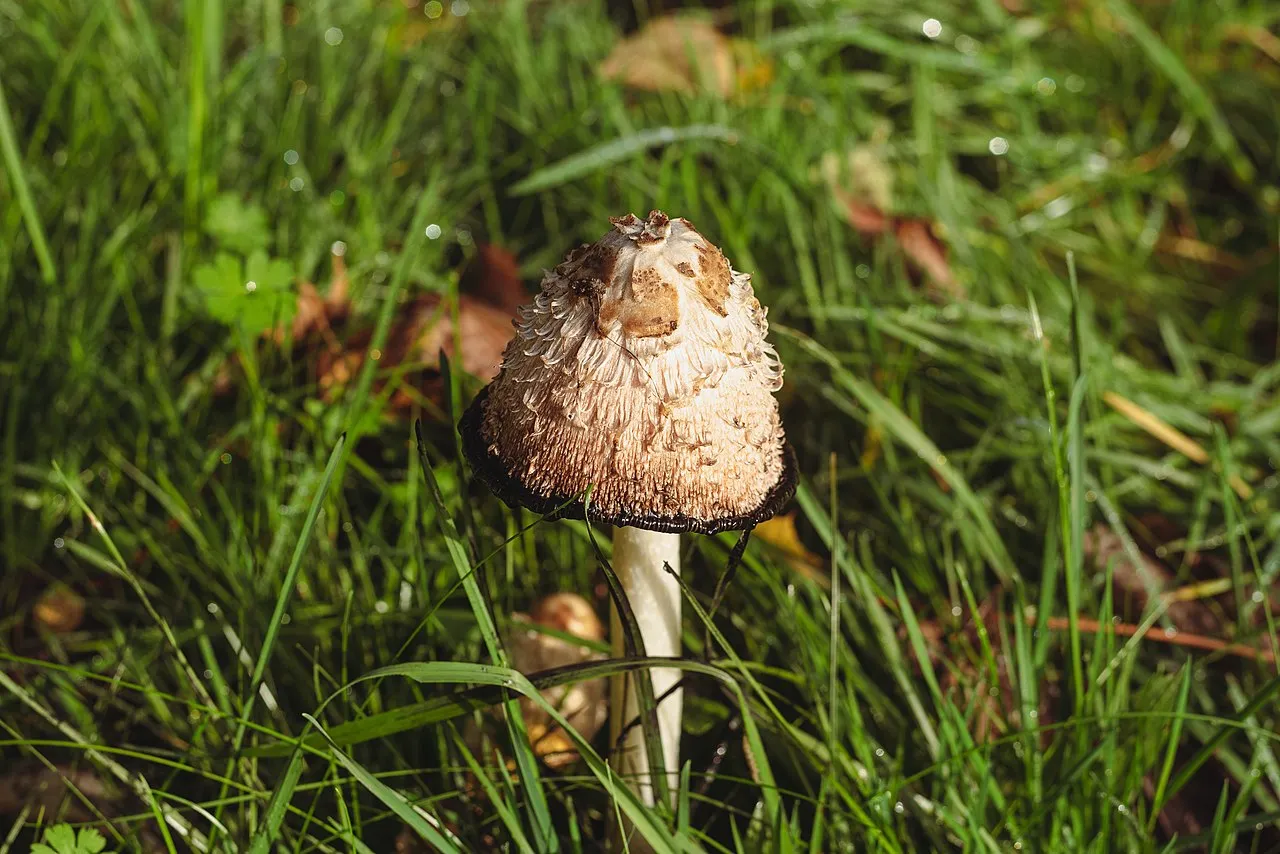
Coprinus comatus (shaggy ink cap, lawyer’s wig, shaggy mane) is a delicious edible mushroom, one of the most recognisable species thanks to its characteristic cylindrical cap with shaggy scales. Its key feature is autodigestion: as the mushroom matures, the gills dissolve into a black inky liquid to disperse the spores.
Described by Otto Friedrich Müller in 1780. Transferred to the genus Coprinus by Christiaan Hendrik Persoon (1797). Modern molecular systematics places it in the family Agaricaceae, not Coprinaceae.
Cap
- Shape: elongated-cylindrical (up to 15 cm tall), later bell-shaped
- Colour: white with a brownish apex
- Surface: covered with large shaggy fibrous scales (hence “shaggy”)
- Autodigestion: as it matures, the edges blacken and dissolve from bottom to top
Gills
- Young: white, very crowded, free
- Mature: pink → black → dissolve into inky liquid (deliquescence)
Stem
- Height: 10–30 cm
- Width: 1–2.5 cm
- Colour: white, hollow
- Ring: movable, white, thin, often drops to the base
Flesh
- Colour: white, thin
- Smell: pleasant, faint
- Taste: delicate, delicious
Spore print
Black.
Where and when
Season in Portugal
- Main season: September–November
- Appears quickly after rain, often in large groups
- Fruiting may repeat several times per season
Habitats in Portugal
- Meadows and pastures — primary biotope
- Lawns, parks, roadsides — an urban saprotroph
- Fields — on fertilised soils
- Saprotroph — grows on organic-rich soils, does not form mycorrhiza
Ecology
The shaggy ink cap is a typical ruderal fungus, preferring disturbed and enriched soils. It frequently appears in urban settings — on lawns, along paths, and on sports fields.
Look-alikes
| Species | How to distinguish |
|---|---|
| Common ink cap (Coprinopsis atramentaria) | Cap smooth, grey, without shaggy scales. Incompatible with alcohol (contains coprine) |
| Glistening ink cap (Coprinellus micaceus) | Much smaller, yellow-brown, with glistening granules on the cap |
Safety rule
The shaggy ink cap is virtually impossible to confuse with dangerous species thanks to its characteristic cylindrical shape and shaggy scales. However, do not confuse it with the common ink cap — which looks entirely different and is dangerous when consumed with alcohol.
Culinary use
When to pick
- Collect only young specimens — while the gills are white or slightly pinkish
- Do not collect if the gills have already blackened — autodigestion is irreversible
- Cook within 2–4 hours of picking
Preparation methods
- Frying in butter — the classic method, bringing out the delicate flavour
- Cream soup — puréed shaggy ink cap gives a silky texture
- Omelette — slice and fry with eggs
- Risotto — add in the last minutes of cooking
Notes
- Cannot be dried or stored for long due to autodigestion
- Can be frozen after frying
- Delicate flavour — do not mask with strong spices
See Also
Habitats:
Related articles:
Image sources
- coprinus-comatus.webp — Shaggy ink cap (Coprinus comatus). Author: Flocci Nivis. License: CC BY 4.0. Source
Sources
- Müller O.F. — Flora Danica (1780) — original description
- Arora D. — Mushrooms Demystified (1986)
- BioDiversity4All / GBIF Portugal — occurrence records of Coprinus comatus
- Sociedade Portuguesa de Micologia — edible species
- First-Nature — Coprinus comatus, Shaggy Inkcap
Disclaimer: Identifying mushrooms from descriptions and photographs on the internet is not a substitute for consulting an experienced mycologist. The authors assume no responsibility for the consequences of collecting and consuming mushrooms. If you suspect mushroom poisoning, call 112 immediately.
All our knowledge is free. Creating it is not.
☕ Support on Ko-fi