Deadly Webcap
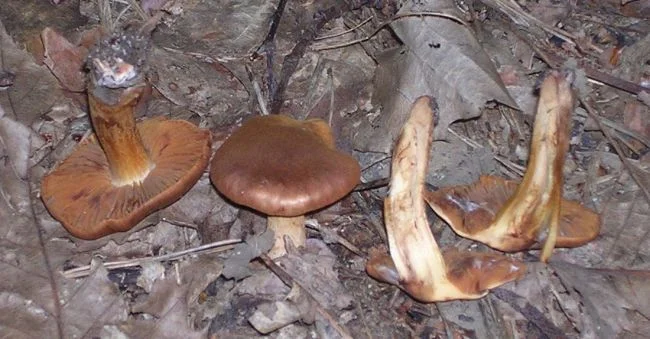 Deadly
| Scientific name | Cortinarius orellanus |
| Family | Cortinariaceae |
| Portuguese name | Cortinário-mortal |
| English name | Fool's webcap, Deadly webcap |
| Season | September, October, November |
| Habitat | Oak forest, Chestnut forest |
| Look-alikes | Chanterelle |
Description
Cortinarius orellanus (deadly webcap, fool’s webcap) is one of the most insidious poisonous mushrooms in Europe. Its main danger lies in the exceptionally long latency period (up to 2–3 weeks), which means patients often fail to connect their symptoms to mushroom consumption. A small, inconspicuous rusty-brown fungus that is easily mistaken for a harmless species.
Cap
- Diameter: 3–8 cm
- Shape: convex, later flattened, sometimes with a slight umbo
- Colour: rusty-brown, warm orange-brown
- Surface: dry, finely scaly, with radial fibres
- Margin: thin, sometimes slightly inrolled
Stem
- Height: 4–9 cm
- Width: 0.5–1.5 cm
- Colour: yellowish, lighter than the cap
- Ring: absent
- Cortina: cobweb-like veil in young specimens, disappears quickly
- Surface: with longitudinal fibres
Flesh
- Colour: yellowish, no colour change when cut
- Smell: faint, unremarkable (described as “radish-like” or “mealy”)
- Taste: mild or slightly bitter
Spore print
Rusty-brown.
Toxicity
Toxin
- Orellanine (3,3’-4,4’-tetrahydroxy-2,2’-bipyridine-1,1’-N-oxide) — first isolated in 1962, structure confirmed in 1979
- Heat-stable — not destroyed by cooking
Mechanism of action: orellanine rapidly concentrates in the kidneys and causes oxidative stress in renal tubular cells, leading to necrosis. Toxicity is cumulative and irreversible.
Course of poisoning
| Phase | Time | Symptoms |
|---|---|---|
| 1. Latent | 2–14 days (up to 3 weeks!) | Asymptomatic. Toxin accumulates in the kidneys |
| 2. Initial | 2–14 days | Thirst, dry mouth, headache, flank pain |
| 3. Renal | Days–weeks | Oliguria (reduced urine output), elevated creatinine, proteinuria |
| 4. Renal failure | Weeks–months | Progressive renal failure requiring dialysis |
Mortality: with modern treatment (dialysis) — low, but the irreversibility of kidney damage makes this mushroom exceptionally dangerous. Many patients require lifelong dialysis or kidney transplantation.
Historical note
A mass poisoning of 135 people in Poland in 1957 first drew serious attention to the toxicity of the genus Cortinarius. 11 people died.
Where and when
Season
- Main season: September–November
- Fruits after autumn rains
Habitats in Portugal
- Primarily in the north of the country — under oaks and chestnuts
- Forms ectomycorrhiza with broadleaf trees, especially oaks (Quercus spp.)
- Prefers acidic soils in warm broadleaf forests
Look-alikes
| Species | Difference from deadly webcap |
|---|---|
| Chanterelle (Cantharellus cibarius) | Chanterelles have false gills (blunt, forked, decurrent), not true gills. Egg-yellow colour, grows on soil |
| Other Cortinarius spp. | Many species in the genus Cortinarius look similar. Expert recommendation: avoid collecting any webcaps for consumption |
Safety rule
The genus Cortinarius contains over 2,000 species, many of which are difficult to distinguish. The only reliable way to avoid poisoning is to not collect webcaps at all.
Image sources
- cortinarius-orellanus.webp — Fool’s webcap (Cortinarius orellanus) — deadly poisonous mushroom. Author: Michaelll. License: CC BY-SA 2.5. Source
See Also
Habitats:
Related articles:
Sources
- Prast H. et al. — Toxic properties of the mushroom Cortinarius orellanus // Archives of Toxicology, 1979
- Dinis-Oliveira R.J. et al. — Orellanine: from fungal origin to cancer treatment // Toxicology, 2023
- Holmdahl J. et al. — Long-term clinical outcome for orellanine poisoning // BMC Nephrology, 2017
- CIAV — Centro de Informação Antivenenos, INEM Portugal
- BioDiversity4All / GBIF — species records
- First-Nature — Cortinarius orellanus identification
Disclaimer: Identifying mushrooms from descriptions and photographs on the internet is not a substitute for consulting an experienced mycologist. The authors assume no responsibility for the consequences of collecting and consuming mushrooms. If you suspect mushroom poisoning, call 112 immediately.
The light is on for free. But someone has to clean the lantern.
☕ Support on Ko-fi