Horn of Plenty
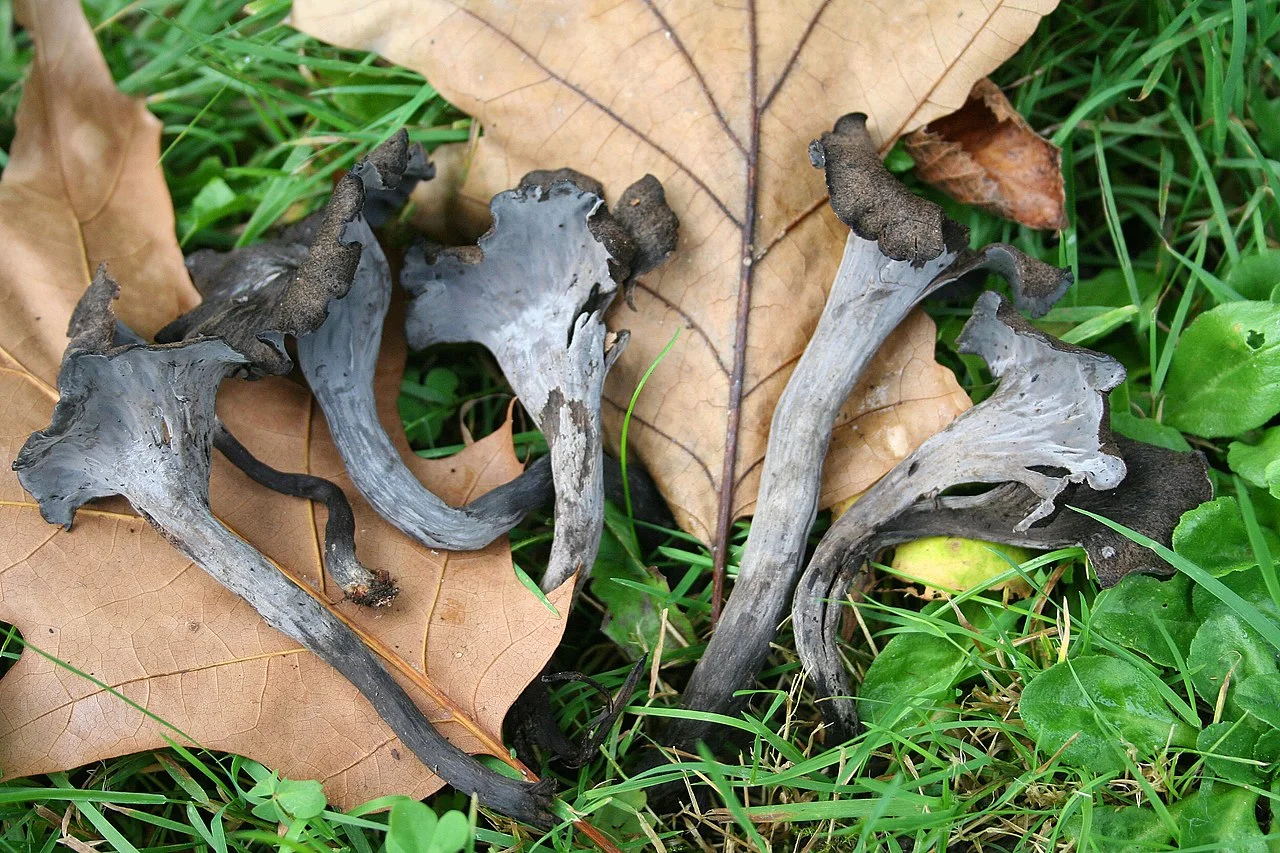 Edible
| Scientific name | Craterellus cornucopioides |
| Family | Cantharellaceae |
| Portuguese name | Trombeta-dos-mortos, Cornucópia, Orelha-de-morcego, Viuvinhas |
| English name | Horn of plenty, Black trumpet, Black chanterelle |
| Season | October, November, December, January |
| Habitat | Oak forest, Cork oak, Chestnut forest, Mixed forest |
Description
Craterellus cornucopioides (horn of plenty, black trumpet, black chanterelle) is one of the most aromatic and culinarily prized edible mushrooms. It has earned the nickname “poor man’s truffle” for its aroma’s resemblance to the black truffle, especially when dried. In Portugal it is known as “trombeta-dos-mortos” (trumpet of the dead — it appears around All Saints’ Day), “cornucópia” (horn of plenty), “orelha-de-morcego” (bat’s ear) and affectionately “viuvinhas” (little widows — after its black colour).
One of the safest mushrooms to forage — there are no poisonous look-alikes.
Fruiting body
- Shape: deeply funnel-shaped, tubular — no clear boundary between cap and stem
- Height: 3–10 cm
- Width: 2–8 cm (at the top)
- Cavity: completely hollow from the cap margin to the base
Cap
- Colour: from dark grey and dark brown to nearly black; darkens when wet, lightens when dry
- Surface: dry, matt, finely fibrillose
- Margin: wavy, irregular, lobed, recurved
Hymenophore (outer surface)
- Type: smooth to slightly wrinkled — no true gills (key feature)
- Colour: grey, ashy-grey
- May have faint longitudinal veins, but no formed gills or folds
Stem
- Height: 5–10 cm
- Width: 0.5–1.5 cm
- Colour: black to bluish-grey
- Surface: longitudinally wrinkled
- Feature: hollow; several stems often fused at the base
Flesh
- Thickness: thin, fragile (significantly thinner than chanterelles)
- Colour: greyish-black
- Smell: pleasant, earthy, woody
- Taste: mild, with pronounced umami
- Feature: leathery, resilient — rarely attacked by larvae
Spore print
White to pale cream. Spores broadly ellipsoidal, smooth, 11–14 × 7–9 µm.
Where and when
Season in Portugal
- Main season: October–December
- In mild winters — until January–February
- Appears after abundant autumn rains (40–50 mm over 15 days)
- Associated with All Saints’ Day (1 November) — hence the name “trumpet of the dead”
Habitats in Portugal
- Broadleaf forests — the main habitat:
- Holm oak (Quercus ilex) and cork oak (Quercus suber)
- Chestnut (Castanea sativa) — especially in the north
- Beech forests (Fagus sylvatica) — in mountain areas
- Mixed forests — broadleaf trees with admixture of pine
- Forms ectomycorrhiza with broadleaf trees
- Grows in damp, shaded spots, on clay and calcareous soils
- Main regions: Trás-os-Montes, Beira, Alentejo
- Forms extensive colonies — if one is found, many more are usually nearby
Economic importance
- One of the commercially important wild mushrooms in Portugal
- Sold through specialist suppliers (Aromas & Boletos and others)
- Most of the harvest is exported to Spain, France, Italy
Look-alikes
The horn of plenty is one of the safest mushrooms to forage. There are no poisonous look-alikes.
| Species | How to distinguish |
|---|---|
| Ashy chanterelle (Cantharellus cinereus) | Has distinct folds on the hymenophore, ashy-grey colour. Grows nearby, often in the same locations. Edible |
Safety rule
A black trumpet-shaped form, hollow inside, without gills — a reliable sign of the horn of plenty. The main “difficulty” when foraging is not danger but the fact that it is hard to spot because of its dark colour against the leaf litter.
Culinary use
The horn of plenty is the “poor man’s truffle” with a rich, smoky, earthy flavour.
Preparation methods
- Dried powder — the principal method: ground dried mushrooms used as a seasoning (a truffle-salt analogue). The aroma intensifies when dried, approaching that of truffle
- Pan-frying — in olive oil or butter (5–7 minutes)
- Sauces and cream soups — an excellent complement to creamy dishes
- Stews (guisados) — the classic Portuguese application
- Risotto and pasta — in the Mediterranean tradition
Gastronomic pairings
- Game (wild boar, venison), mature beef
- Aged cheeses
- Full-bodied red wines
- Garlic, thyme, parsley
Notes
- Dries easily (thin flesh) — stores for months in dried form
- To rehydrate: 15–20 minutes in warm liquid (water, wine, stock); the liquid is also used
- Thin flesh cooks quickly — no prolonged processing required
Image sources
- craterellus-cornucopioides.webp — Horn of plenty (Craterellus cornucopioides). Author: Jean-Pol Grandmont. License: CC BY 3.0. Source
See Also
Habitats:
Related articles:
Sources
- Biodiversidade da Mitra — Universidade de Évora: Craterellus cornucopioides
- Fungipedia Portugal — Craterellus cornucopioides
- NaturData — Craterellus cornucopioides em Portugal
- Aromas & Boletos — Cogumelos silvestres: Craterellus cornucopioides
- CCRES — Cogumelos Silvestres em Portugal
- First-Nature — Craterellus cornucopioides identification
Disclaimer: Identifying mushrooms from descriptions and photographs on the internet is not a substitute for consulting an experienced mycologist. The authors assume no responsibility for the consequences of collecting and consuming mushrooms.
If this article was useful — help us write the next one.
☕ Support on Ko-fi