Livid Pinkgill
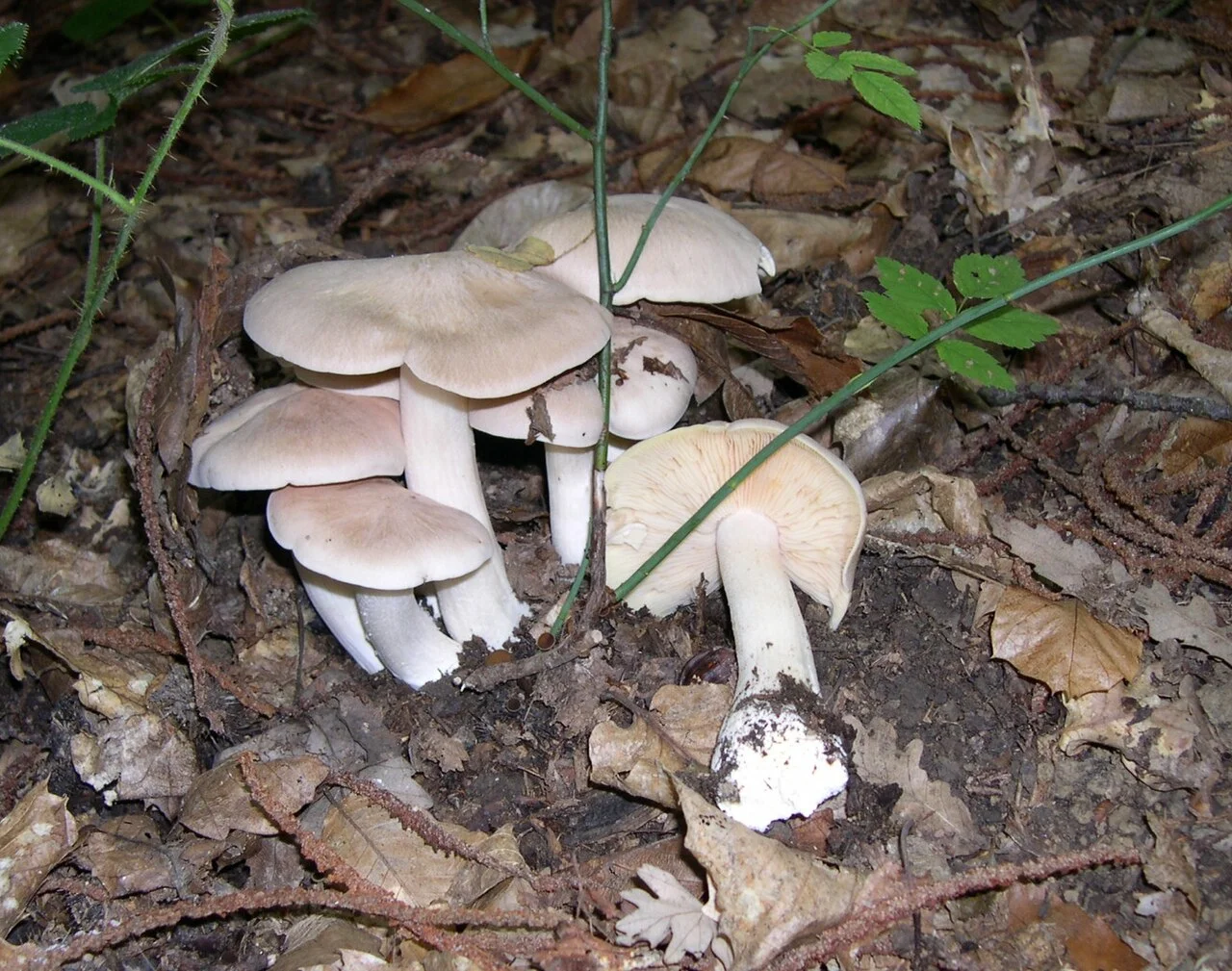 Toxic
Toxic| Scientific name | Entoloma sinuatum |
| Family | Entolomataceae |
| Portuguese name | Entoloma-lívido |
| English name | Livid pinkgill |
| Season | September, October, November |
| Habitat | Oak forest, Cork oak, Mixed forest |
| Look-alikes | Field Mushroom |
Description
Entoloma sinuatum (livid pinkgill, formerly Entoloma lividum) is a large, robust mushroom with a deceptively “edible” appearance. Its pale, fleshy cap and thick stem make it resemble many edible species, leading to frequent poisonings. It is one of the most common causes of mushroom poisoning in Europe.
Cap
- Diameter: 6–20 cm (one of the largest poisonous mushrooms)
- Shape: convex when young, later expanded with a wavy margin
- Colour: whitish-grey, greyish-yellow, leaden grey (Latin lividum — “leaden”)
- Surface: smooth or slightly fibrous, matte
- Margin: wavy, often uneven, inrolled in young specimens
Stem
- Height: 6–15 cm
- Width: 1.5–4 cm
- Colour: white, later greyish
- Ring: absent
- Surface: longitudinally fibrous
- Base: slightly thickened
Flesh
- Colour: white, firm, fleshy
- Smell: mealy (described as “fresh flour” or “cucumber-like”). Pleasant
- Taste: mealy. The pleasant taste and smell are deceptive — this is not a sign of edibility
Spore print
Pink — the key diagnostic feature of the genus Entoloma. Spores are characteristically angular in shape (under microscopy).
Toxicity
Toxins
The exact toxins are not identified. Likely a group of substances that irritate the gastrointestinal mucosa. Does not contain amatoxins (not hepatotoxic).
Poisoning symptoms
| Parameter | Description |
|---|---|
| Onset | 30 minutes – 3 hours after ingestion |
| Duration | Up to 48 hours |
Manifestations:
- Severe nausea and intense vomiting
- Pronounced diarrhoea (sometimes bloody)
- Sharp abdominal cramps
- Headache, dizziness
- Profuse sweating
- Dehydration — the main danger, especially for children and the elderly
Fatality: extremely rare, but at least one fatality has been documented. The main danger is severe dehydration.
Statistics
- Responsible for approximately 10% of all mushroom poisoning cases in Europe
- In 1983 in Geneva alone — 70 hospitalisations
Where and when
Season
- Main season: September–November
- Fruits after autumn rains
Habitats in Portugal
- Broadleaf forests — under oaks, chestnuts
- Cork oak forests (montado)
- Mixed forests
- Parks and gardens with broadleaf trees
- Forms ectomycorrhiza or grows as a saprotroph in leaf litter
- Documented in the Biodiversidade da Mitra catalogue (University of Évora) and on BioDiversity4All
Look-alikes
| Species | How to distinguish from Entoloma |
|---|---|
| The miller (Clitopilus prunulus) | Gills decurrent (Entoloma’s are sinuate). Mealy smell in both, but the miller’s gills become pink earlier. Usually smaller |
| St George’s mushroom (Calocybe gambosa) | Grows in spring (April–May), not autumn. Spore print white (not pink). Crowded, cream-coloured gills |
| Clouded agaric (Clitocybe nebularis) | Decurrent gills. Characteristic “smoky” smell |
| Field mushroom (Agaricus campestris) | Gills free, turning pink → dark chocolate-brown. Spore print dark brown (not pink). Flesh turns pink when cut |
| Knights (Tricholoma spp.) | Spore print white (not pink). Key test for differentiation |
Key rule
When collecting mushrooms that resemble Entoloma, always check the spore print. A pink spore print indicates the genus Entoloma. If uncertain — do not collect.
Image sources
- entoloma-sinuatum.webp — Livid pinkgill (Entoloma sinuatum). Author: Archenzo. License: CC BY-SA 3.0. Source
See Also
Habitats:
Related articles:
Sources
- Noorlidah A. et al. — Entoloma sinuatum: the toxic mushroom // Toxicology, 2012
- Biodiversidade da Mitra — Universidade de Évora
- BioDiversity4All / GBIF Portugal — species records
- First-Nature — Entoloma sinuatum identification
- Ultimate Mushroom — Entoloma sinuatum guide
- Sociedade Portuguesa de Micologia
Disclaimer: Identifying mushrooms from descriptions and photographs on the internet is not a substitute for consulting an experienced mycologist. The authors assume no responsibility for the consequences of collecting and consuming mushrooms.
If this article was useful — help us write the next one.
☕ Support on Ko-fi