Beefsteak Fungus
 Edible
| Scientific name | Fistulina hepatica |
| Family | Fistulinaceae |
| Portuguese name | Língua-de-vaca, Língua-de-boi, Fígado de boi |
| English name | Beefsteak fungus, Ox tongue, Poor man's steak |
| Season | August, September, October, November |
| Habitat | Oak forest, Chestnut forest |
Description
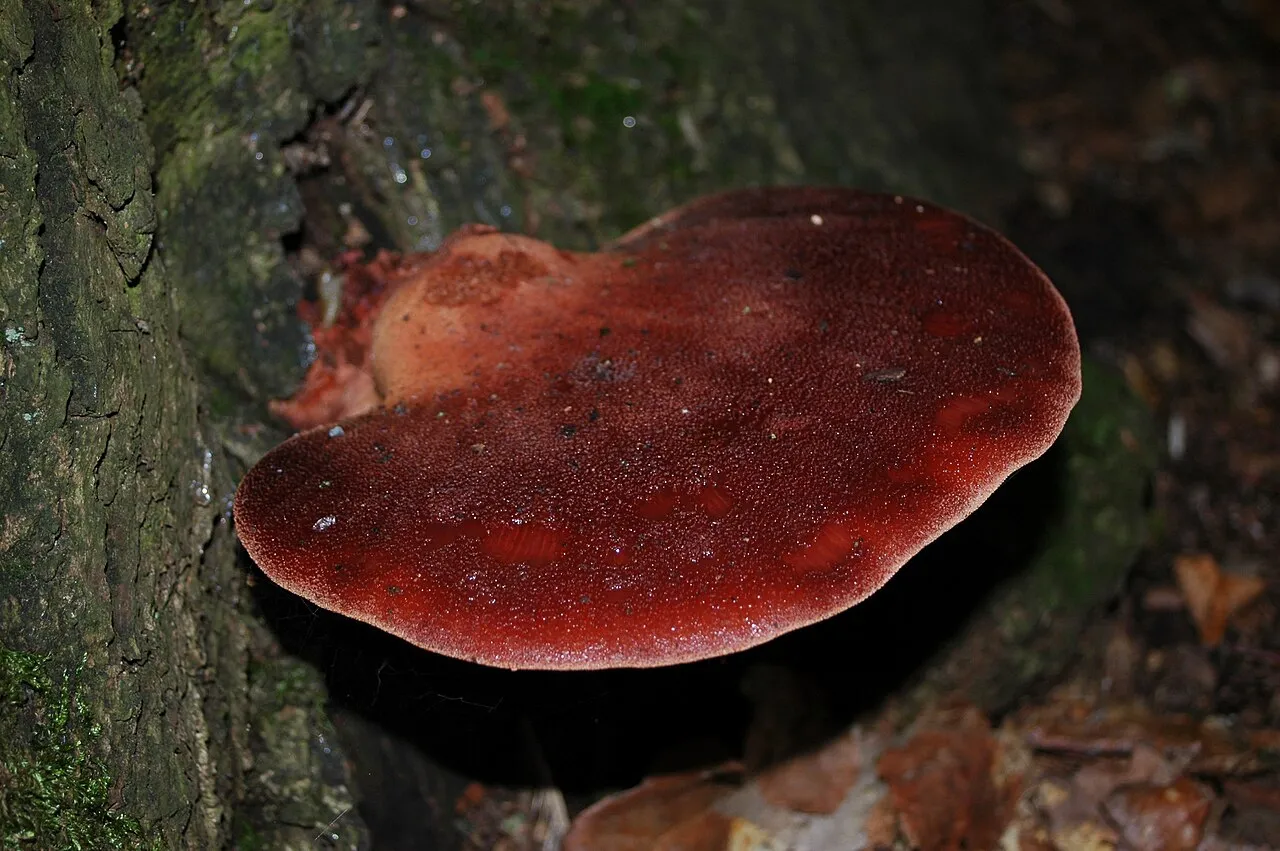
Fistulina hepatica (beefsteak fungus, ox tongue) is one of Europe’s most unusual edible mushrooms. The fruiting body resembles a large tongue or piece of raw liver — the marbled flesh with red veins looks exactly like meat when cut. In Portugal it is known as “língua-de-vaca” (cow’s tongue) or “fígado de boi” (ox liver).
Described by Jacob Christian Schaeffer in 1774 (as Boletus hepaticus). Transferred to the genus Fistulina by William Withering in 1792.
Its key uniqueness lies in its unfused tubes: the hymenophore consists of individual, independent tubes (like a bundle of tiny straws), found in no other bracket fungus in the world. This feature led to the establishment of the separate family Fistulinaceae.
Fruiting body
- Shape: tongue-like or kidney-shaped, attached laterally to the trunk
- Size: 7–30 cm wide, 2–6 cm thick
- Stipe: if present — up to 5 cm long
- Colour: pinkish-red when young, darkening to reddish-brown (liver-coloured)
- Surface: covered with blood-red papillae that darken with age
Hymenophore (tube layer)
- Tubes: individual, unfused — each tube is separated from its neighbours
- Surface: creamy-white
- Reaction: reddens when damaged
- Feature: unique structure among all bracket fungi — like a “bundle of straws”
Flesh
- Colour: when cut — marbled, with red and white veins, resembling raw meat
- Juice: exudes a dull red juice when damaged (stains hands and surfaces)
- Smell: faint, pleasant
- Taste: sour/acidic and slightly bitter — due to high organic acid content (malic, citric, ascorbic acid)
Spore print
Pinkish. Spores ellipsoid, smooth, yellowish, 4–5.5 × 3–4 µm.
Where and when
Season in Portugal
- Main season: August–November
- Peak: September–October
- Fruiting body is annual — appears and dies within one season
- In Mediterranean climates, fruiting shifts to autumn when rains begin after the summer drought
Habitats in Portugal
- Grows on trunks of oaks and chestnuts — on the lower trunk or on stumps
- Main host trees:
- Cork oak (Quercus suber) — the primary oak of the montado
- Holm oak (Quercus ilex / Q. rotundifolia) — azinheira
- Sweet chestnut (Castanea sativa) — chestnut forests of the north
- Other oaks (Q. faginea, Q. pyrenaica)
- Weak parasite of living trees — affects only the dead heartwood
- Also a saprotroph — grows on dead oaks and stumps
- Prefers old-growth trees with bark damage
Ecological role
The beefsteak fungus causes brown rot — it breaks down cellulose while leaving lignin intact. This creates cavities in the oak’s heartwood.
On chestnuts, it causes CRS (Chestnut Red Stain) — discolouration of the heartwood, a problem for forestry in Spain and Portugal.
Look-alikes
The beefsteak fungus is one of the most recognisable mushrooms. Confusing it with anything else is extremely difficult.
| Feature | How to confirm |
|---|---|
| Meat-like flesh | When cut — red veins, exudes red juice |
| Unfused tubes | Hymenophore like a bundle of separate straws |
| Sour taste | Characteristic acidity absent in other bracket fungi |
| Growth on oaks/chestnuts | Always on trunks of broadleaf trees |
Safety rule
The beefsteak fungus has virtually no dangerous look-alikes. If the mushroom is tongue-shaped, fleshy, reddish, with individual tubes and a sour taste — it is Fistulina hepatica.
Culinary use
The beefsteak fungus is one of the few large mushrooms that can be eaten raw (in small quantities).
Preparation methods
- Thin slices in salads — young specimens, raw or lightly seared
- Grilling — with a marinade of oil, herbs, balsamic vinegar or sugar (to balance the acidity)
- Stewing — slow simmering to soften the flesh
- In cream sauces — the mushroom’s acidity is well balanced by cream
Preparation
- Young specimens — the most tender and least acidic, ready to use immediately
- Older specimens — recommended to soak overnight in water or milk to remove excess acidity
- Juice of old specimens may cause stomach upset — discard it
Notes
- The texture resembles raw meat — used as a vegetarian steak substitute (hence “poor man’s steak”)
- Contains vitamin C (ascorbic acid) — a rarity among mushrooms
- Historically used as a meat substitute by the poor
See Also
Habitats:
Related articles:
Image sources
- fistulina-hepatica.webp — Beefsteak fungus (Fistulina hepatica). Author: Jiri Berkovec. License: CC BY-SA 3.0. Source
Sources
- Schaeffer J.C. — Fungorum qui in Bavaria et Palatinatu nascuntur icones — species description (1774)
- First-Nature — Fistulina hepatica, Beefsteak Fungus
- Fungipedia PT — Fistulina hepatica
- ScienceDirect — Phenolic compounds and antioxidative properties of beefsteak fungus
- BioDiversity4All — Fistulina hepatica in Portugal
- Wikipedia — Fistulina hepatica
Disclaimer: Identifying mushrooms from descriptions and photographs on the internet is not a substitute for consulting an experienced mycologist. The authors assume no responsibility for the consequences of collecting and consuming mushrooms.
The light is on for free. But someone has to clean the lantern.
☕ Support on Ko-fi