False Morel
 Conditionally edible
| Scientific name | Gyromitra esculenta |
| Family | Discinaceae |
| Portuguese name | Falsa-morchela, Bonete |
| English name | False morel, Brain mushroom, Turban fungus |
| Season | March, April, May |
| Habitat | Pine forest, Mixed forest |
| Look-alikes | Common Morel |
Description
Gyromitra esculenta (false morel, brain mushroom, turban fungus) is a conditionally edible mushroom, historically eaten in Scandinavia and Eastern Europe, but banned from sale in many countries due to its gyromitrin content. The name esculenta (“edible”) is a paradox left over from the era before its toxicity was discovered.
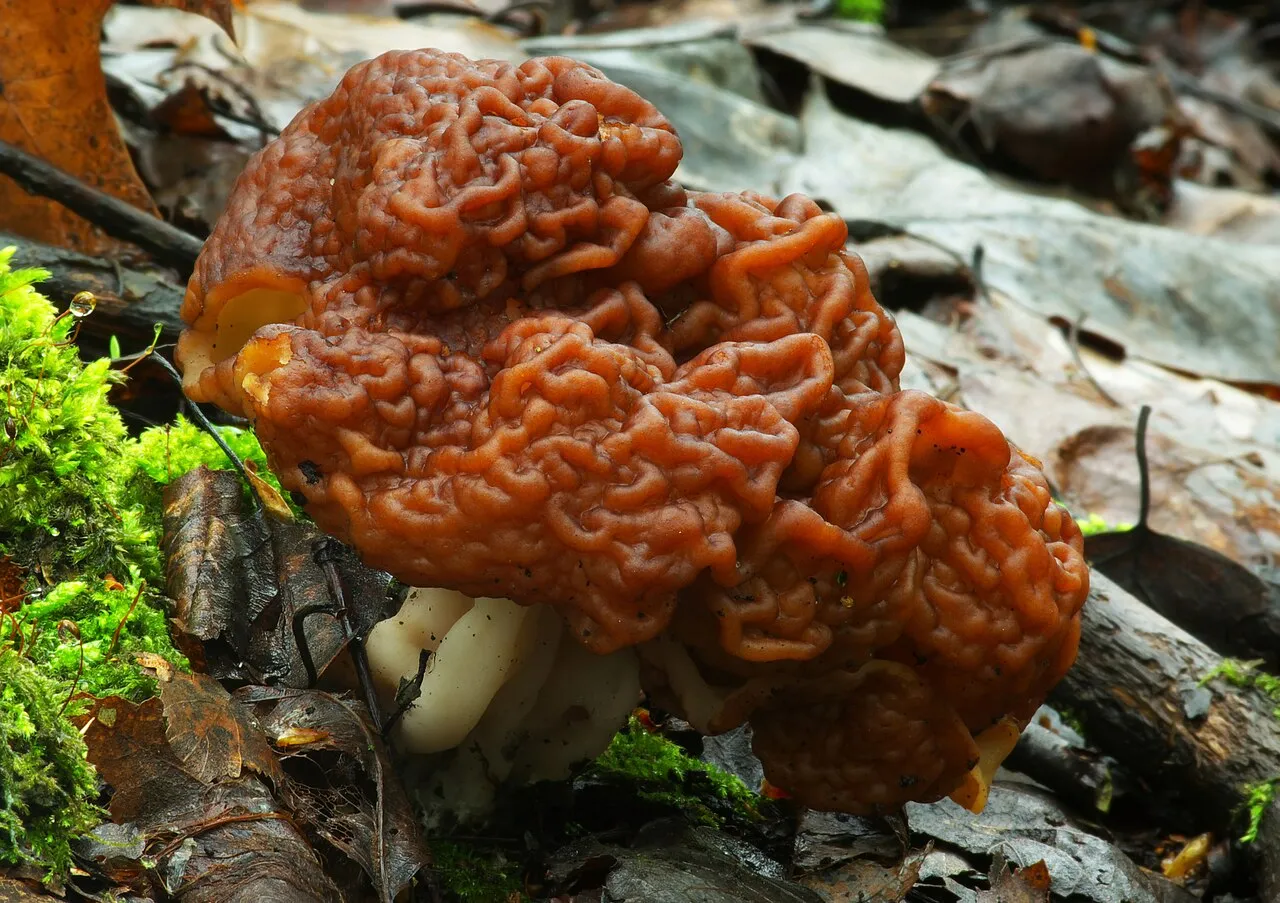
The cap resembles a human brain — wrinkled, lobed, and irregular. This appearance is the key to distinguishing the false morel from true morels.
Cap
- Diameter: 4–12 cm
- Shape: brain-like — irregularly lobed, bumpy, wrinkled
- Colour: light brown to dark chestnut
- Surface: deeply folded with convoluted furrows (NOT honeycomb-like, as in morels)
- Key difference from morels: folds are random, not forming a regular honeycomb pattern
Stem
- Height: 3–7 cm
- Width: 2–5 cm
- Colour: whitish to cream
- Structure: hollow or with irregular chambers, brittle
Flesh
- Colour: whitish, thin, brittle
- Smell: pleasant, mushroomy
- Taste: pleasant (DO NOT taste raw!)
Spore print
Cream.
Where and when
Season in Portugal
- Main season: March–May (an early spring species)
- One of the first mushrooms of the season — appears when forest mushrooms are not yet growing
Habitats in Portugal
- Pine forests — under pines, on sandy soils
- Mixed forests — on forest edges, clearings
- Logged areas and burned ground — often on disturbed sites
- Saprotroph — grows on dead wood or organic-rich soil
Look-alikes
Comparison with the morel
| Feature | False morel (Gyromitra) | Morel (Morchella) |
|---|---|---|
| Cap | Brain-like, wrinkled, lobed | Honeycomb (like a sponge), regular |
| Folds | Random, chaotic | Regular pits |
| Stem | Chambered, not truly hollow | Hollow — single cavity from cap to base |
| Cap colour | Chestnut | Yellowish-brown to grey |
| Season | Early spring (March–April) | Spring (April–May) |
Safety rule
If the cap folds are chaotic (like a brain), not honeycomb (like a sponge) — it is a false morel. Do not collect if you are not 100% certain.
Toxicology
Gyromitrin
- Compound: gyromitrin (N-methyl-N-formylhydrazone of acetaldehyde)
- Metabolism: hydrolysed in the body to monomethylhydrazine (MMH) — a highly toxic compound
- MMH — a rocket fuel component, hepatotoxin, possible carcinogen
Poisoning symptoms (6–12 hours after ingestion)
- Phase 1 (6–12 h): nausea, vomiting, watery diarrhoea, abdominal pain
- Phase 2 (24–48 h): jaundice, right upper quadrant pain — liver damage
- Phase 3 (severe cases): kidney failure, methaemoglobinaemia, coma
- Mortality: 10–30% without intensive care
First aid
- Call 112 immediately
- Call CIAV: 808 250 143
- Do not induce vomiting
- Save remaining mushrooms and vomit for analysis
- Prepare for hospitalisation — intensive care may be required
See Also
Safety:
Species:
Image sources
- gyromitra-esculenta.webp — False morel (Gyromitra esculenta). Author: Kruczy89. License: CC0. Source
Sources
- Persoon C.H. — Synopsis methodica fungorum (1801) — original description
- Michelot D., Toth B. — Poisoning by Gyromitra esculenta — a review. Journal of Applied Toxicology (1991)
- Flammer R., Schenk-Jäger K. — Gyromitrin poisoning. Swiss Medical Weekly (2018)
- BioDiversity4All / GBIF Portugal — occurrence records of Gyromitra esculenta
- First-Nature — Gyromitra esculenta, False Morel
Disclaimer: Identifying mushrooms from descriptions and photographs on the internet is not a substitute for consulting an experienced mycologist. The authors assume no responsibility for the consequences of collecting and consuming mushrooms. If you suspect mushroom poisoning, call 112 immediately.
All our knowledge is free. Creating it is not.
☕ Support on Ko-fi