Hedgehog Mushroom
 Edible
| Scientific name | Hydnum repandum |
| Family | Hydnaceae |
| Portuguese name | Pé-de-carneiro, Carneirinha, Língua-de-vaca |
| English name | Hedgehog mushroom, Wood hedgehog |
| Season | October, November, December, January |
| Habitat | Pine forest, Oak forest, Chestnut forest, Mixed forest |
Description
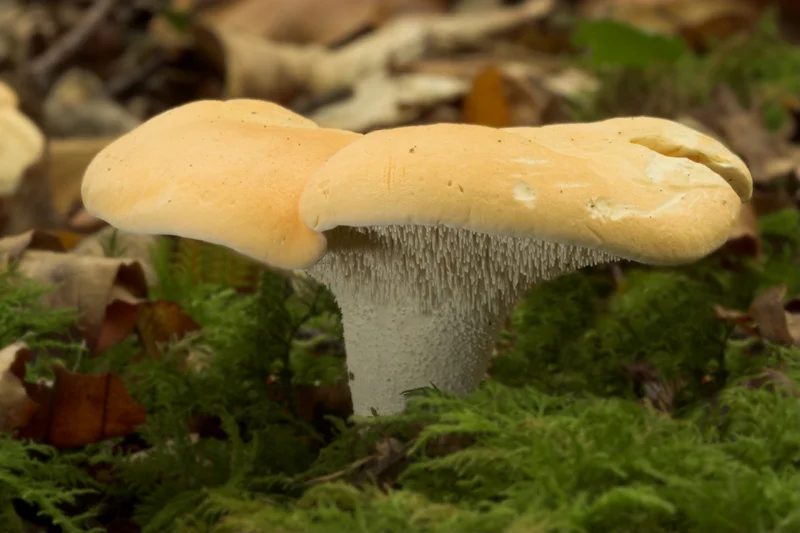
Hydnum repandum (hedgehog mushroom, wood hedgehog) is one of the safest and most recognisable edible mushrooms. Its unique feature is spines (teeth) on the underside of the cap instead of gills or tubes. In Portugal it is known as “pé-de-carneiro” (sheep’s foot — a calque from the French “pied de mouton”), as well as “carneirinha”, “língua-de-vaca” (cow’s tongue) and “língua-de-gato” (cat’s tongue).
Economic importance: Hydnum repandum is the leading commercially harvested wild mushroom in Portugal, accounting for approximately 50% of the total volume of commercialised wild mushrooms.
Cap
- Diameter: 5–17 cm
- Shape: irregular, broadly convex to flat; may become concave with age
- Colour: pale orange, cream, ochre-yellow to light brown
- Surface: dry, smooth or slightly felty
- Margin: wavy, often recurved (hence the species name repandum — “turned back”)
Stem
- Height: 3–10 cm
- Width: 1–3 cm
- Position: central or eccentric
- Colour: white to pale yellow
- Surface: smooth, dry, solid (not hollow)
- Ring: absent
Flesh
- Colour: white, firm, brittle
- Smell: mild, faint, with slight notes of orange blossom
- Taste: nutty, mild in young specimens; may become bitter in older ones
Hymenophore (spines)
- Type: spines (teeth) — the key diagnostic feature
- Length: 1–7 mm
- Colour: white to pale cream
- Arrangement: densely packed, slightly decurrent (running down the stem)
- Feature: easily detach from the flesh when pressed
Spore print
White.
Where and when
Season in Portugal
- Main season: October–January
- May continue into February–March in mild winters
- Appears after the first autumn rains
- One of the mushrooms that fruits in winter
Habitats in Portugal
- Coniferous forests — mainly under maritime pine (Pinus pinaster). According to Aromas & Boletos, collected “predominantly in coniferous forests”
- Broadleaf forests — under oaks (Quercus spp.) and chestnuts (Castanea sativa)
- Mixed forests — the most typical habitat
- Forms ectomycorrhiza with a wide range of trees — a generalist among mycorrhizal fungi
- Grows on soil, among moss and leaf litter
- Recorded from the north (Vila Real, Viseu) to the south (Beja, Almodôvar), including Madeira and the Azores
Commercial importance
- Accounts for approximately 50% of all commercially traded wild mushrooms in Portugal
- Total wild mushroom sales in Portugal: 30–40 tonnes/year
- Most of the harvest is exported to operators in France, Spain and Germany
- Price: from 5 EUR/kg (seasonal) to 28 EUR/kg (gourmet format)
Look-alikes
The hedgehog mushroom is one of the safest mushrooms to forage. The spines on the underside of the cap make it virtually unmistakable. Among mushrooms with a spiny hymenophore, there are no poisonous species.
| Species | How to distinguish |
|---|---|
| Terracotta hedgehog (Hydnum rufescens) | Smaller, more vivid reddish colour, spines do not run down the stem. Edible |
| Pale hedgehog (Hydnum pallidum) | White to pale grey, yellows/oranges when damaged. Edible |
Safety rule
Spines instead of gills or tubes — a reliable sign of hedgehog mushrooms. All species in the genus Hydnum are edible. This makes the hedgehog mushroom ideal for beginner foragers.
Culinary use
The hedgehog mushroom is a versatile culinary mushroom with a nutty flavour and firm texture.
Preparation
- Cleaning: with a dry brush (do not wash — it becomes waterlogged)
- Spines: it is recommended to remove them — they contain the main bitterness
- Older specimens: blanching removes bitterness
Preparation methods
- Pan-frying — in butter with garlic (the classic method, brings out the nutty flavour)
- Stewing — in casseroles and stews; holds its shape well during prolonged cooking
- In cream sauces — with cream
- Omelettes — sliced with eggs
- Drying — dries well; can be ground into powder for sauces
Notes
- Young specimens are the tastiest (no bitterness)
- The firm texture is well preserved during cooking
- Aromas & Boletos (Portugal) produces a hedgehog mushroom pâté — a unique product highlighted by Revista de Vinhos magazine
Image sources
- hydnum-repandum.webp — Hedgehog mushroom (Hydnum repandum). Author: D J Kelly. License: Public domain. Source
See Also
Habitats:
Related articles:
Sources
- Naturdata — Hydnum repandum em Portugal
- Aromas & Boletos — Hydnum repandum fresco (boletosdeorum.pt)
- DRAPC — Cogumelos Silvestres em Portugal
- BioDiversity4All / GBIF Portugal — species records
- First-Nature — Hydnum repandum identification
- Reforma Agrária — Cogumelos: Hydnum repandum
- Revista de Vinhos — Patê de Hydnum repandum
Disclaimer: Identifying mushrooms from descriptions and photographs on the internet is not a substitute for consulting an experienced mycologist. The authors assume no responsibility for the consequences of collecting and consuming mushrooms.
The light is on for free. But someone has to clean the lantern.
☕ Support on Ko-fi