Deadly Fibrecap
 Toxic
Toxic| Scientific name | Inocybe erubescens |
| Family | Inocybaceae |
| Portuguese name | Inocibe-vermelho |
| English name | Deadly fibrecap, Red-staining inocybe |
| Season | May, June, July |
| Habitat | Oak forest, Mixed forest |
Description
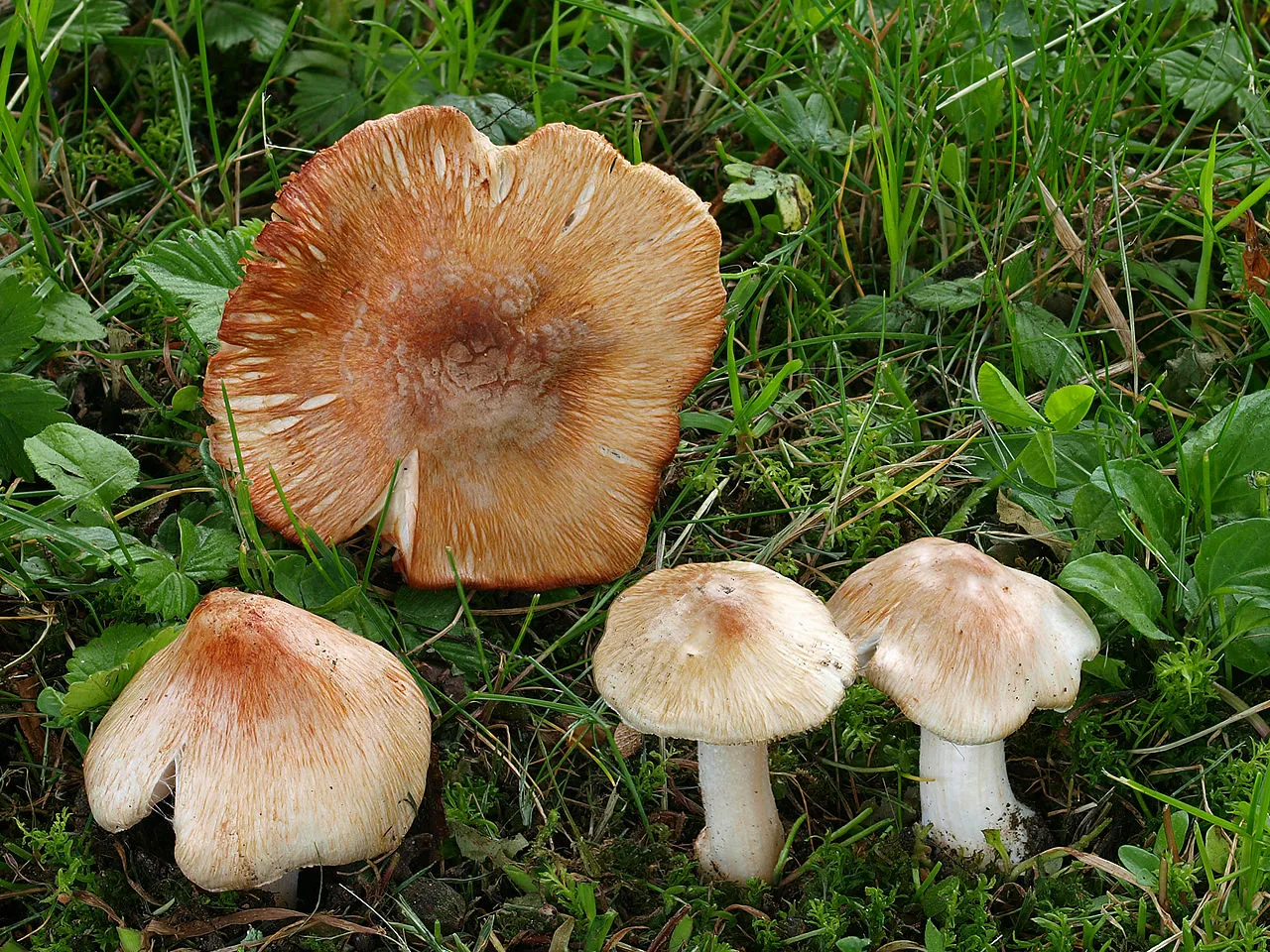
Inocybe erubescens (deadly fibrecap, red-staining inocybe) is a deadly poisonous mushroom containing muscarine in concentrations up to 20 times that of the fly agaric. Synonym: Inocybe patouillardii. Named after the French mycologist Narcisse Théophile Patouillard.
Described by Elias Magnus Fries. One of the most dangerous mushrooms in Europe — fatalities have been recorded.
Cap
- Diameter: 3–9 cm
- Shape: conical when young, then convex with a pronounced umbo
- Colour: white to cream; reddens when damaged
- Surface: smooth, silky-fibrous, with radial cracks when mature
Gills
- Young: white to cream
- Mature: olive-brown
- Key feature: redden or brown when damaged
- Attachment: adnate
- Spacing: crowded
Stem
- Height: 4–10 cm
- Width: 1–2 cm
- Colour: white; reddens when damaged
- Surface: longitudinally fibrous
- Ring: absent
Flesh
- Colour: white; when damaged turns pink then red
- Smell: faint, fruity
- Taste: mild (DO NOT taste!)
Spore print
Brown.
Where and when
Season in Portugal
- Main season: May–July (an early, spring–summer species!)
- One of the few dangerous mushrooms of the early season
Habitats in Portugal
- Oak forests — under Quercus spp.
- Mixed forests — under deciduous trees
- Parks and gardens — sometimes under ornamental trees
- Ectomycorrhizal fungus — forms mycorrhiza with deciduous trees
- Prefers calcareous soils
Look-alikes
| Species | How to distinguish |
|---|---|
| Field mushroom (Agaricus campestris) | Grows in meadows (not forests). Gills pink→brown. Spore print dark brown |
| Sweetbread mushroom (Clitopilus prunulus) | Mealy smell. Gills pink, decurrent. Without fibrous cap |
| Other fibrecaps (Inocybe spp.) | Many species also contain muscarine. All fibrecaps should be treated as poisonous |
Safety rule
Do not collect fibrecaps. The genus Inocybe contains hundreds of species, many of which are poisonous, and identification to species level is extremely difficult even for experts.
Muscarine poisoning
Mechanism
Muscarine is a parasympathomimetic. It activates muscarinic cholinergic receptors, causing SLUDGE syndrome.
Symptoms (within 15–30 minutes)
- S — Salivation
- L — Lacrimation
- U — Urination
- D — Defecation / Diarrhoea
- G — GI distress
- E — Emesis (vomiting)
Also: profuse sweating, pupil constriction (miosis), slowed pulse (bradycardia), hypotension.
Antidote
Atropine — the specific antidote. Administered intravenously in a hospital setting.
First aid
- Call 112 immediately
- Call CIAV: 808 250 143
- Do not induce vomiting
- Save remaining mushrooms for identification
- Mention mushrooms when calling emergency services
Prognosis
With timely atropine administration — full recovery. Without treatment, death is possible from cardiac or respiratory failure.
See Also
Safety:
Image sources
- inocybe-erubescens.webp — Deadly fibrecap (Inocybe erubescens). Author: Andreas Kunze. License: CC BY-SA 3.0. Source
Sources
- Bresadola G. — Iconographia Mycologica — descriptions and illustrations
- Benjamin D.R. — Mushrooms: Poisons and Panaceas (1995) — muscarine toxicology
- BioDiversity4All / GBIF Portugal — occurrence records
- CIAV (Centro de Informação Antivenenos) — muscarinic poisoning protocol
- First-Nature — Inocybe erubescens, Deadly Fibrecap
Disclaimer: Identifying mushrooms from descriptions and photographs on the internet is not a substitute for consulting an experienced mycologist. The authors assume no responsibility for the consequences of collecting and consuming mushrooms. If you suspect mushroom poisoning, call 112 immediately.
The light is on for free. But someone has to clean the lantern.
☕ Support on Ko-fi