Saffron Milk Cap
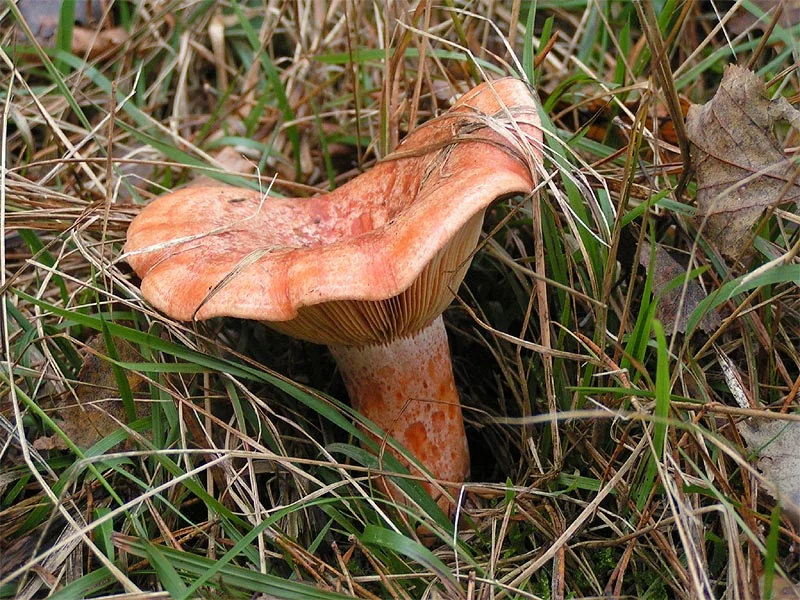 Edible
| Scientific name | Lactarius deliciosus |
| Family | Russulaceae |
| Portuguese name | Míscaro-laranja, Sancha, Míscaro |
| English name | Saffron milk cap |
| Season | October, November, December |
| Habitat | Pine forest |
Description
Lactarius deliciosus (saffron milk cap) is one of the most prized edible mushrooms in Europe. Its distinguishing feature is the orange milk that exudes when the flesh is damaged and gradually turns green on exposure to air. In Portugal it is known as “míscaro-laranja” (orange míscaro) and “sancha”, or simply “míscaro” in some regions.
Cap
- Diameter: 5–15 cm
- Shape: depressed in the centre, funnel-shaped when mature
- Colour: orange, carrot-coloured, with darker concentric zones
- Surface: smooth, slightly sticky in wet weather
- Margin: inrolled when young, later flattening out
- Feature: turns green when damaged — a characteristic trait
Stem
- Height: 3–7 cm
- Width: 1.5–3 cm
- Colour: orange, with lighter pits (scrobiculations)
- Surface: smooth, often with a pitted texture
- Ring: absent
- Feature: hollow in mature specimens
Flesh
- Colour: pale orange
- Milk: orange-red, copious, turning green within 15–30 minutes on exposure to air — the key diagnostic feature
- Smell: pleasant, fruity, with hints of pine resin
- Taste: mild, slightly sweet
Gills
- Colour: orange, turning green when damaged
- Attachment: slightly decurrent
- Spacing: crowded
Spore print
Pale ochre.
Where and when
Season in Portugal
- Main season: October–December
- Mass fruiting after the first autumn rains
- One of the earliest mushrooms of the autumn season in pine forests
Habitats in Portugal
- Exclusively pine forests — forms ectomycorrhiza only with pines (Pinus)
- Main partners: maritime pine (Pinus pinaster), Scots pine (Pinus sylvestris)
- Centro (Beiras) and Norte — main collection areas
- Alentejo — in maritime pine plantations
- Prefers sandy and acidic soils
- Often grows in groups, sometimes forming fairy rings
Economic importance
The saffron milk cap is one of the most commercially important mushrooms in Portugal and Spain. Actively collected and sold at local markets. The name “míscaro” in central Portugal may refer to both the saffron milk cap and other prized species.
Look-alikes
| Species | How to distinguish |
|---|---|
| Woolly milk cap (Lactarius torminosus) | Milk is white (not orange!). Cap is pink with a shaggy margin. Toxic when raw |
| False saffron milk cap (Lactarius deterrimus) | Orange milk but paler. Grows under spruce (not pine). Less flavourful but edible |
| Bloody milk cap (Lactarius sanguifluus) | Milk is dark red (not orange). Found in Mediterranean forests. Edible |
| Other milk caps (Lactarius spp.) | Many milk caps have white or yellow milk. Orange milk is a reliable sign of the saffron milk cap group |
Safety rule
Orange milk that turns green on exposure to air is a reliable sign of saffron milk caps. Mushrooms with white milk and a shaggy cap margin are other milk caps, often inedible.
Culinary use
The saffron milk cap is one of the finest culinary mushrooms, with a delicate fruity flavour.
Preparation methods
- Grilling — whole or halved, with olive oil and garlic. The classic Mediterranean method
- Pan-frying — with onion and herbs
- Salting — a traditional eastern European method (cold and hot salting)
- Pickling — with vinegar and spices
Notes
- One of the few mushrooms that can be eaten lightly cooked (grilled for 3–5 minutes)
- May colour dishes orange when cooked
- Greenish spots on the flesh are normal (oxidation of the milk), not a sign of spoilage
- Young specimens with firm flesh are the most prized
Image sources
- lactarius-deliciosus.webp — Saffron milk cap (Lactarius deliciosus). Author: Wikimedia Commons. License: CC BY-SA 3.0. Source
See Also
Habitats:
Related articles:
Sources
- Fungipedia Portugal — Lactarius deliciosus
- Naturdata — Lactarius deliciosus em Portugal
- BioDiversity4All / GBIF Portugal — species records
- First-Nature — Lactarius deliciosus identification
- Museu Virtual da Biodiversidade — Universidade de Évora
Disclaimer: Identifying mushrooms from descriptions and photographs on the internet is not a substitute for consulting an experienced mycologist. The authors assume no responsibility for the consequences of collecting and consuming mushrooms.
If this article was useful — help us write the next one.
☕ Support on Ko-fi