Brown Birch Bolete
 Edible
| Scientific name | Leccinum scabrum |
| Family | Boletaceae |
| Portuguese name | Boleto-escabroso |
| English name | Brown birch bolete, Birch bolete |
| Season | September, October, November |
| Habitat | Mixed forest |
| Look-alikes | Porcini |
Description
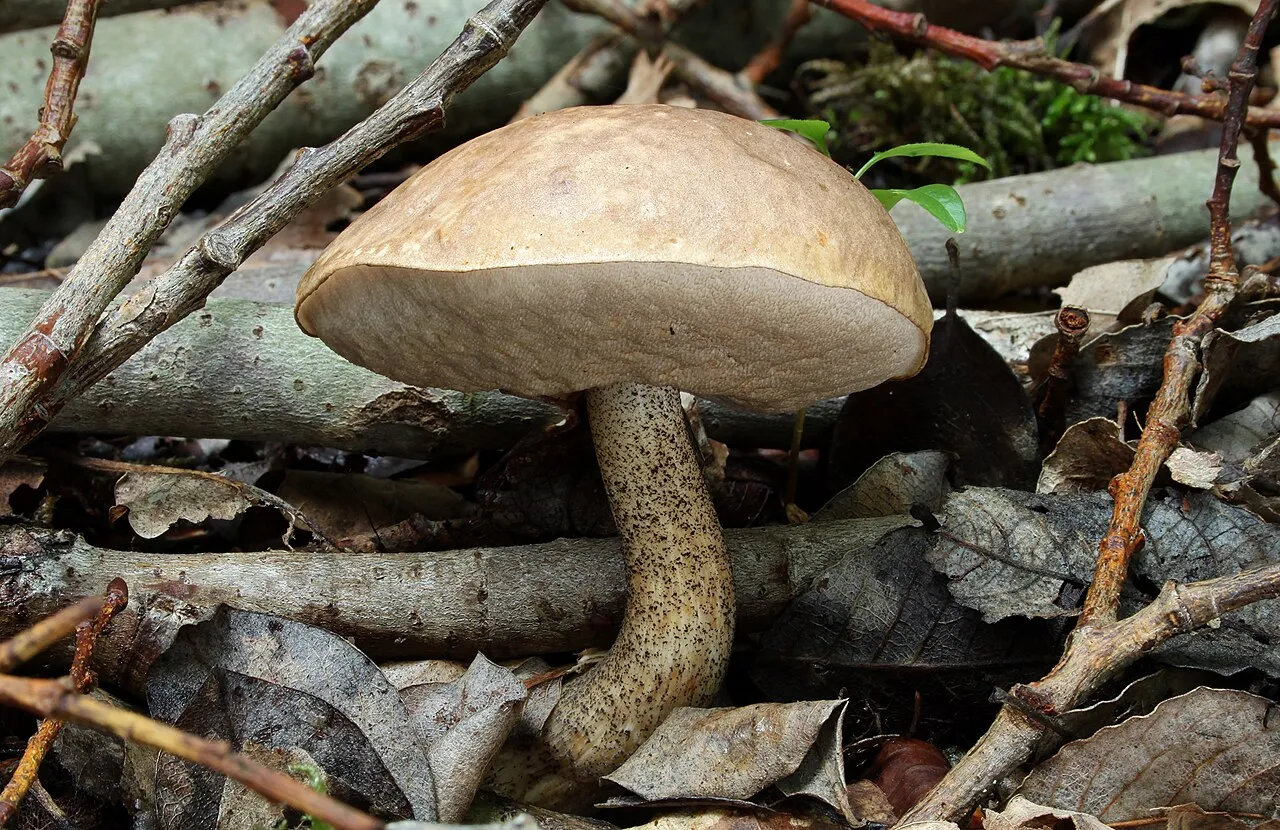
Leccinum scabrum (brown birch bolete) is a widespread edible bolete, an obligate mycorrhizal partner of birch trees. In Portugal it is found in the mountain forests of Serra do Gerês, where Betula celtiberica (Celtiberian birch) grows. The characteristic black scabers (scales) on the white stem are the hallmark of the genus Leccinum.
Described by Pierre Bulliard in 1783 (as Boletus scaber). Transferred to the genus Leccinum by Samuel Frederick Gray in 1821.
Cap
- Diameter: 5–15 cm
- Shape: hemispherical when young, then convex to cushion-shaped
- Colour: greyish-brown to dark brown
- Surface: smooth or slightly velvety; slightly sticky in wet weather
Tube layer
- Pores: small, round
- Colour: whitish when young, then greyish-brown
- Reaction: does not change or slightly browns when pressed
Stem
- Height: 8–20 cm
- Width: 1.5–3 cm
- Shape: cylindrical, slightly widening towards the base
- Key feature: white surface covered with black or dark brown scabers (scales)
Flesh
- Colour: white; turns slightly pink or grey when cut; blackens when boiled (normal for birch boletes)
- Smell: faint, pleasant, mushroomy
- Taste: mild
- Texture: soft; in older specimens — spongy and watery
Spore print
Olive-brown.
Where and when
Season in Portugal
- Main season: September–November
- Peak: October
- Tied to the start of autumn rains
Habitats in Portugal
- Mountain forests of Serra do Gerês — the main range in Portugal, where Betula celtiberica (Celtiberian birch) grows
- Serra da Estrela — at elevations with birch trees
- Ectomycorrhizal fungus — obligately associated with birch; does not grow without birch
Look-alikes
| Species | How to distinguish |
|---|---|
| Porcini (Boletus edulis) | Stem without black scabers, with a white reticulum. Flesh does not darken. Tube layer olive in mature specimens |
| Slate bolete (Leccinum duriusculum) | Under aspens/poplars. Flesh pinks then darkens more intensely |
| White birch bolete (Leccinum holopus) | Paler, cap nearly white. Also under birch |
Safety rule
All species in the genus Leccinum are edible after cooking. There are no dangerous look-alikes. Darkening of the flesh during cooking is normal.
Culinary use
Preparation methods
- Frying — slice and fry until golden
- Soups — classic mushroom soup
- Drying — a traditional preservation method; blackens when dried (normal)
- Pickling — young firm specimens
Notes
- Young specimens with firm flesh are the most prized
- Older specimens with soft watery flesh are best dried
- Do not eat raw — requires cooking
- Darkening of flesh during cooking is perfectly normal and does not affect flavour
See Also
Habitats:
Related articles:
Image sources
- leccinum-scabrum.webp — Brown birch bolete (Leccinum scabrum). Author: Holger Krisp. License: CC BY 3.0. Source
Sources
- Bulliard P. — Herbier de la France (1783) — original description as Boletus scaber
- Breitenbach J., Kränzlin F. — Fungi of Switzerland, Vol. 3 (1991)
- BioDiversity4All / GBIF Portugal — occurrence records of Leccinum scabrum
- Pinho-Almeida F. et al. — Macrofungi of Peneda-Gerês National Park (2012)
- First-Nature — Leccinum scabrum, Brown Birch Bolete
Disclaimer: Identifying mushrooms from descriptions and photographs on the internet is not a substitute for consulting an experienced mycologist. The authors assume no responsibility for the consequences of collecting and consuming mushrooms. If you suspect mushroom poisoning, call 112 immediately.
All our knowledge is free. Creating it is not.
☕ Support on Ko-fi