Parasol Mushroom
 Edible
| Scientific name | Macrolepiota procera |
| Family | Agaricaceae |
| Portuguese name | Púcara, Roca, Frade |
| English name | Parasol mushroom |
| Season | September, October, November |
| Habitat | Meadow, Montado, Mixed forest, Pine forest |
Description
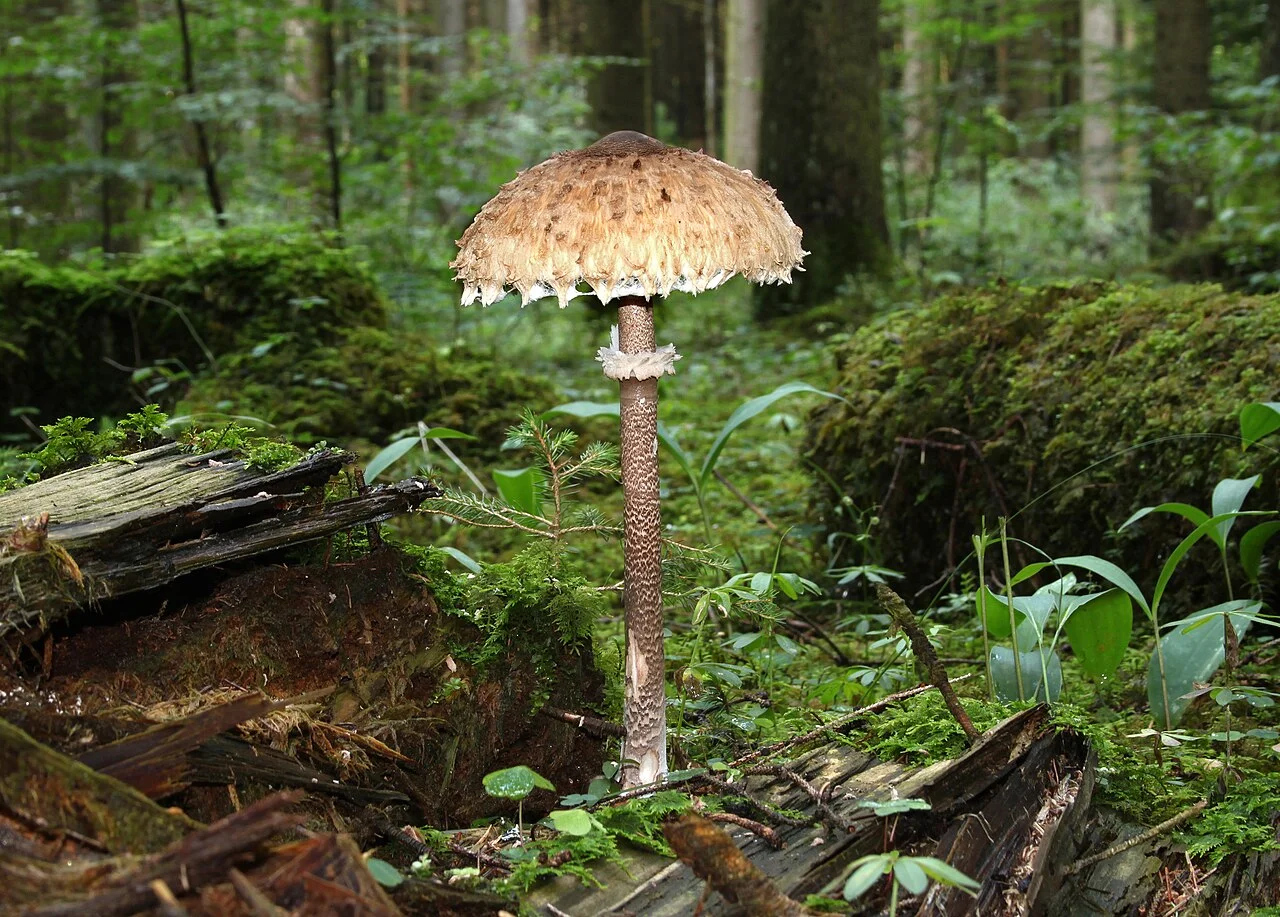
Macrolepiota procera (parasol mushroom) is one of the largest gilled mushrooms in Europe. When fully opened, it resembles a parasol — hence the name. Highly prized for the delicate flesh of its cap. In Portugal it is known as “púcara”, “roca” and “frade” (monk — after the shape of the unopened fruiting body).
Cap
- Diameter: 10–40 cm (one of the largest mushrooms!)
- Shape: egg-shaped when young, later parasol-shaped with a central umbo
- Colour: beige, light brown with large brown scales
- Centre: darker, smooth
- Margin: thin, sometimes overhanging
Stem
- Height: 15–40 cm
- Width: 1–2.5 cm
- Colour: brownish
- Surface: covered with a snakeskin pattern (dark brown scales on a light background) — key identifying feature
- Ring: large, double, freely movable up and down the stem — the most important diagnostic feature
- Base: bulbous
Flesh
- Colour: white, does not change colour when cut
- Smell: pleasant, nutty
- Taste: mild, pleasant
- Feature: cap flesh is soft and tender; stem flesh is tough, fibrous — the stem is not eaten
Gills
- Colour: white, becoming cream with age
- Attachment: free (not attached to the stem)
- Spacing: crowded
Spore print
White.
Where and when
Season in Portugal
- Main season: September–November
- Appears after autumn rains
- May fruit until December in mild years
Habitats in Portugal
- Meadows and pastures — main habitat
- Forest edges, clearings, roadsides
- Montado (cork oak forests) — in open areas
- Pine forests — in clearings
- Grows on soil, saprotroph (feeds on decaying organic matter)
- Prefers sandy and light soils
- Found throughout continental Portugal
Look-alikes
| Species | How to distinguish |
|---|---|
| Deadly dapperling (Lepiota brunneoincarnata) | DEADLY POISONOUS! Size small (cap 2–7 cm). Ring immovable. No snakeskin pattern on stem. Grows in parks and gardens |
| Pinkish dapperling (Lepiota helveola) | DEADLY POISONOUS! Size small (cap 2–5 cm). Contains amatoxins. Scales pinkish-brown |
| Green-spored parasol (Chlorophyllum molybdites) | Poisonous (severe gastroenteritis). Spore print greenish (not white!). Rare in Portugal |
| Shaggy parasol (Chlorophyllum rhacodes) | Edible (but causes GI upset in some people). Flesh reddens when cut. No snakeskin pattern on stem |
Safety rule
Three signs of the true parasol mushroom:
- Large size — cap over 15 cm
- Movable ring — slides freely up and down the stem
- Snakeskin pattern — dark scales on the stem forming a “snakeskin”
If any of these signs is absent — do not collect the mushroom.
Culinary use
The parasol mushroom is a delicacy highly prized in European cuisine.
Preparation methods
- “Schnitzel” — the classic method: dip the cap in egg and breadcrumbs, then fry. The most popular recipe
- Pan-frying — sliced caps with garlic and herbs
- Grilling — whole caps on the grill with olive oil
- Drying — dries well, aroma intensifies
Notes
- Only caps are used — stems are too fibrous
- Best to collect young specimens while the cap is still not fully opened
- Can be eaten raw in salads (one of the few mushrooms suitable for this)
Image sources
- macrolepiota-procera.webp — Parasol mushroom (Macrolepiota procera). Author: Holger Krisp. License: CC BY 3.0. Source
See Also
Habitats:
Related articles:
Sources
- Fungipedia Portugal — Macrolepiota procera
- Naturdata — Macrolepiota procera em Portugal
- BioDiversity4All / GBIF Portugal — species records
- First-Nature — Macrolepiota procera identification
- MushroomExpert.com — Macrolepiota procera
Disclaimer: Identifying mushrooms from descriptions and photographs on the internet is not a substitute for consulting an experienced mycologist. The authors assume no responsibility for the consequences of collecting and consuming mushrooms.
If this article was useful — help us write the next one.
☕ Support on Ko-fi