Common Morel
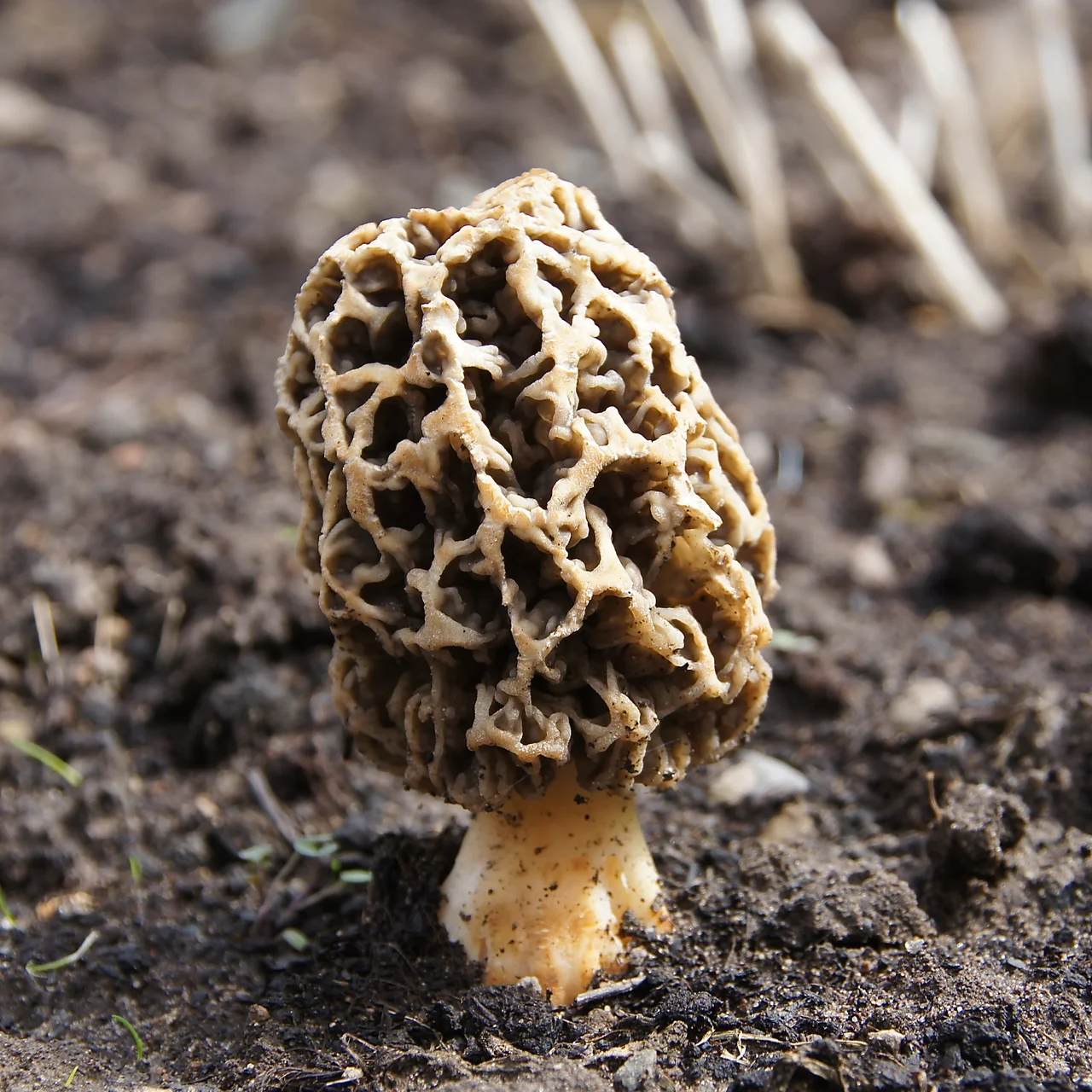 Conditionally edible
| Scientific name | Morchella esculenta |
| Family | Morchellaceae |
| Portuguese name | Pantorra, Morchela |
| English name | Common morel, Yellow morel |
| Season | March, April, May |
| Habitat | Oak forest, Chestnut forest, Pine forest, Mixed forest |
| Look-alikes | False Morel |
Description
Morchella esculenta (common morel, yellow morel) is one of the most prized and sought-after spring mushrooms in Europe. It belongs to the division Ascomycota (sac fungi), distinguishing it from most familiar mushroom species. Its characteristic honeycomb-like cap makes the morel virtually unmistakable — provided it is not confused with the false morel.
Cap
- Height: 4–10 cm
- Shape: ovoid to conical, honeycomb-like — with a network of ridges and pits (alveoli)
- Colour: pale yellow to ochre-brown. Ridges lighter than the pits
- Surface: alveolate, with irregular polygonal depressions
- Attachment: attached to the stem at the base (fruiting body is hollow inside)
Stem
- Height: 3–8 cm
- Width: 2–4 cm
- Colour: white to cream
- Surface: slightly granular or mealy
- Feature: hollow inside (both stem and cap)
Flesh
- Colour: white, thin, brittle
- Smell: pleasant, mushroomy
- Taste: mild (when cooked — rich, nutty)
- Feature: the entire fruiting body is hollow — when cut in half, a single cavity runs from base to top
Spore print
Creamy-yellow. Spores are produced in asci on the surface of the pits.
Raw toxicity
- Contains thermolabile haemolysins — destroyed by heat
- Does not contain gyromitrin (that is a toxin of false morels, not true morels)
- Boiling for at least 10–15 minutes at a full boil is mandatory
- Drying is also effective — dried morels are safe after rehydration and subsequent cooking
Where and when
Season in Portugal
- Main season: late March – April (sometimes until May–June)
- One of the few spring mushrooms
- Fruiting triggered by soil warming to 10–15°C with sufficient moisture
- Harvest is unpredictable: abundant some years, absent in others
Habitats in Portugal
- Nordeste Transmontano (Trás-os-Montes) — main collection area
- Norte and Centro of Portugal
- In the south (Algarve) — virtually absent
- Under broadleaf trees: oak (Quercus), chestnut (Castanea), poplar (Populus)
- Under conifers: pine (Pinus)
- In Mediterranean woodlands: also under strawberry tree (Arbutus), olive (Olea), ash (Fraxinus)
- “Lameiros” (water meadows), “soutos” (chestnut groves), “pinhais” (pine forests)
Economic importance
The morel is one of the most expensive wild mushrooms. In Portugal, prices reach 20 EUR/kg fresh and up to 300 EUR/kg dried. Collecting “pantorras” is an important part of the rural economy in Trás-os-Montes.
Look-alikes
| Feature | Morel (Morchella) | False morel (Gyromitra esculenta) |
|---|---|---|
| Cap | Honeycomb-like — regular pits with distinct ridges | Brain-like — convoluted, without regular pits |
| Interior | Hollow fruiting body | Chambered (not hollow, with internal partitions) |
| Toxin | Haemolysins (thermolabile) | Gyromitrin → monomethylhydrazine (heat-resistant!) |
| Processing | Cooking makes it safe | Cooking does not guarantee safety |
Safety rule
If the mushroom’s cap is convoluted and brain-like (not honeycomb-like) — it is not a morel. Do not collect it.
Culinary use
The morel is a gourmet mushroom with a unique flavour, highly prized in European and Portuguese cuisine.
Preparation methods
- Mandatory: pre-boil for 10–15 minutes, discard the water
- Pan-frying — after boiling, with onion and garlic
- Cream sauces — a classic pairing, especially with meat and game
- Dried: soak in warm water for 20–30 minutes; use soaking liquid for stock. Aroma intensifies when dried
Notes
- The hollow fruiting body may contain insects and dirt — wash thoroughly before cooking
- Young, firm specimens are the most prized
- In Portugal, “pantorras” are a traditional delicacy of Trás-os-Montes
Image sources
- morchella-esculenta.webp — Morel (Morchella esculenta). Author: TOMMES-WIKI. License: CC BY-SA 3.0. Source
See Also
Habitats:
Related articles:
Sources
- Florestas.pt — Cogumelos da primavera que são preciosas iguarias
- Agroportal — Pantorras no Nordeste Transmontano
- Diário de Notícias — Morchella: 300 euros o quilo
- NAMA — Mushroom Poisoning Syndromes
- First-Nature — Morchella esculenta identification
- BioDiversity4All / GBIF Portugal — species records
Disclaimer: Identifying mushrooms from descriptions and photographs on the internet is not a substitute for consulting an experienced mycologist. The authors assume no responsibility for the consequences of collecting and consuming mushrooms.
All our knowledge is free. Creating it is not.
☕ Support on Ko-fi