Jack-o'-Lantern Mushroom
 Toxic
Toxic| Scientific name | Omphalotus olearius |
| Family | Omphalotaceae |
| Portuguese name | Cogumelo-da-oliveira |
| English name | Jack-o'-lantern mushroom |
| Season | July, August, September, October |
| Habitat | Oak forest, Cork oak |
| Look-alikes | Chanterelle |
Description
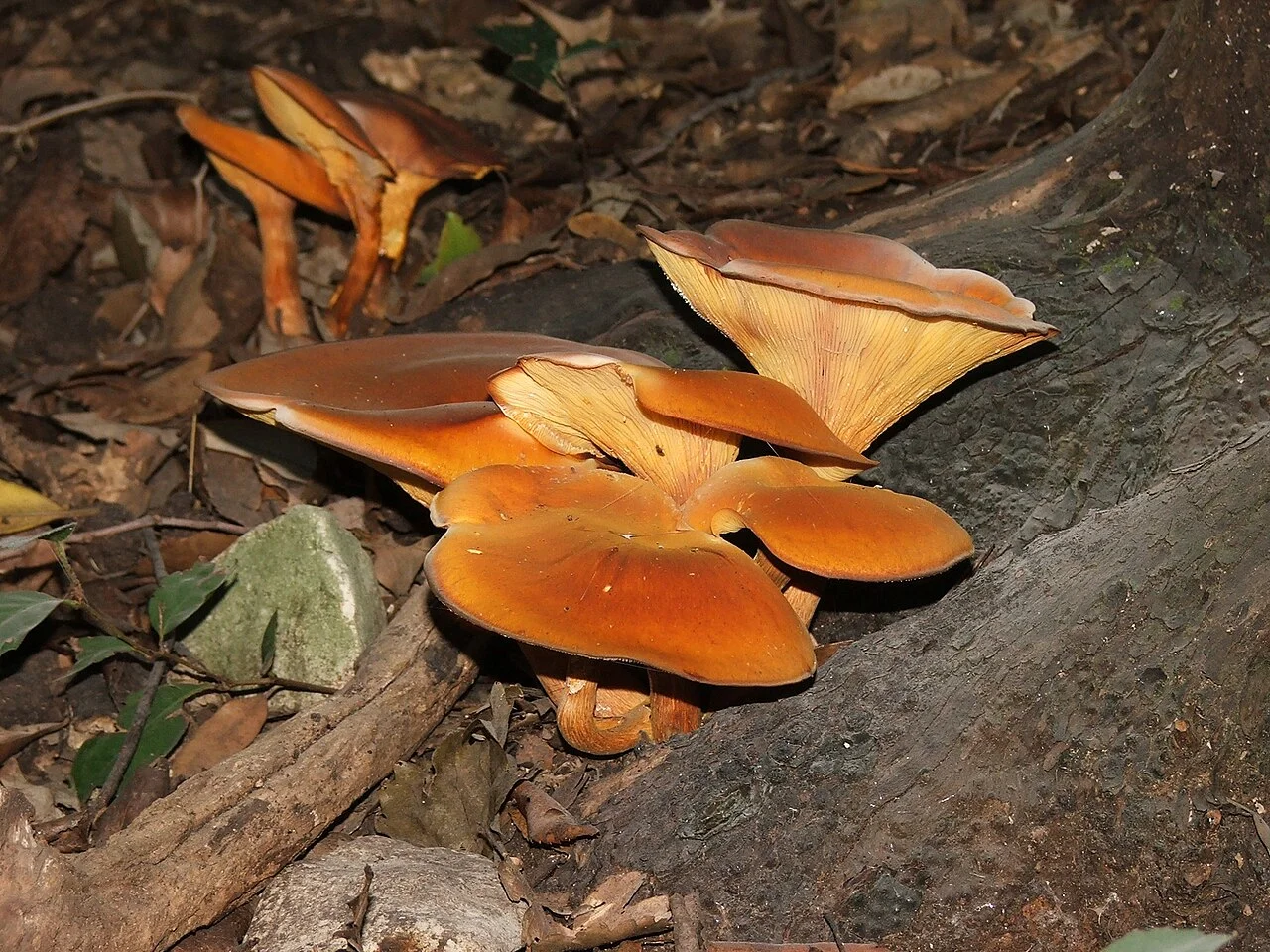
Omphalotus olearius (jack-o’-lantern mushroom) is a large, brightly orange poisonous mushroom that grows in clusters on dead wood. It possesses a unique ability — bioluminescence: its gills glow greenish in complete darkness. Native to the Mediterranean basin and widespread in Portugal.
Cap
- Diameter: 5–15 cm
- Shape: convex when young, later funnel-shaped (depressed in the centre)
- Colour: bright orange, pumpkin-orange. Uniformly intense colour inside and out
- Surface: smooth, slightly fibrous
- Margin: inrolled, wavy
Stem
- Height: 5–15 cm
- Width: 1–2.5 cm
- Colour: same colour as the cap (orange)
- Ring: absent
- Surface: smooth, often curved
- Base: tapering downwards, attached to wood
Flesh
- Colour: orange-yellow
- Smell: unpleasant, sweetish
- Taste: do not taste!
Spore print
Creamy-yellow.
Bioluminescence
A unique feature of Omphalotus olearius is its glowing gills in complete darkness. The greenish glow is caused by the enzymatic oxidation of luciferin by fungal luciferase. The glow is faint and only visible after prolonged adaptation to complete darkness (at least 10–15 minutes).
Toxicity
Toxin
- Illudin S (sesquiterpene) — the primary toxin. Alkylates DNA, damages rapidly dividing cells
- Muscarine was previously cited, but illudin S is responsible for the toxic effects
Mechanism: illudin S reacts with DNA, creating lesions that block transcription. Genotoxic — induces gene mutations.
Poisoning symptoms
| Parameter | Description |
|---|---|
| Onset | 30 minutes – 2 hours after ingestion |
| Duration | 18 hours – several days |
Manifestations:
- Severe abdominal cramps
- Intense nausea and vomiting
- Pronounced diarrhoea
- Weakness, dizziness, sweating
- Dehydration
Fatality: extremely rare. Recovery is usually complete, but the process can be agonisingly prolonged (up to several days).
Where and when
Season
- Main season: July–October (earlier than many other species)
- Characteristic of the Mediterranean climate
Habitats in Portugal
- Oak forests — on dead roots and stumps of holm oak and cork oak
- Olive groves — on dead olive wood (hence the name olearius)
- Grows in clusters on dead wood and buried roots
- Native to the Mediterranean basin
- Documented in Portugal on Wilder.pt and BioDiversity4All
Ecology
Saprotroph — decomposes dead wood. Unlike the chanterelle, which is a mycorrhizal fungus.
Look-alikes
Comparison with the chanterelle
| Feature | Jack-o’-lantern | Chanterelle |
|---|---|---|
| Gills | True, sharp, not forked | False ridges — blunt, forked, decurrent |
| Growth | In clusters on wood (stumps, roots) | Singly or in groups on soil |
| Colour | Pumpkin-orange, uniform | Egg-yellow, lighter inside |
| Flesh | Orange-yellow | Pale yellow, lighter when cut |
| Glow | Gills glow in the dark | No |
| Smell | Unpleasant, sweetish | Pleasant, fruity (apricot-like) |
| Size | Usually larger (up to 15 cm) | Usually smaller (3–10 cm) |
Safety rule
If you find a “chanterelle” growing in a cluster on a stump or dead root — it is NOT a chanterelle. True chanterelles always grow on soil.
Image sources
- omphalotus-olearius.webp — Jack-o’-lantern mushroom (Omphalotus olearius). Author: Antonio Abbatiello. License: Public domain. Source
See Also
Habitats:
Related articles:
Sources
- Kirchmair M. et al. — Toxicology and detoxification of illudin S // Toxicon, 2003
- Wilder.pt — Que espécie é esta: Omphalotus olearius
- BioDiversity4All / GBIF Portugal — species records
- First-Nature — Omphalotus olearius identification
- La Casa de las Setas — Olive mushroom
- Sociedade Portuguesa de Micologia
Disclaimer: Identifying mushrooms from descriptions and photographs on the internet is not a substitute for consulting an experienced mycologist. The authors assume no responsibility for the consequences of collecting and consuming mushrooms.
All our knowledge is free. Creating it is not.
☕ Support on Ko-fi