Oyster Mushroom
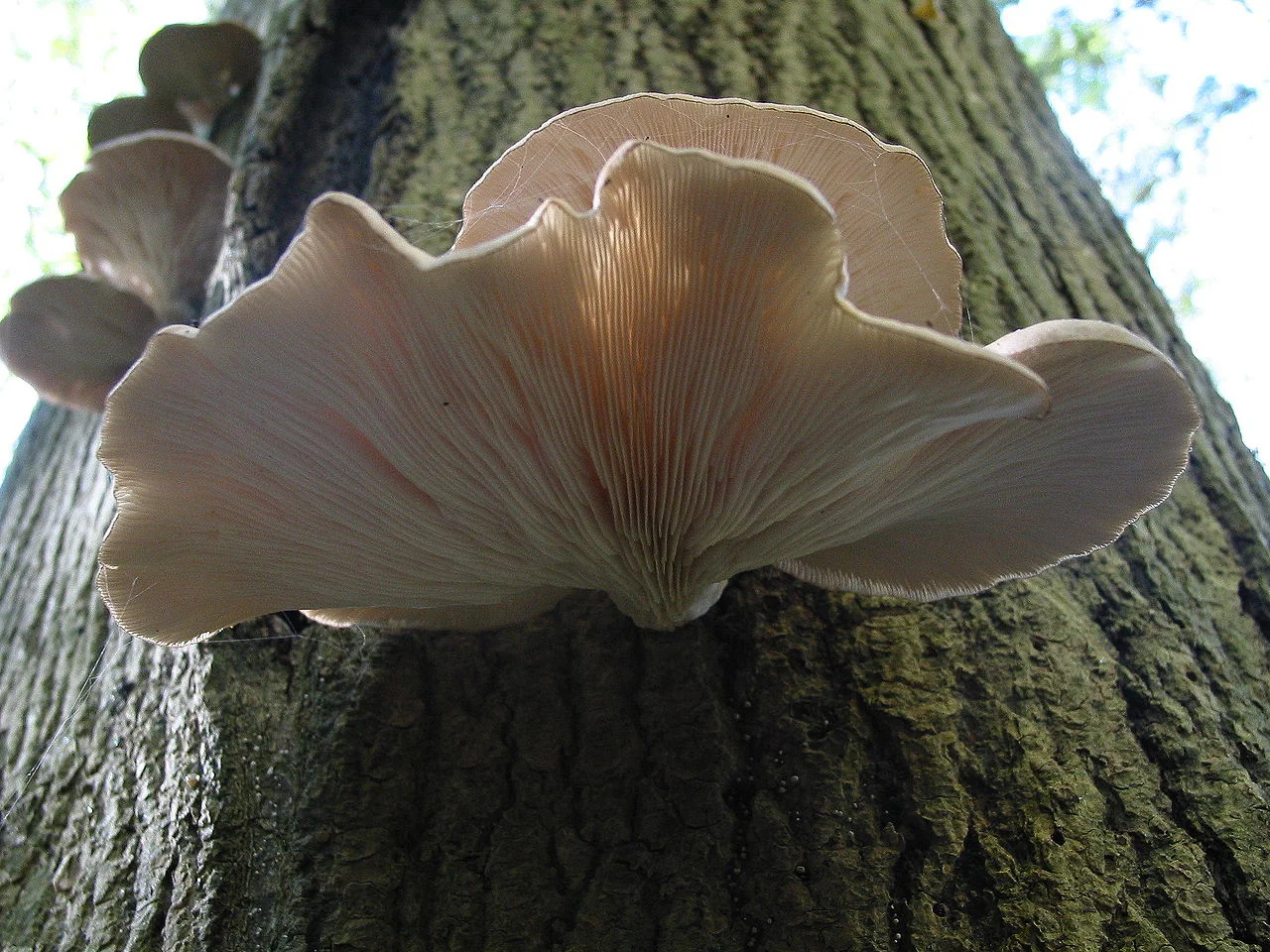 Edible
| Scientific name | Pleurotus ostreatus |
| Family | Pleurotaceae |
| Portuguese name | Repolga, Cogumelo-ostra, Pleuroto-ostra |
| English name | Oyster mushroom |
| Season | October, November, December, January, February, March |
| Habitat | Oak forest, Eucalyptus, Mixed forest |
Description
Pleurotus ostreatus (oyster mushroom) is one of the most common, accessible and recognisable mushrooms in the world. It grows on dead and weakened wood in characteristic shelf-like tiers. In Portugal it is known as “repolga” — a traditional folk name, as well as “cogumelo-ostra” (oyster mushroom) and “pé-de-botão”.
Cap
- Diameter: 5–25 cm
- Shape: fan-shaped, shell-shaped (hence the name “oyster mushroom”)
- Colour: white to grey, bluish-grey or brown. Darkens in cold weather
- Surface: smooth, slightly velvety
- Margin: thin, inrolled when young, later wavy
Stem
- Height: 1–4 cm (often virtually absent)
- Position: eccentric or lateral — the stem is offset towards the edge of the cap
- Colour: white
- Surface: firm, with velvety down at the base
Flesh
- Colour: white
- Smell: pleasant, mild, with hints of anise
- Taste: mild, delicate
- Texture: firm in young specimens, tough in older ones
Gills
- Colour: white, becoming cream to yellowish with age
- Attachment: strongly decurrent (running far down the stem) — a characteristic feature
- Spacing: moderate
Spore print
White to pale lilac.
Where and when
Season in Portugal
- Main season: October–March
- One of the few mushrooms that fruits during winter
- Actively grows at 5–20°C
- Appears after rains in the cold season
Habitats in Portugal
- Broadleaf trees — the main substrate. Grows on trunks, stumps and branches of:
- Poplar (Populus)
- Elm (Ulmus)
- Beech (Fagus)
- Oak (Quercus)
- Eucalyptus plantations — can grow on eucalyptus
- Grows in tiers (shelves) — in groups on trunks
- May grow on living but weakened trees (weak parasite)
- Found throughout Portugal
Ecology: a carnivorous mushroom!
The oyster mushroom is one of the few known carnivorous fungi. Its hyphae release a volatile ketone (3-octanone) that paralyses nematodes (microscopic worms). The fungus then digests the paralysed prey, obtaining an additional source of nitrogen.
This is an adaptation to life on wood, which is nitrogen-poor. The discovery was published in Science Advances (2023).
Cultivation in Portugal
The oyster mushroom is one of the most widely cultivated mushrooms in the world and in Portugal:
- Aromas & Boletos (Leiria) — production of spawn, substrates and growing kits
- Golden Cap — cultivation on wheat straw and recycled sawdust
- Agro Cachola — commercial production
- Grown on straw, sawdust, eucalyptus substrate
- Price fresh: approximately 9–18 EUR/kg from Portuguese producers
Look-alikes
The oyster mushroom is one of the safest mushrooms to forage. Serious poisonous look-alikes in Portugal are virtually absent.
| Species | How to distinguish |
|---|---|
| Angel wings (Pleurocybella porrigens) | White, thin, stemless. Grows on coniferous trees (not broadleaf). Potentially toxic (poisonings documented in Japan). Extremely rare in Portugal |
| Other Pleurotus (P. pulmonarius, P. cornucopiae) | Morphologically similar. All edible — no dangerous mistake |
| Crepidotus (Crepidotus spp.) | Small (1–5 cm), soft, brown spore print. Not toxic but inedible |
Safety rule
Growing on broadleaf wood in tiers, with white decurrent gills and a white to lilac spore print — it is an oyster mushroom. On coniferous trees — exercise more caution.
Culinary use
The oyster mushroom is a versatile culinary mushroom with a tender texture.
Preparation methods
- Pan-frying — with garlic, onion and olive oil (the most popular method in Portugal)
- Stewing — in cream sauces
- Soups and stews — adds a delicate mushroom flavour
- Breaded — coated in breadcrumbs and fried (Portuguese “repolgas panadas”)
- Pickling — with vinegar and spices
Notes
- Use only caps of young specimens — stems are tough
- Old specimens are tough and flavourless — collect young ones
- Does not require pre-boiling
Image sources
- pleurotus-ostreatus.webp — Oyster mushroom (Pleurotus ostreatus). Author: Jean-Pol Grandmont. License: CC BY 3.0. Source
See Also
Habitats:
Related articles:
Sources
- Naturdata — Pleurotus ostreatus em Portugal
- Fungipedia Portugal — Pleurotus ostreatus
- HortoFungi — Nomes populares em Portugal: Pleurotus, Repolgas
- Lee et al. — A carnivorous mushroom paralyzes and kills nematodes via a volatile ketone // Science Advances, 2023
- BioDiversity4All / GBIF Portugal — species records
- Aromas & Boletos (boletosdeorum.pt) — commercial cultivation in Portugal
Disclaimer: Identifying mushrooms from descriptions and photographs on the internet is not a substitute for consulting an experienced mycologist. The authors assume no responsibility for the consequences of collecting and consuming mushrooms.
All our knowledge is free. Creating it is not.
☕ Support on Ko-fi