Charcoal Burner
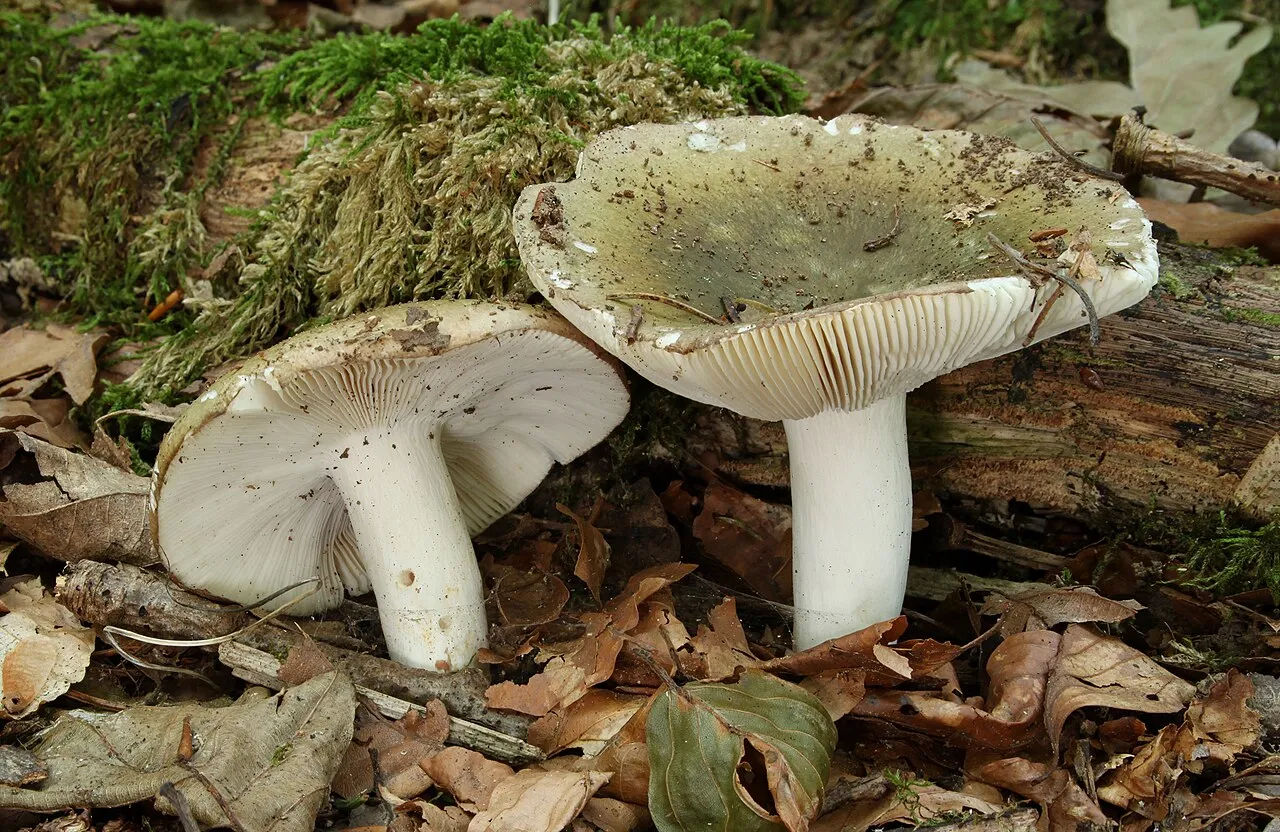 Edible
| Scientific name | Russula cyanoxantha |
| Family | Russulaceae |
| Portuguese name | Camarinha, Camarinha-azul |
| English name | Charcoal burner |
| Season | August, September, October, November |
| Habitat | Oak forest, Cork oak, Mixed forest |
Description
Russula cyanoxantha (charcoal burner) is one of the finest edible species in the genus Russula. It is regarded as the “queen of brittlegills” thanks to its mild taste, firm flesh, and unique flexible gills that do not crumble when pressed — an extremely rare feature among Russula species.
First described by Elias Magnus Fries in 1863. Widely distributed across Europe, including Portugal.
Cap
- Diameter: 5–15 cm
- Shape: hemispherical when young, later convex, then flat or slightly depressed
- Colour: highly variable — from blue-violet and greyish-green to olive and brownish, often unevenly coloured
- Surface: smooth; shiny and slightly greasy in wet weather
- Skin: peels away about 2/3 from the margin
Gills
- Colour: white to cream
- Key feature: flexible, greasy to the touch — do not crumble when rubbed with a finger (in all other Russula species the gills are brittle!)
- Attachment: slightly adnate or free
- Spacing: crowded
Stem
- Height: 5–10 cm
- Width: 1.5–3 cm
- Colour: white, solid
- Surface: smooth, sometimes slightly wrinkled
Flesh
- Colour: white, does not change when cut
- Smell: faint, pleasant
- Taste: mild, without bitterness or peppery heat — another distinction from bitter Russula species
- Texture: firm, not crumbly
Spore print
White to cream.
Where and when
Season in Portugal
- Main season: August–November
- Peak: September–October
- Appears after autumn rains
Habitats in Portugal
- Oak forests — primary biotope, in symbiosis with oaks (Quercus suber, Q. ilex, Q. faginea)
- Chestnut forests — in the north
- Mixed forests — also under beech, hornbeam
- Montado — under cork oaks
- Ectomycorrhizal fungus — forms mycorrhiza with deciduous trees
Look-alikes
The charcoal burner is one of the most recognisable species in the genus, thanks to its unique flexible gills.
| Feature | How to confirm |
|---|---|
| Flexible gills | Rub with a finger — they don’t crumble (other Russula species break apart) |
| Mild taste | No bitterness or pepperiness |
| Unchanging flesh | Does not discolour when cut |
Possible confusions
| Species | How to distinguish |
|---|---|
| Sickener / Beechwood sickener (R. emetica, R. nobilis) | Gills brittle, taste burning-hot. Not poisonous but inedible |
| Green cracking Russula (Russula virescens) | Edible. Cap with cracked, granular skin |
Culinary use
The charcoal burner is one of the finest culinary mushrooms among Russula species.
Preparation methods
- Frying — slice and fry with butter and onions
- Stewing — in cream sauce
- Pickling — young firm specimens
- Drying — preserves aroma well
Notes
- Flesh stays firm after cooking
- Young specimens with closed caps are the most prized
- Mild taste requires no prolonged soaking
See Also
Habitats:
Related articles:
Image sources
- russula-cyanoxantha.webp — Charcoal burner (Russula cyanoxantha). Author: Holger Krisp. License: CC BY 3.0. Source
Sources
- Fries E.M. — Monographia Hymenomycetum Sueciae (1863) — original description
- Bon M. — The Mushrooms and Toadstools of Britain and North-Western Europe (1987)
- BioDiversity4All / GBIF Portugal — occurrence records of Russula cyanoxantha
- Sociedade Portuguesa de Micologia — edible species
- First-Nature — Russula cyanoxantha, The Charcoal Burner
Disclaimer: Identifying mushrooms from descriptions and photographs on the internet is not a substitute for consulting an experienced mycologist. The authors assume no responsibility for the consequences of collecting and consuming mushrooms. If you suspect mushroom poisoning, call 112 immediately.
All our knowledge is free. Creating it is not.
☕ Support on Ko-fi