Slippery Jack
 Edible
| Scientific name | Suillus luteus |
| Family | Suillaceae |
| Portuguese name | Boleto viscoso, Boleto-anelar |
| English name | Slippery Jack |
| Season | September, October, November, December |
| Habitat | Pine forest |
Description
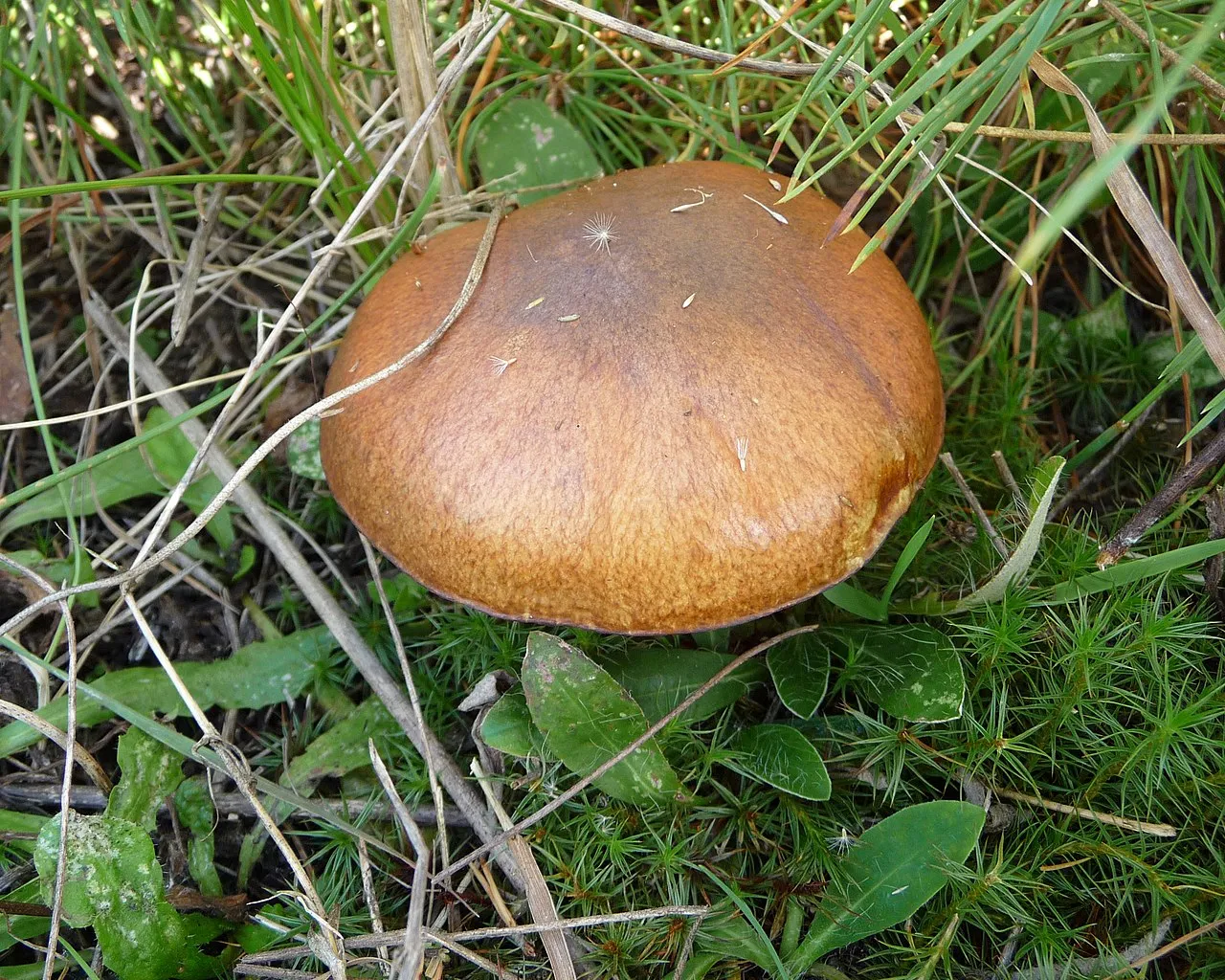
Suillus luteus (slippery jack, sticky bun) is one of the most abundant edible mushrooms in pine forests worldwide. Described by Linnaeus himself in 1753 (as Boletus luteus), it is the type species of the genus Suillus. The characteristic slimy cap gave rise to the English name “Slippery Jack” and the Russian “maslyonok” (масленок — from “maslo”, meaning butter/oil).
In Portugal, no specific folk name is established — the scientific name or descriptive terms like “boleto viscoso” (sticky bolete) are more commonly used.
Cap
- Diameter: 5–12 cm (rarely up to 20 cm)
- Shape: conical when young, later convex-flattened to flat
- Colour: chestnut, dark brown, russet-brown
- Surface: characteristically slimy — glossy even in dry weather
- Cuticle: peels off easily in one piece — a classic diagnostic feature of Suillus
Stem
- Height: 3–8 cm
- Width: 1–2.5 cm
- Colour: whitish above the ring, dirty white with brownish tinge below
- Ring: present — membranous, white, developing a violet/purple tinge on the underside with age. One of the few Suillus species with a true ring
- Glandular dots: small clusters of pigmented cells above the ring
Flesh
- Colour: white, yellowish beneath the cuticle and near the hymenophore
- Colour change: does not change when damaged
- Smell: pleasant, mushroomy
- Taste: mild
Hymenophore (tube layer)
- Type: tubular
- Pore colour: yellow when young, later olive-yellow
- Pores: small, round
- Feature: separates easily from the flesh
Spore print
Ochre, clay-yellow to olive-yellow. Spores elongate-ellipsoid, 7–10 × 3–3.5 µm, smooth.
Where and when
Season in Portugal
- Main season: September–December
- Peak: October–November
- Mass fruiting after autumn rains
- In warmer areas (Algarve, southern Alentejo) the season may extend into January
Habitats in Portugal
- Exclusively pine forests — obligate ectomycorrhizal symbiont of two-needled pines
- Main partners in Portugal:
- Maritime pine (Pinus pinaster) — the dominant pine species in the country, ~23,000 ha of coastal dunes
- Stone pine (Pinus pinea) — Alentejo, coastline
- Scots pine (Pinus sylvestris) — mountain areas (Serra da Estrela)
- Norte and Centro — primary regions (extensive P. pinaster forests)
- Coastline from Minho to Algarve — maritime pine plantations on dunes
- Prefers sandy and acidic soils
Ecological significance
Suillus luteus is used in Portuguese reforestation programmes: Pinus pinaster seedlings inoculated with this fungus show significant growth increases, with the effect persisting 3 years after field planting. The fungus is important for forest recovery after wildfires.
Granulated Bolete (Suillus granulatus)
More common than S. luteus in Portugal. Key differences:
| Feature | S. luteus (Slippery Jack) | S. granulatus (Granulated Bolete) |
|---|---|---|
| Ring | Present — membranous, white → purple | Absent |
| Drops on pores | No | Yes — milky-white in young specimens |
| Cap colour | Dark brown | Lighter, orange-brown |
| Stem granules | Dots above the ring | Prominent brown granules |
Both species are edible and used identically. The related Suillus collinitus (no ring, pinkish rhizomorphs at the base) is also found in Mediterranean pine forests.
Look-alikes
Slippery jacks are among the safest mushrooms to identify. Tubular hymenophore + pine forest + slimy cap = Suillus.
| Species | Danger | How to distinguish |
|---|---|---|
| Suillus granulatus | None (edible) | No ring; milky drops on pores |
| Suillus collinitus | None (edible) | No ring; pinkish rhizomorphs at the base |
| Suillus grevillei | None (edible) | Bright orange-yellow cap; grows under larches |
| Cortinarius spp. | Caution! (some are deadly) | Gills (not pores!). Cobweb-like veil. Rusty-brown spore print |
Safety rule
All Suillus species have a tubular hymenophore (pores, not gills). If you see gills under the cap — it is not a Suillus, and the mushroom requires careful identification.
Culinary use
Slippery jack is a versatile culinary mushroom, especially popular in Eastern Europe.
Preparation methods
- Frying — first remove the cuticle and discard tubes of mature specimens
- Pickling — young, firm specimens whole (a Slavic cuisine classic)
- Soups — add a rich mushroom flavour
- Drying — for winter storage
Preparation
- Always remove the slimy cuticle — it peels off easily in one piece
- For mature specimens — remove the tubes (spongy layer)
- Cooking is mandatory
- Rinse off slime and debris
Notes
- Young, firm specimens are the most valued
- Often infested with larvae — check when collecting
- Used on pizza in Italy as a substitute for porcini
See Also
Habitats:
Related articles:
Image sources
- suillus-luteus.webp — Slippery jack (Suillus luteus). Author: George Chernilevsky. License: Public domain. Source
Sources
- Linnaeus C. — Species Plantarum — species description (1753)
- First-Nature — Suillus luteus, Slippery Jack
- Springer — Mycorrhiza: inoculation of Pinus pinaster with Suillus
- BioDiversity4All / GBIF Portugal — species records
- FungiAtlas — Suillus luteus identification
- Wikipedia — Suillus luteus
Disclaimer: Identifying mushrooms from descriptions and photographs on the internet is not a substitute for consulting an experienced mycologist. The authors assume no responsibility for the consequences of collecting and consuming mushrooms.
If this article was useful — help us write the next one.
☕ Support on Ko-fi