Desert Truffle
 Edible
| Scientific name | Terfezia arenaria |
| Family | Pezizaceae |
| Portuguese name | Tubera, Criadinha, Batatinha |
| English name | Desert truffle, Sand truffle |
| Season | February, March, April, May |
| Habitat | Meadows and pastures, Montado |
Description
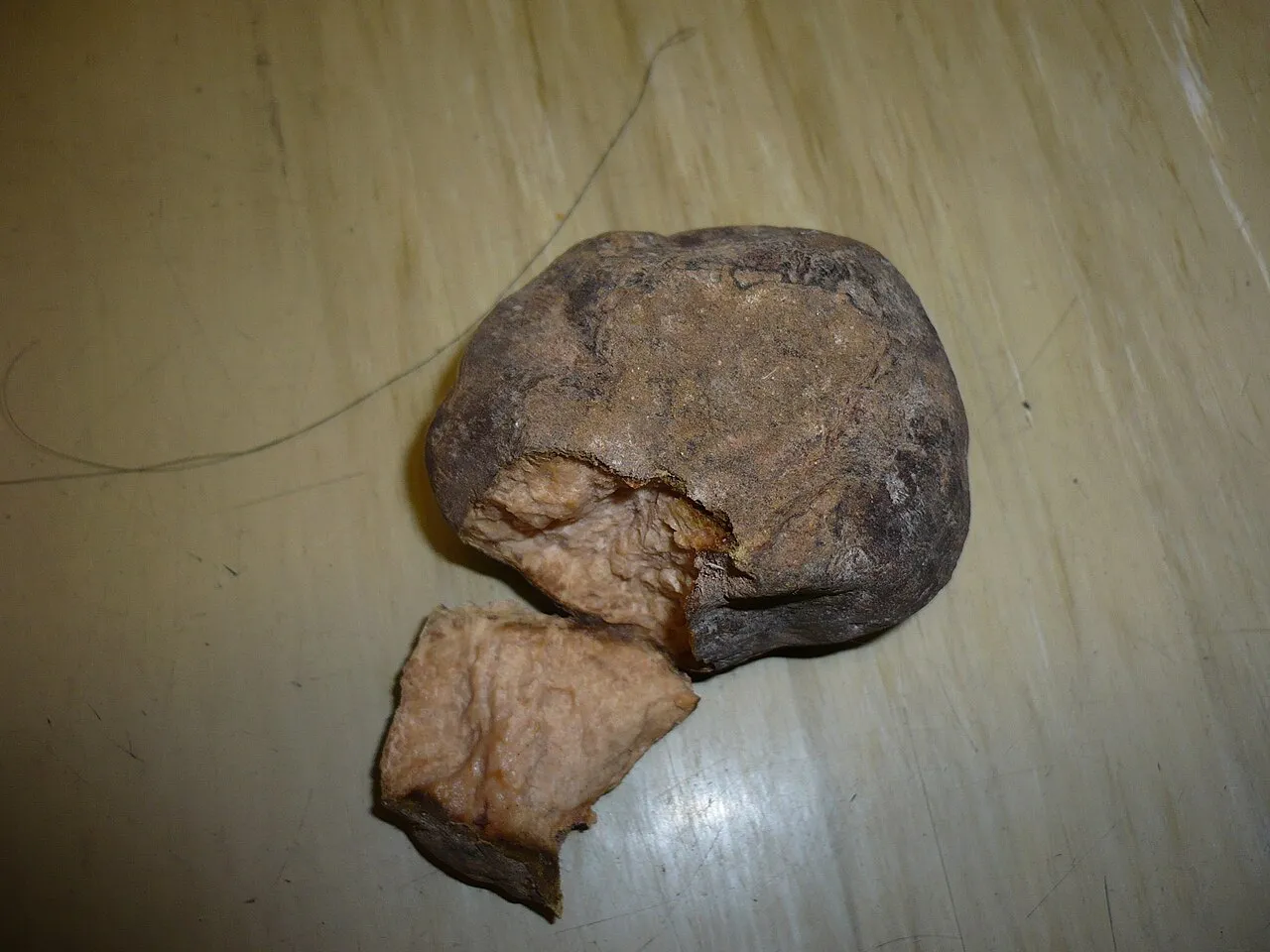
Terfezia arenaria (tubera, criadinha) is a subterranean (hypogeous) fungus growing 5–15 cm below the surface in acidic sandy soils in symbiosis with the annual plant Tuberaria guttata (spotted rock-rose). In Portugal it is known as “tubera” or “criadinha”, and in parts of Beira as “batatinha” (little potato).
Described by Italian botanist Giuseppe Giacinto Moris in 1829 from Sardinia (as Tuber arenaria). Transferred to the genus Terfezia by James Trappe in 1971.
Fruiting body
- Shape: subglobose (nearly spherical), irregular, “potato-like”
- Size: 3–10 cm in diameter
- Weight: from a few dozen to several hundred grams
- Base: covered with a mycelial network ending in a large rhizomorph
Peridium (outer layer)
- Thickness: 2–3 mm
- Young: white, smooth, with dark spots
- Mature: turns pinkish, then darkens to brownish-black, cracks
- In cross-section: pinkish
Gleba (inner tissue)
- Young: white to beige, compact
- Mature: pinkish with pale veins
- Feature: traversed by striations separating the fertile portions
Aroma and flavour
- Smell: subtle, earthy, pleasant, slightly sweet — significantly weaker than true truffles
- Taste: mild, reminiscent of potato, hazelnut, artichoke
- Dominant volatile compound: 1-octen-3-ol (64% of volatile profile) — the compound responsible for the characteristic “mushroom” aroma
Spore print
Ochre. Spores globose (spherical), 18–20 × 24–28 µm, with characteristic truncated warts resembling a cogwheel — a key diagnostic feature distinguishing it from other Terfezia species.
Where and when
Season in Portugal
- Main season: February–May — a spring species
- Peak: March–April
- Fruits after winter and early spring rains
- Coincides with the season of silarca — another spring endemic
Habitats in Portugal
- Alentejo — primary region
- Acidic sandy soils — key requirement (unlike T. claveryi, which prefers alkaline soils)
- Forms ectomycorrhiza with plants:
- Tuberaria guttata (= Xolantha guttata) — primary host, an annual with white flowers and a yellow centre
- Cistus salviifolius — sage-leaved cistus
- Cistus ladanifer — gum rockrose
- Dehesas (montado), xerophytic grasslands, forest clearings
How to find tuberas
Unlike true truffles, tuberas are found without dogs — using only observation and knowledge:
- Find the host plant — Tuberaria guttata (white flowers with a yellow centre)
- Examine the soil around the plants: mature tuberas push up the earth, creating bumps and cracks
- Use a pointed stick — probe the soil repeatedly until you find the fruiting body
- Dig from the side to avoid damaging the fungus
- Fill the hole after extraction — this aids regeneration
Terfezia diversity in Portugal
Research by the University of Évora (2021) identified 10 species of Terfezia in Portugal — previously only 3 were known. Among them, two endemics described for the first time:
- Terfezia lusitanica — endemic to Portugal
- Terfezia solaris-libera — endemic to Portugal
This makes Portugal one of the world’s centres of Terfezia diversity.
Cultural significance
Tuberas are the “secret of the Alentejo”. Knowledge of collection sites and search techniques is passed from generation to generation within families, and locals are extremely reluctant to share their secrets with outsiders. Unlike the Míscaros festival or the Silarca festival, tuberas remain a “quiet” tradition.
Historically, tuberas were an important source of protein for the rural population of the Alentejo (14–23 g protein per 100 g dry weight — comparable to meat).
Look-alikes
Tuberas are relatively safe to identify — all Terfezia species are edible. However, there are dangerous “false truffles”:
| Species | Danger | How to distinguish |
|---|---|---|
| Other Terfezia (T. claveryi, T. fanfani) | None (all edible) | Molecular analysis; T. claveryi grows in alkaline soils with Helianthemum |
| Scleroderma polyrhizum | Toxic (earthball) | Very thick, hard peridium. Gleba black to purplish-black. No truffle aroma |
| Scleroderma citrinum | Toxic | Yellowish, warty. Gleba black. Causes gastrointestinal distress |
| Choiromyces meandriformis | Possible GI upset | Larger, gleba white with winding (meandric) veins. Grows under trees |
Safety rule
All Terfezia species are edible. The main danger comes from earthballs (Scleroderma spp.) with black gleba and a thick, hard peridium. If the gleba is white-pinkish with pale veins — it is Terfezia.
Culinary use
Tuberas are a delicacy of traditional Alentejo cuisine.
Preparation methods
- Scrambled eggs with tuberas (ovos mexidos com tuberas) — the classic Alentejo recipe, where the mushroom’s mild flavour is not lost
- Frying — sliced, in olive oil with onion
- Freezing — for long-term storage
Preparation
- Wash thoroughly — sand and soil accumulate in peridium cracks
- Remove dark spots — they may contain dirt
- Slice — like potatoes for frying
Nutritional value (per 100 g dry weight)
- Protein: 14–23 g (comparable to meat)
- Carbohydrates: 67–77 g
- Fat: 2.2–5.1 g
- Nutri-Score: A
See Also
Habitats:
Related articles:
Image sources
- terfezia-arenaria.webp — Terfezia arenaria — desert truffle of Alentejo. Author: Gerhard Koller. License: CC BY-SA 3.0. Source
Sources
- Moris G.G. — Stirp. sard. elench. — species description (1829)
- Pensoft Blog — Lifting the veil over mysterious desert truffles (2021)
- PMC — Using Science and Technology to Unveil The Hidden Delicacy Terfezia arenaria
- The Portugal News — Tuberas: a secret of the Alentejo (2023)
- IUCN Red List — Terfezia arenaria (Vulnerable)
- Trufamania — Terfezia arenaria description
- Universidade de Évora — Mycorrhization of Cistus spp. with Terfezia arenaria
Disclaimer: Identifying mushrooms from descriptions and photographs on the internet is not a substitute for consulting an experienced mycologist. The authors assume no responsibility for the consequences of collecting and consuming mushrooms.
If this article was useful — help us write the next one.
☕ Support on Ko-fi