Yellow Knight
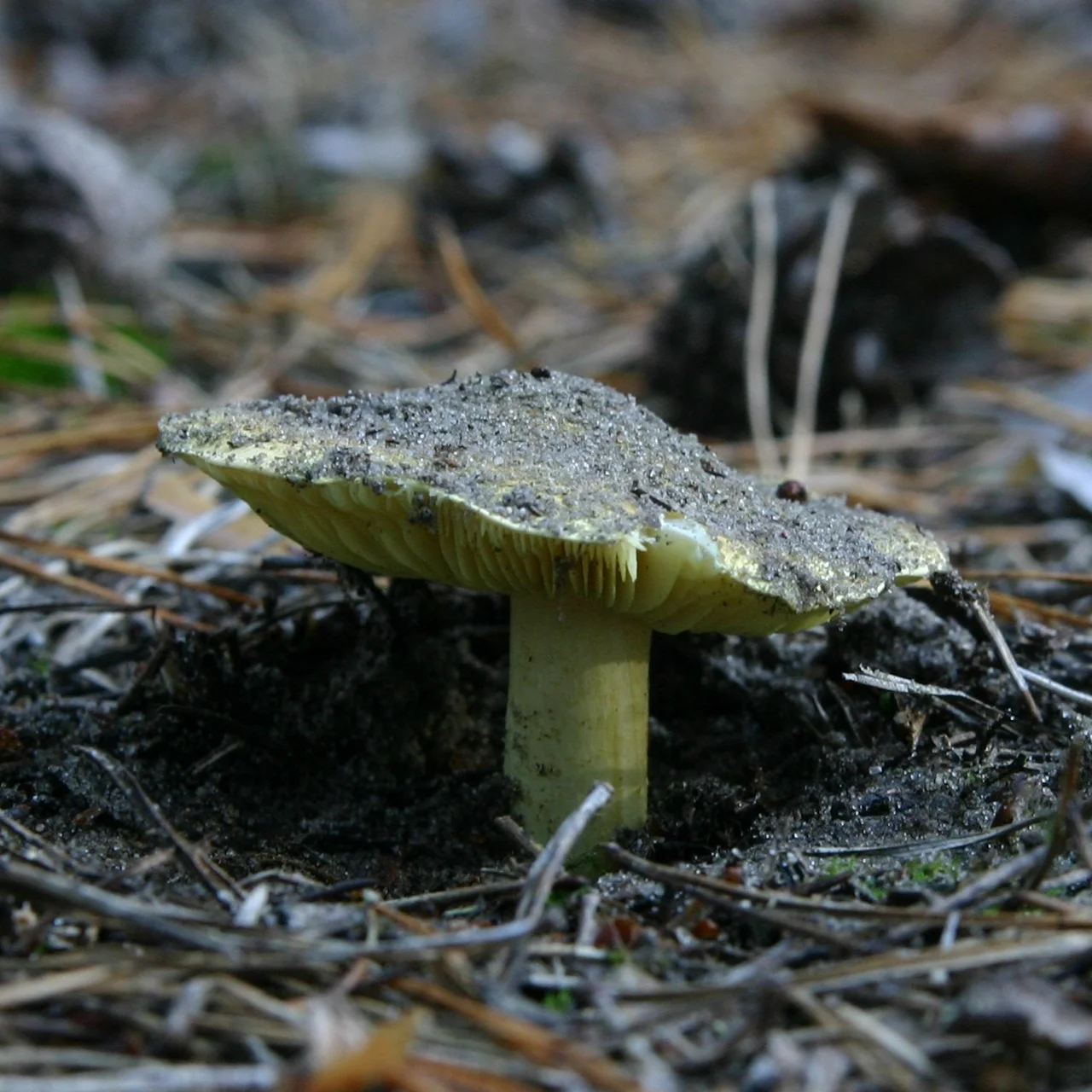 Conditionally edible
| Scientific name | Tricholoma equestre |
| Family | Tricholomataceae |
| Portuguese name | Míscaro, Míscaro-amarelo |
| English name | Yellow knight, Man on horseback |
| Season | October, November |
| Habitat | Pine forest |
Description
Tricholoma equestre (yellow knight, man on horseback; synonyms: T. flavovirens, T. auratum) is a medium-sized mushroom with a yellow-green cap and yellow gills. In Portugal it is known as “míscaro” and traditionally collected in the central regions, especially in the Beiras area. However, following a series of fatal poisonings in France, its safety has been seriously questioned.
Cap
- Diameter: 5–12 cm
- Shape: convex, later flattened, sometimes with a central umbo
- Colour: yellow-green, olive-yellow, with a darker centre
- Surface: smooth, sticky in wet weather, often with adhering sand and pine needles
- Margin: thin, inrolled when young
Stem
- Height: 4–8 cm
- Width: 1–2.5 cm
- Colour: yellow, paler than the cap
- Ring: absent
- Surface: smooth or slightly scaly
Flesh
- Colour: white to pale yellow, firm
- Smell: mealy
- Taste: mild, mealy
Gills
- Colour: yellow (sulphur-yellow to lemon) — characteristic feature
- Attachment: sinuate
- Spacing: crowded
Spore print
White.
Safety controversy
The Bedry incident (France, 2001)
Published in the New England Journal of Medicine (Bedry et al., 2001):
- 12 poisoning cases over the period 1992–2001
- 3 fatalities
- Diagnosis: rhabdomyolysis — destruction of skeletal muscle tissue
- All victims had consumed T. equestre 3 or more times within 2 weeks
- Critical volume: over 400 g total across the series of meals
- Symptoms appeared 1–4 days after the last consumption
Additional cases
- Lithuania (2004–2013): 4 cases, 1 fatality
- Confirms the problem is not limited to France
Rhabdomyolysis symptoms
- Fatigue, muscle weakness, myalgia (muscle pain)
- Dark urine (myoglobinuria)
- Sharply elevated creatine kinase (CK)
- In severe cases — kidney failure, cardiac arrest
Status by country
| Country | Status |
|---|---|
| France | Banned (since 2005, ANSES decision) |
| Spain | Classified as poisonous |
| Italy | Classified as poisonous |
| Lithuania | Classified as poisonous |
| Poland | Considered edible (widely consumed) |
| Turkey | Considered edible |
| Portugal | Official status not established. Traditionally consumed |
Scientific consensus
There is no unified consensus. A systematic review (Rzymski et al., 2020, PubMed) concluded:
- T. equestre should be considered conditionally edible
- Contains a toxin associated with rhabdomyolysis
- Repeated heavy consumption is not recommended
- The issue may be linked to specific genetic lineages (species complex)
Where and when
Season in Portugal
- Main season: October–November
- Fruits in pine forests after autumn rains
Habitats in Portugal
- Centro region (Beiras) — main collection area
- Pine forests — forms ectomycorrhiza with pines (Pinus)
- Prefers sandy soils
- One of the most frequently collected mushrooms by rural communities in central Portugal
Look-alikes
| Species | How to distinguish |
|---|---|
| Sulphur knight (Tricholoma sulphureum) | Strong unpleasant smell (hydrogen sulphide / gas-like). Inedible |
| Other Tricholoma | Yellow gills are a characteristic feature of T. equestre. Most knights have white or greyish gills |
Safety recommendations
If you choose to collect this mushroom (at your own risk):
- Never consume more than 2–3 times per season
- Never eat more than 200 g per serving
- Never eat on consecutive days
- If you experience muscle weakness, muscle pain, or dark urine — seek medical attention immediately, mention mushroom consumption
- Cooking is mandatory — never eat raw
Image sources
- tricholoma-equestre.webp — Yellow knight (Tricholoma equestre). Author: Wikimedia Commons. License: CC BY-SA 3.0. Source
See Also
Habitats:
Related articles:
Sources
- Bedry R. et al. — Wild-mushroom intoxication as a cause of rhabdomyolysis // New England Journal of Medicine, 2001
- Rzymski P. et al. — Is the Yellow Knight Mushroom Really Edible? A Systematic Review // Toxins, 2020
- Rzymski P. et al. — The Yellow Knight Fights Back: Toxicological, Epidemiological, and Survey Study // Toxins, 2018
- ANSES — Avis relatif à Tricholoma equestre, 2005
- Clube de Vinhos Portugueses — Sabores de Portugal: Míscaros
- Universidade de Lisboa — Caracterização morfológica e molecular de T. equestre
Disclaimer: Identifying mushrooms from descriptions and photographs on the internet is not a substitute for consulting an experienced mycologist. The authors assume no responsibility for the consequences of collecting and consuming mushrooms. The safety status of Tricholoma equestre is not definitively established — consumption is at your own risk.
All our knowledge is free. Creating it is not.
☕ Support on Ko-fi