Black Truffle
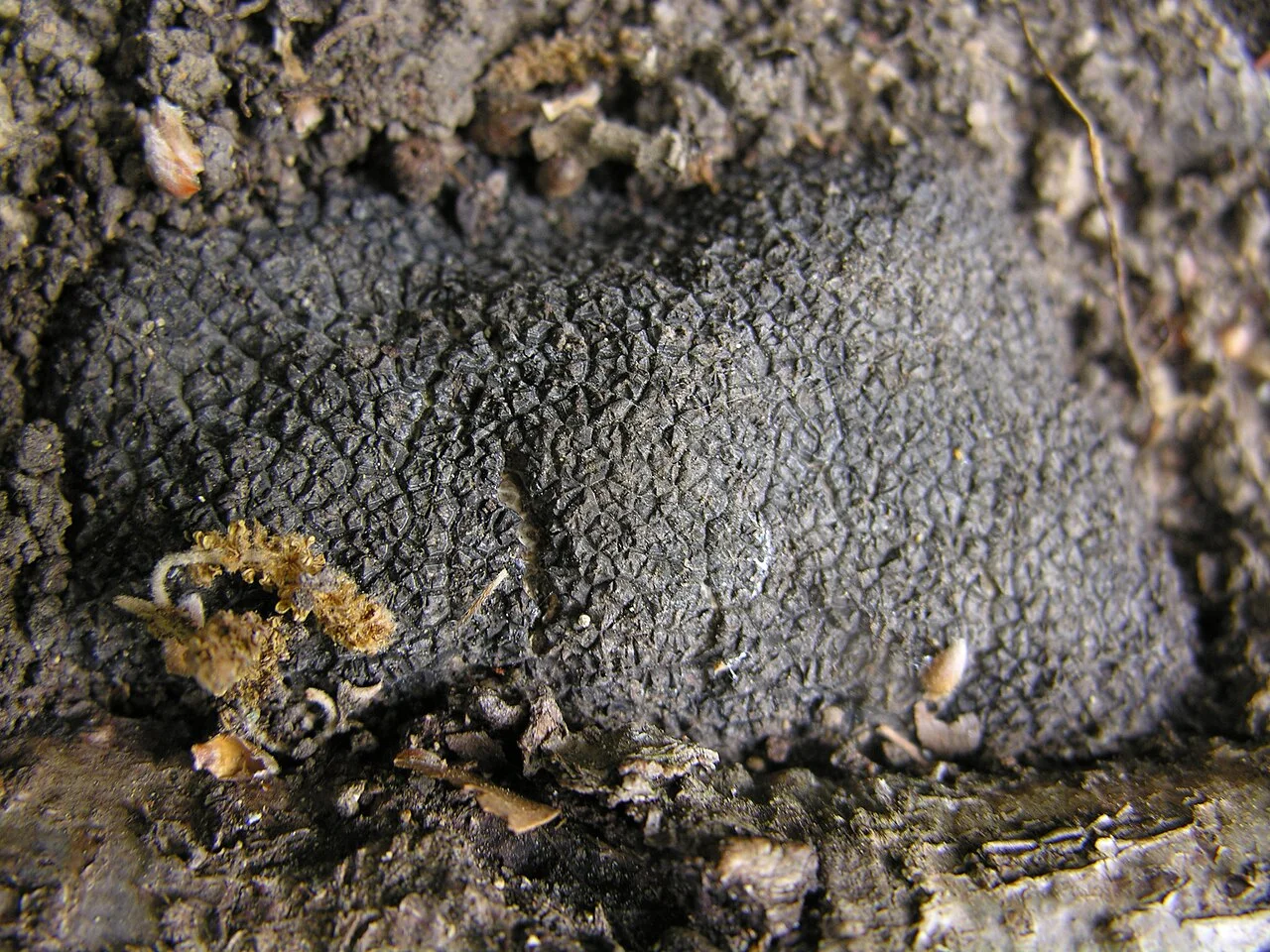 Edible
| Scientific name | Tuber melanosporum |
| Family | Tuberaceae |
| Portuguese name | Trufa-negra, Trufa-negra de Inverno, Trufa de Périgord |
| English name | Black Périgord truffle, Black truffle |
| Season | December, January, February |
| Habitat | Oak forest, Calcareous soils |
Description
Tuber melanosporum (black truffle, Périgord truffle) is an underground (hypogeous) fungus, one of the most valuable and expensive mushrooms in the world. It grows beneath the soil at a depth of 5–30 cm in symbiosis with the roots of oaks and hazels. Specially trained dogs (formerly pigs) are used to locate them. In Portugal it is known as “trufa-negra” and “trufa-negra de Inverno” (winter black truffle).
Price: from 1,000 to 2,000 EUR/kg — one of the most expensive food products in the world.
Fruiting body
- Shape: subglobose (nearly spherical) to tuber-like, irregular
- Size: 2–10 cm in diameter (rarely up to 15 cm)
- Weight: usually 20–200 g; exceptional specimens over 1 kg
Peridium (outer layer)
- Colour: dark brown to black
- Surface: warty (verrucose), covered with polygonal warts (alveolae)
- Warts: 2–5 mm, polygonal, creating a characteristic rough texture
Gleba (inner tissue)
- Immature: whitish
- Mature: dark brown to chocolate, with a network of thin white veins
- Feature: veins develop a reddish tinge when exposed to air — a diagnostic characteristic
- Consistency: firm, fleshy
Aroma and taste
- Aroma: strong, complex — earthy, nutty, with notes of chocolate. Intensifies as the truffle matures
- Taste: rich, with deep umami
- Main value: it is the aroma that makes the truffle a unique culinary product
Spore print
Dark brown. Spores ellipsoidal, with reticulate ornamentation, 28–48 × 20–30 µm.
Where and when
Season in Portugal
- Main season: December–February
- Peak: January–February (maximum aroma)
- Fruits when soil temperature drops below 10°C
- A winter truffle — harvested during the coldest time of year
Habitats in Portugal
- Forms ectomycorrhiza with trees:
- Holm oak (Quercus ilex) — the main host
- Cork oak (Quercus suber)
- Hazel (Corylus avellana) — used in cultivation
- Requires alkaline calcareous soils (pH 7.5–8.5) — this limits distribution in Portugal, where acidic soils predominate
- Regions with potential: Alentejo, Trás-os-Montes, Beira Interior, Algarve
Trufficulture in Portugal
Trufficulture is at an early stage but actively developing:
- Algarve Truffles (Monchique, Algarve) — the first professional plantation in Portugal (since 2010)
- Mycotrend (since 2012) — production of mycorrhized oak and hazel seedlings
- Technology: planting pre-mycorrhized trees, density 300–800 trees/ha
- First harvest: 5–10 years after planting
In 2024, Tuber aestivum (summer truffle) was discovered in the wild in Portugal for the first time — confirmed by molecular analysis. This proves that the genus Tuber is present in Portugal’s natural ecosystems.
Look-alikes
| Species | How to distinguish |
|---|---|
| Winter truffle (Tuber brumale) | Peridium peels off easily. Inner veins wider and more widely spaced. Aroma musky, less pleasant. Price three times lower. Often used for adulteration |
| Chinese truffle (Tuber indicum) | Peridium smoother, dark red. Virtually no aroma — the key difference. Main problem: fraud on the market |
| Summer truffle (Tuber aestivum) | Harvested in summer (May–September). Flesh paler (beige to olive). Weaker aroma. Lower value (100–400 EUR/kg) |
| Mesenteric truffle (Tuber mesentericum) | Characteristic phenolic (carbolic) smell. Unpleasant taste |
Safety rule
All species of the genus Tuber are edible — there are no poisonous truffles. However, confusion between species can lead to significant financial losses (buying a cheap species at the price of an expensive one). PCR analysis is used for reliable identification.
Culinary use
The black truffle is the pinnacle of Mediterranean gastronomy.
Methods of use
- Shaved onto hot dishes — thinly shaved over pasta, risotto, fried eggs, omelettes
- Carpaccio — paper-thin slices with olive oil
- With foie gras — the classic pairing of French cuisine
- Truffle oil — olive oil infused with truffle
Portuguese tradition
- Perdizes à Moda do Convento de Alcântara — partridges with foie gras, truffle and Port wine. One of the most exquisite dishes in Portuguese cuisine
Notes
- Do not subject to intense heat — the aroma is destroyed by cooking
- Add at the end of preparation or shave onto the finished dish
- Storage: wrap in kitchen paper, in a sealed container, in the fridge, no more than 5–7 days
Image sources
- tuber-melanosporum.webp — Black truffle (Tuber melanosporum). Author: Michel Royon. License: CC BY-SA 3.0. Source
See Also
Habitats:
Related articles:
Sources
- Reforma Agrária — Trufa-negra de Inverno (Tuber melanosporum)
- Mycotrend — Árvores micorrizadas com trufa negra
- Algarve Truffles — Truficultura em Portugal
- Trufamania — Tuber melanosporum identification
- First-Nature — Tuber melanosporum
- The Portugal News — Truffles discovered in Portugal (2024)
- CCRES — Enquadramento legal dos cogumelos silvestres
Disclaimer: Identifying mushrooms from descriptions and photographs on the internet is not a substitute for consulting an experienced mycologist. The authors assume no responsibility for the consequences of collecting and consuming mushrooms.
The light is on for free. But someone has to clean the lantern.
☕ Support on Ko-fi