Arrábida — A Mushroom Island Among Stone
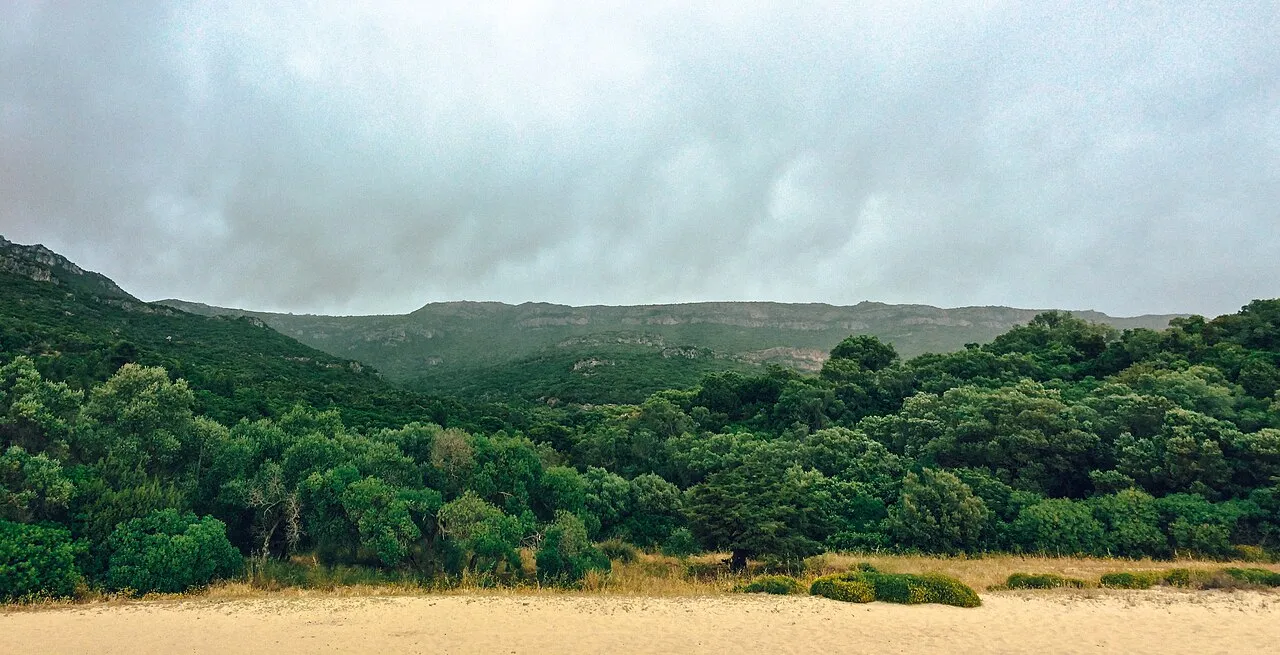
The Stone Island
Picture this: you drive south from Lisbon, cross the Vasco da Gama bridge, and thirty minutes later a ridge rises before you, unlike anything else in Portugal. Serra da Arrábida — 500 metres of limestone cliffs plunging into the Atlantic. Below — turquoise coves. Above — impenetrable Mediterranean maquis: rockrose, mastic tree, wild olive, kermes oak.
The rest of Portugal sits on granite and schist. Acidic soils. pH 4.5–6.5. But here — Jurassic limestone. pH 7.0–8.5. For a mushroom hunter, this is like discovering a tropical island in the middle of the Arctic.
Because Arrábida’s mushrooms are different. They exist nowhere else in the country.
Two Slopes — Two Worlds
Scientists from the Gulbenkian Institute discovered something remarkable in 2002: the northern and southern slopes of Arrábida are two completely different fungal worlds. On one side — moisture, shade, rich diversity. On the other — scorching sun, drought, xerophilic specialists.
From the leaves of just five plant species, they collected 1,029 strains of filamentous fungi (36+ species) and 540 yeast strains (46+ species). Some turned out to be previously undescribed by science.
On a tiny territory — 17,000 hectares — some ~1,450 plant species have been described. That’s 40% of all Portuguese flora. And fungi — possibly even more, but nobody has systematically counted them.
The Fungal Core: Who Lives Here
In old-growth holm oak forest (Quercus ilex) — the closest relative of Arrábida’s Quercus coccifera — 234 fungal species have been recorded from 5,382 fruiting bodies. Among them:
- Russulaceae (Russula, Lactarius) — 34% of all fungi
- Cortinariaceae (Cortinarius) — another 34%
- Cenococcum geophilum — up to 35% of all mycorrhizal root tips
- Laccaria laccata, Inocybe tigrina, Lactarius chrysorrheus — the three most abundant species
Across the entire Iberian Peninsula, 605 mycorrhizal taxa have been documented in Mediterranean oak forests. A significant proportion of these may be present in Arrábida.
The Great Mystery: Where Are the Truffles?
The Black Truffle (Tuber melanosporum) requires alkaline soils of pH 7.5–8.5 and oak trees. Arrábida is the only place in Portugal where both conditions are met naturally.
Quercus faginea — one of the black truffle’s main hosts — grows here. The limestone is here. The right climate is here.
Yet scientific evidence of natural Tuber populations in Arrábida still does not exist. Nobody has specifically looked. This is one of the most intriguing open questions in Portuguese mycology.
In 2024, Tuber aestivum (summer truffle) was discovered wild in Portugal for the first time — confirmed by molecular analysis. If it’s here — then T. melanosporum may well be too. Only systematic research will tell.
Three Worlds Within an Hour
Arrábida’s uniqueness becomes especially vivid when you look at neighbouring ecosystems:
| Ecosystem | Soils | Characteristic fungi |
|---|---|---|
| Arrábida (limestone) | Alkaline, pH 7–8.5 | Russula, Cortinarius, Inocybe, possibly Tuber |
| Tróia (sand) | Acidic, pH 4.5–6 | Slippery jacks, saffron milk caps |
| Montado (south) | Moderately acidic | Caesar’s mushroom, silarca, chanterelles |
Three completely different fungal worlds — within a thirty-minute drive. For a mushroom explorer, this is paradise.
The Conservation Paradox
Arrábida is a natural park. Mushroom collecting may be restricted by ICNF regulations. And rightly so: this ecosystem is too fragile and unique to be subjected to uncontrolled harvesting.
But that’s precisely why Arrábida is the perfect place for mushroom photography and mycological tourism. Not collecting, but observing. Not picking, but photographing. Not taking, but studying.
Afterword
Arrábida is a reminder that the most amazing discoveries hide in the most unexpected places. Among stone and dry maquis, in the ocean wind, under the scorching Mediterranean sun — an entire world lives, about which we know almost nothing.
Perhaps one day someone will find a black truffle here. Or perhaps something is hiding here that doesn’t yet exist in the catalogues of science.
More about the ecosystem: Serra da Arrábida: A Mushroom Eldorado
Image sources
- arrabida-island.webp — Serra da Arrábida panorama from Creiro beach. Author: Rudisicyon. License: CC BY-SA 4.0. Source
Sources
- Inácio J. et al. — Estimation of phylloplane fungal diversity on selected plants in Serra da Arrábida // Microbial Ecology, 2002
- de Vries B.W.L. et al. — Macrofungi of old-growth Quercus ilex forest // Cryptogamie Mycologie, 2003
- Rinaldi A.C. et al. — Ectomycorrhizal fungal diversity — the state of the art // Plant Biosystems, 2008
- Parque Natural da Arrábida — Plano de Ordenamento, ICNF
- The Portugal News — Truffles discovered in Portugal (2024)
The light is on for free. But someone has to clean the lantern.
☕ Support on Ko-fi